Goldenrod Essential Oil and Ragweed: Frequently Asked Questions
If you've ever picked up a bottle of goldenrod essential oil and paused, wondering whether you're about to bring ragweed into your home, you're in good company. The is goldenrod essential oil the same as ragweed question is one of the most common things people ask us, and it usually comes from a lifetime of seeing goldenrod's bright yellow blooms get blamed for late-summer sneezing that ragweed actually causes. Below we've gathered the goldenrod plant vs ragweed plant questions, the goldenrod oil ragweed confusion itself, and a batch of goldenrod essential oil allergy questions, all answered in plain language, grouped by theme so you can jump to what you need.
Goldenrod Essential Oil
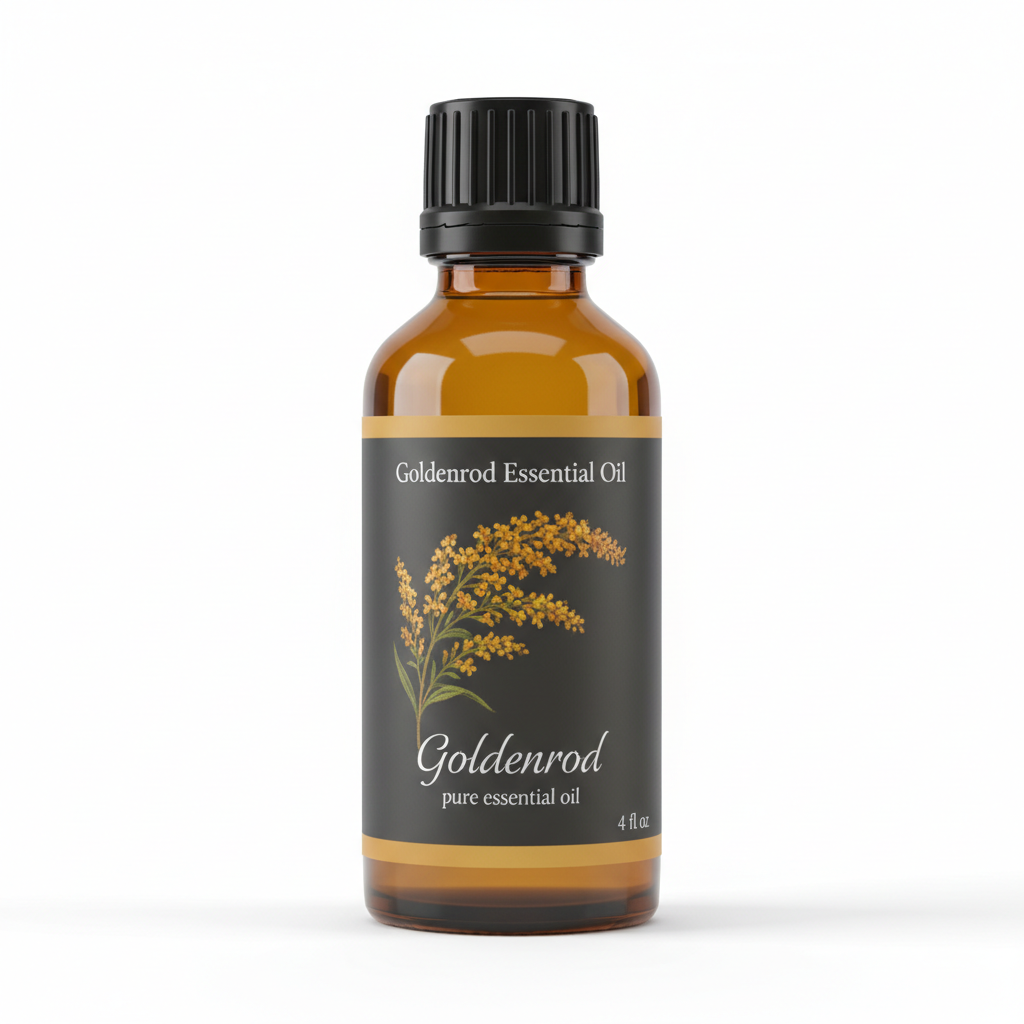
Our own Goldenrod Essential Oil, in sizes from 0.5 oz to bulk.
From $15.99
Shop Now →Plant Identification: Goldenrod Plant vs Ragweed Plant
Before getting into the oil itself, it helps to settle the botany. Goldenrod (Solidago) and ragweed (Ambrosia) are unrelated genera that simply happen to bloom in the same fields at the same time of year, which is where most of the mix-up starts.
| Trait | Goldenrod (Solidago) | Ragweed (Ambrosia) |
|---|---|---|
| Flowers | Dense, showy clusters of small bright yellow blooms | Small, dull green-yellow flower spikes, easy to miss |
| Leaves | Simple, lance-shaped, alternating along the stem | Feathery, deeply lobed, almost fern-like |
| Pollen | Heavy and sticky, spread mainly by insects | Light and dry, carried for miles on wind |
| Bloom window | Late summer into fall | Late summer into fall |
Is goldenrod essential oil the same as ragweed?
No. Goldenrod belongs to the genus Solidago, while ragweed belongs to the unrelated genus Ambrosia. They aren't the same species, the same genus, or even close botanical relatives; they're simply two separate plants that happen to flower in the same fields during the same weeks of late summer.
What does goldenrod look like compared to ragweed?
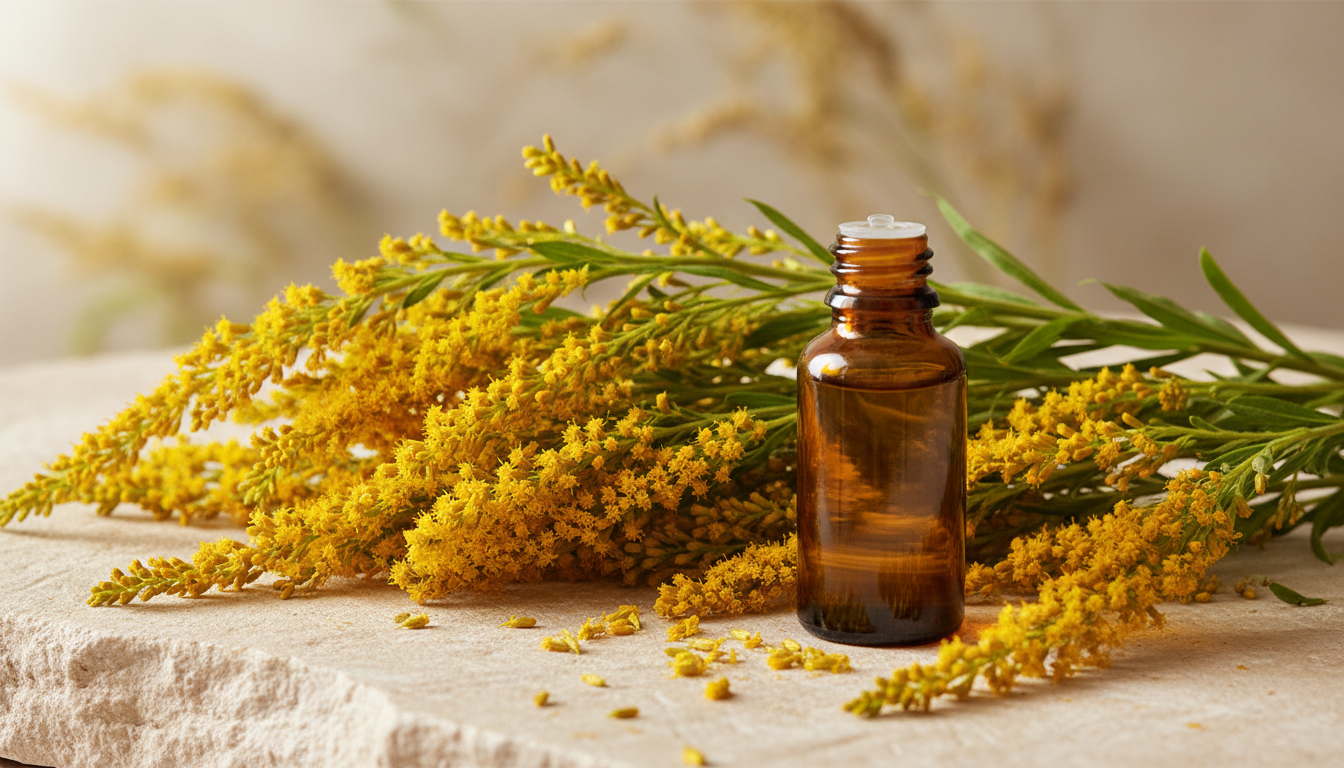
Goldenrod is the plant most people actually notice: tall stalks topped with dense, bright yellow flower plumes that catch the eye across a roadside or meadow. Ragweed, by contrast, has small, dull green flower spikes and finely divided, feathery leaves, and it tends to blend into the background rather than stand out.
Why do people confuse goldenrod and ragweed?
Timing is the whole reason. Both plants flower in late summer and early fall, often in the exact same fields, roadsides, and vacant lots. Because goldenrod is the showy, visible one when symptoms flare, it gets the visual blame while ragweed, which is easy to walk right past, goes unnoticed.
Do goldenrod and ragweed bloom at the same time?
Yes, and that overlap is the root of the goldenrod oil ragweed confusion. Both plants typically flower from August through October depending on region and climate, which means anyone reacting to something in the late-summer air is standing in a field where both plants happen to be present at once.
Is goldenrod pollen airborne like ragweed pollen?
Not in the same way. Goldenrod pollen is heavier and stickier, built to cling to the insects that pollinate it, so relatively little becomes airborne. Ragweed pollen is light, dry, and produced in enormous quantities per plant, which is why it travels easily on wind currents and reaches people far from where the plant is actually growing.
The Goldenrod Oil Ragweed Confusion: Where the Mix-Up Comes From
This section covers the goldenrod essential oil allergy questions we hear most, focused on why the mix-up happens and why it matters when you're shopping.
Why does goldenrod get blamed for reactions that ragweed causes?
Because goldenrod is the plant people can actually see. When someone starts sneezing in a field full of tall yellow blooms, it's a natural (if mistaken) leap to point at the obvious flower rather than the inconspicuous green ragweed growing nearby. This visual bias has followed goldenrod for well over a century.
Does goldenrod pollen ever reach people the way ragweed's does?
It's far less likely to. Because goldenrod relies on insects rather than wind to move its pollen, very little of it ends up floating through the air where a person could breathe it in from a distance. Ragweed, by contrast, is a wind pollinator built specifically to broadcast pollen widely, which is the more direct route to reaching someone's nose.
Is goldenrod essential oil made from a plant known for causing reactions?
Goldenrod itself has a much smaller reputation for causing reactions than ragweed does, largely because of the pollen difference described above. That said, any plant material, including goldenrod, can be a source of sensitivity for some individuals, so we always recommend a patch test before regular use, discussed more below.
Does this confusion affect how goldenrod products are marketed?
It does, and honestly it's part of why we field so many of these questions. Some shoppers hesitate to even try goldenrod-based products because the name alone triggers a mental association with ragweed season, even though the two plants are unrelated.
Why does this mix-up matter if I'm just buying essential oil?
It matters because informed sourcing decisions should be based on the actual plant, not a decades-old case of mistaken identity. Understanding the goldenrod plant vs ragweed plant distinction lets you evaluate the oil on its own merits: how it's grown, how it's distilled, and how it's meant to be used, rather than on a myth.
Essential Oil Questions: Sourcing, Safety, and Allergy Questions
Here we turn to the goldenrod essential oil allergy questions specific to the distilled oil itself, since the plant confusion and the oil's properties are two separate conversations.
Does steam distillation change what's in goldenrod essential oil?
Yes, meaningfully so. Steam distillation captures the plant's volatile aromatic compounds and leaves behind solid plant matter, including pollen grains, which are far too large and non-volatile to travel through the distillation process. What ends up in the bottle is aromatic oil, not pollen.
Is there such a thing as ragweed essential oil, and is it related to goldenrod oil?
Ragweed isn't grown commercially for essential oil production the way goldenrod is, so you won't find the two side by side as comparable products. Even if a ragweed-derived oil existed somewhere in small batches, it would come from an entirely different plant and would have no relationship to goldenrod oil beyond sharing the same flowering season in the wild.
Can someone with plant sensitivities try goldenrod essential oil?
Everyone's skin and sensitivities are individual, so we can't make a blanket call for every person. What we can say is that goldenrod essential oil should always be diluted properly and patch tested first, and anyone with known sensitivities to plants in the aster family (which includes goldenrod, ragweed, chamomile, and chrysanthemum) may want to check with a qualified healthcare provider before adding it to a routine.
What is patch testing and why does it matter for goldenrod oil?
Patch testing means applying a small, diluted amount of the oil to a discreet area of skin, such as the inner forearm, and waiting 24 to 48 hours to see how your skin responds before using it more broadly. It's a standard first step for any new essential oil, goldenrod included, and it's the simplest way to catch an individual sensitivity early rather than after a full application.
How should goldenrod essential oil be diluted for topical use?
Essential oils are concentrated and are not meant to touch skin undiluted. A common general guideline is a 1 to 2 percent dilution in a carrier oil, roughly 6 to 12 drops of essential oil per ounce of carrier, though exact ratios can vary by intended use and by individual. When in doubt, start on the lower end and consult a qualified aromatherapy or healthcare resource for guidance specific to your situation.
Are there people who should avoid goldenrod essential oil altogether?
Pregnant or nursing individuals, young children, and anyone with a known sensitivity to the aster plant family should speak with a qualified healthcare provider before using goldenrod essential oil. This is general precautionary guidance that applies to most essential oils, not a finding specific to goldenrod, and it's always better to ask first than to guess.
Sourcing, Quality, and Everyday Use
The last cluster of goldenrod essential oil allergy questions and general buying questions we hear tend to be about the practical side: what to look for, what it smells like, and where it comes from.
What does "Meadow Gold" distilled mean for this oil?
It describes both the source and the process: goldenrod harvested from open meadow growth and put through a distilled steam extraction rather than a solvent method. That combination is what produces a true essential oil, as opposed to an infused oil or an absolute, and it's worth knowing the difference when comparing products.
How can I tell if my goldenrod oil is genuinely well-sourced?
Look for a supplier that discloses where the goldenrod was grown, how it was distilled, and ideally provides batch-specific testing documentation such as a GC-MS report. Vague labeling with no origin, no botanical name, or no testing information is a signal to keep looking rather than assume.
Does goldenrod essential oil have a strong scent, and what does it smell like?
Goldenrod essential oil has a warm, herbaceous, slightly honeyed scent with a soft green undertone, more subtle than many floral oils. It's often described as earthy and grounding rather than sweet or perfume-forward, which is part of why perfumers reach for it as a base note rather than a top note.
Is goldenrod essential oil used in skincare or aromatherapy blends?
Yes, it's a popular addition to both. In skincare formulations it's typically used at low dilution alongside carrier oils, and in aromatherapy blends it's often paired with woody or citrus notes for a grounding, autumnal profile in a diffuser.
Where does goldenrod used for essential oil typically grow?
Goldenrod is native to North America and grows widely across meadows, roadsides, and open fields, particularly in the eastern and midwestern United States. Commercial distillers generally source it from cultivated or managed wild stands rather than random roadside picking, both for consistency and for plant identification accuracy.
The short version, if you only remember one thing from this page: goldenrod and ragweed are two different plants with two different pollen strategies, and the essential oil itself goes through a distillation process that leaves pollen behind entirely. If you have specific plant sensitivities or health questions, a qualified healthcare provider is always the right person to ask before adding any new botanical product to your routine.