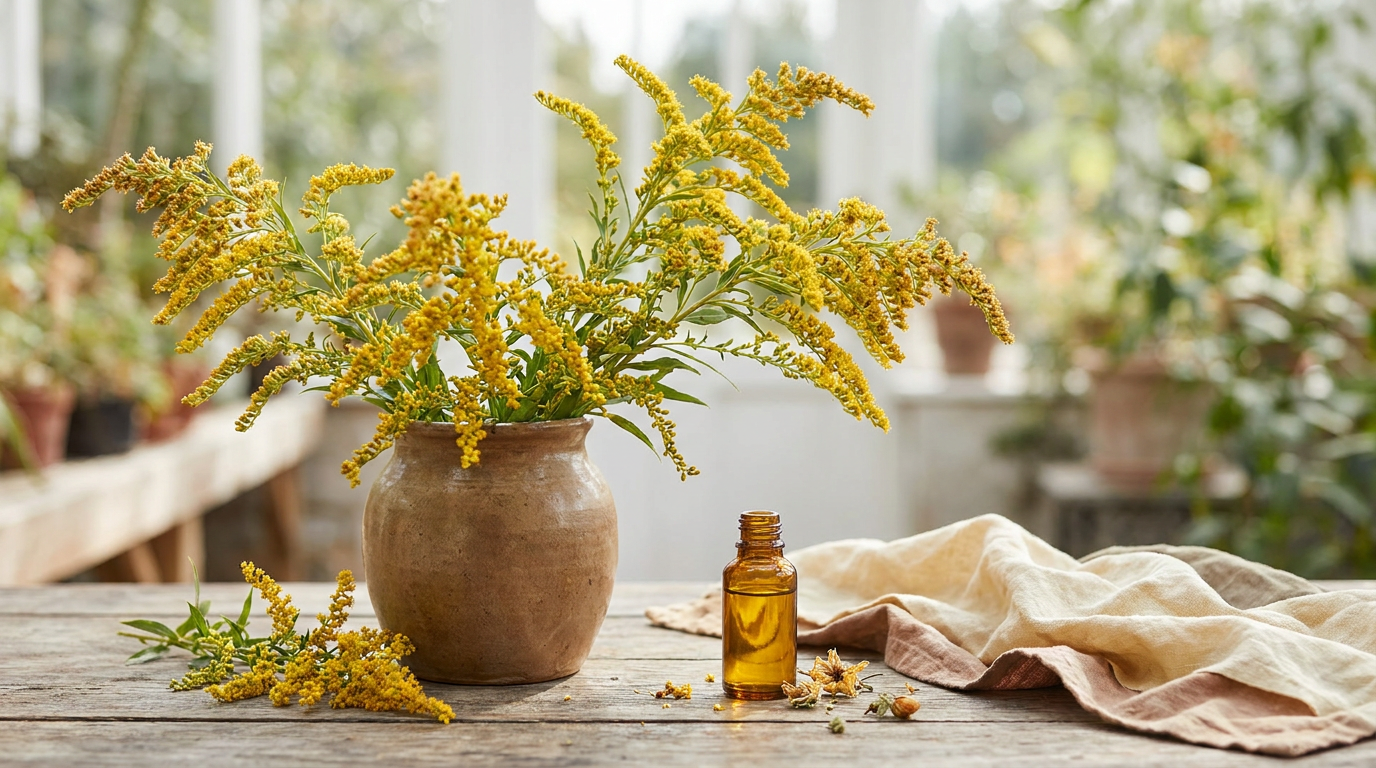
Goldenrod Essential Oil vs Mimosa Absolute: Two Gold-Toned Florals
Open a bottle of goldenrod essential oil next to a vial of mimosa absolute and you will notice something right away: both smell like late summer sunlight, but they arrive at that impression from opposite directions. One is a distilled wildflower with a green, honeyed edge. The other is a solvent-extracted tree blossom, thick and almost edible in its sweetness. Perfumers and candle makers reach for both when they want a warm, golden note in a blend, but they are not interchangeable, and knowing why matters before you buy either one.
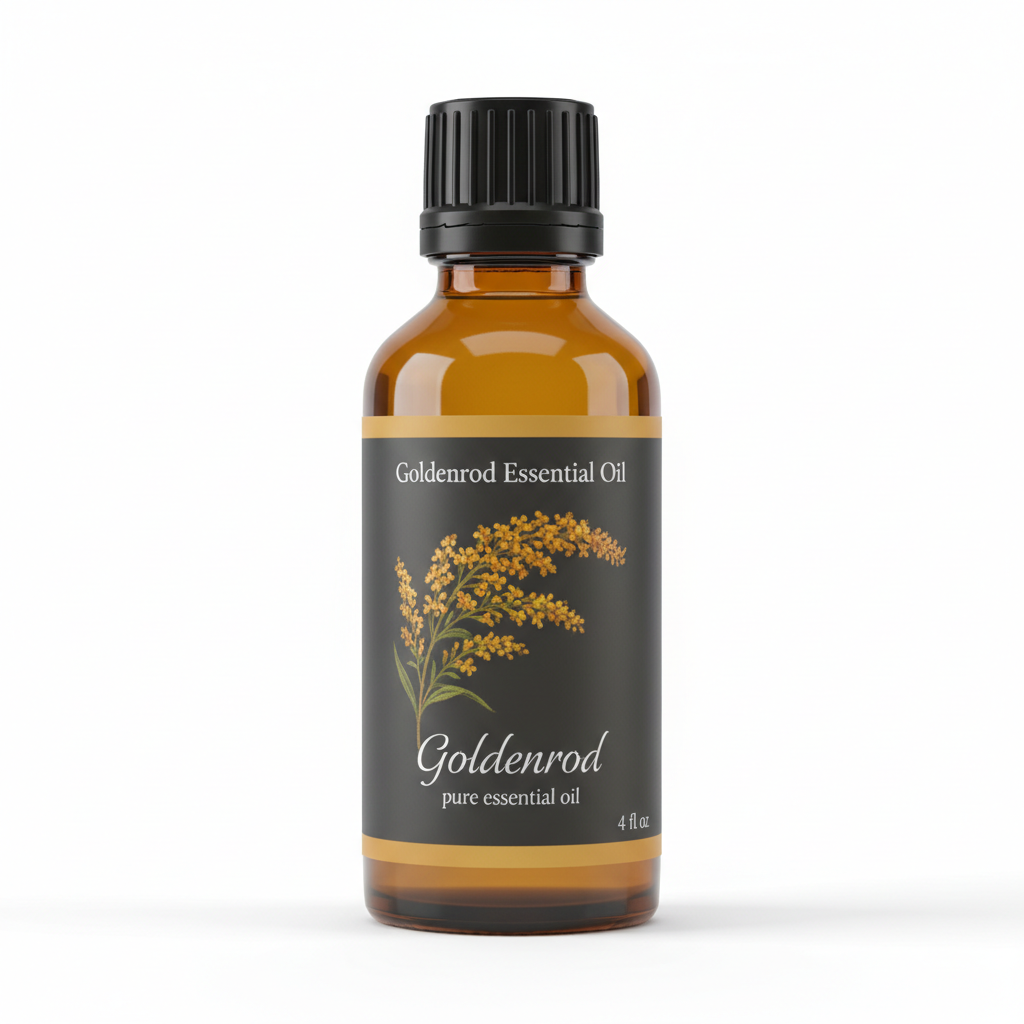
Goldenrod Essential Oil
Our own Goldenrod Essential Oil, in sizes from 0.5 oz to bulk.
From $15.99
Shop Now →This comparison lays out how each oil is made, what it actually smells like, what it costs, and where each one earns its place on a blending bench. If you are weighing goldenrod oil vs mimosa absolute for a specific project, the short answer is that they solve different problems. The long answer is below.
What Is Goldenrod Essential Oil
Goldenrod essential oil is steam distilled from the flowering tops of Solidago canadensis or related Solidago species, the tall, plume-topped wildflower that lines roadsides, meadows, and field edges across North America from late summer into fall. The distillation is straightforward: fresh or lightly wilted flowering tops go into a still, steam passes through, and the aromatic compounds carried off with the vapor are condensed and separated from the water. No solvents, no intermediate concrete. What comes out the other end is a pale yellow to amber oil with a scent that is more herbaceous than floral: think warm hay, a touch of anise, and a soft honey undertone that keeps it from reading as purely green.
Because Solidago is a wild-harvested or small-plot crop rather than a commodity flower grown at industrial scale, yields per acre are modest and the oil stays a niche item. That scarcity is part of why we have written at length about what goldenrod essential oil actually is and how small-batch goldenrod distillation works for readers trying to understand what they are paying for.
What Is Mimosa Absolute
Mimosa absolute comes from the fluffy yellow flower clusters of Acacia dealbata, commonly called mimosa or silver wattle, grown mainly in southern France, Morocco, and India. Unlike goldenrod, mimosa flowers do not give up much of their scent to steam. The delicate aromatic molecules degrade under distillation heat, so producers use a solvent extraction process instead. Fresh blossoms are washed with a solvent (traditionally hexane) to pull out waxes, pigments, and aromatics, producing a solid, wax-heavy paste called a concrete. The concrete is then washed again with alcohol, which dissolves the aromatic fraction and leaves the heavier waxes behind. Once the alcohol evaporates, what remains is the absolute: a thick, deep-yellow to olive-brown liquid with an intensely sweet, powdery, almost cocoa-and-violet scent.
This two-step process is expensive and labor intensive, and flower-to-absolute yields are low, which is the main reason mimosa absolute costs several times more per ounce than most floral essential oils. It also means mimosa absolute is not, strictly speaking, an essential oil at all. It is a solvent-extracted aromatic, a distinction that matters if you are formulating for a market that expects "essential oil" on the label or avoiding solvent-based extracts on principle.
Scent Profile Face-Off
Both oils land in what perfumers loosely call the "gold floral" family, but they occupy different corners of it. Goldenrod essential oil comparison work in the fragrance world consistently describes it as green-herbaceous first, floral second: warm straw, dried grass, a whisper of anise or tarragon, and a soft honeyed base note that keeps it from smelling medicinal. It reads more like a field at the end of a hot day than a bouquet. If you want a deeper walk through the individual notes, our piece on what goldenrod essential oil smells like breaks the profile down stage by stage as it develops on a blotter.
Mimosa absolute, by contrast, is unmistakably floral and heavier. Expect layers of honey, a soft powdery iris-violet quality, a faint green undertone from the leaves that come along with the harvested blossoms, and a rounded sweetness that can lean toward cocoa or almond in some batches. It sits low and slow on the skin, more of a base-to-heart note than a top note, and a little goes a long way. Where goldenrod oil brightens a blend, mimosa absolute tends to anchor and sweeten one.
Comparison Table
| Attribute | Goldenrod Essential Oil | Mimosa Absolute |
|---|---|---|
| Botanical source | Solidago canadensis / Solidago gigantea | Acacia dealbata |
| Extraction method | Steam distillation | Solvent extraction (concrete, then absolute) |
| Plant part used | Flowering tops | Fresh flower clusters |
| Technically an essential oil? | Yes | No (an absolute) |
| Scent family | Green, herbaceous, honeyed | Sweet, powdery, honeyed floral |
| Typical perfume note | Top to mid note | Mid to base note |
| Color | Pale yellow to amber | Deep yellow to olive brown |
| Viscosity | Thin, free-flowing | Thick, semi-solid in cool weather |
| Relative cost per ounce | Moderate to high | High to very high |
| Availability | Limited, small-batch producers | Specialty perfumery suppliers |
| Blends well with | Clary sage, cypress, citrus, cedarwood | Rose, violet, sandalwood, vanilla |
| Best format for beginners | Pre-diluted roll-on or blend | Pre-diluted perfumer's dilution (5–10%) |
Pros and Cons: Goldenrod Essential Oil
Pros
- True steam-distilled essential oil, which matters for solvent-free formulations and labeling
- Bright, herbaceous top note that lifts and freshens a blend rather than weighing it down
- Sources from a genuinely wild, unglamorous roadside plant, which appeals to people who like a story behind a bottle
- Thin viscosity makes it easy to measure and blend precisely, even in cooler rooms
- Pairs naturally with woody and citrus notes for an autumn-leaning palette
Cons
- Small-batch supply means pricing and availability can shift season to season
- The scent reads as more "green field" than "flower," which will not suit every gold-floral brief
- Fewer suppliers overall compared to well-established florals, so sourcing takes more legwork
Pros and Cons: Mimosa Absolute
Pros
- Rich, rounded, unmistakably floral character that reads as luxurious in finished perfumes
- Long-lasting base note that anchors a composition for hours
- Well established in classical and niche perfumery, so reference formulas and blending guidance are easy to find
- Pairs beautifully with other high-end florals like rose and violet
Cons
- Solvent extraction means trace solvent residue is possible, which some formulators and shoppers specifically avoid
- Not a true essential oil, so it cannot be labeled or marketed as one
- Among the pricier absolutes on the market, largely due to low extraction yield
- Thick, semi-solid texture at cool room temperature makes precise measuring more fiddly
- Strength means overdosing a blend is an easy mistake for beginners
Best For: Use-Case Recommendations
Neither of these gold floral perfumery oils is a universal answer, so the right pick depends on what you are actually making.
- Natural, solvent-free perfumers: goldenrod essential oil is the clear choice, since it is a true distillate with no solvent processing involved.
- Formulators chasing a rich, classic floral base note: mimosa absolute wins here. Nothing about goldenrod oil replicates that powdery, honeyed depth.
- Candle and soy wax melt makers on a budget: goldenrod oil's lower relative cost and thin viscosity make it easier to work into larger batches.
- Niche or artisan perfumers building a rose-violet-sandalwood composition: mimosa absolute's traditional pairing with those notes makes it the more natural fit.
- Collectors of unusual, story-driven botanicals: goldenrod is the more interesting bottle to have on a shelf, precisely because so few brands carry it. Our roundup of goldenrod essential oil uses for a collector's cabinet covers ideas beyond straightforward perfumery.
- Anyone formulating for a strict "essential oils only" product line: goldenrod qualifies; mimosa absolute, being solvent-extracted, does not.
Blending and Application Notes
Both oils are potent and should be diluted before they touch skin. A common starting ratio for either one in a personal-care blend is 1 to 2 drops per teaspoon of a carrier oil such as jojoba or fractionated coconut oil, roughly a 1% to 2% dilution, adjusted based on the finished use. Mimosa absolute in particular is often sold pre-diluted at 5% to 10% in a carrier because the neat absolute is so concentrated that measuring accurate drop counts is genuinely difficult.
Before using either oil on skin, do a patch test: apply a small diluted amount to the inside of the forearm and wait 24 to 48 hours, watching for redness or irritation. People who are pregnant, nursing, or managing any ongoing condition should check with a qualified healthcare provider before adding a new botanical to a personal-care routine, and neither oil should be taken internally. If you keep a rare or limited-supply oil like goldenrod on hand, storage matters too. Our guide on protecting a small batch of goldenrod oil covers light, heat, and container choices that extend shelf life, and the companion piece on dilution and patch-test basics is worth a read before your first blend.
Cost and Availability
Mimosa absolute is generally the pricier of the two per ounce, sometimes significantly so, because of the double-extraction process and low flower-to-absolute yield. Goldenrod essential oil sits in a moderate to high price bracket of its own, driven less by extraction complexity and more by limited small-batch supply; it is a true distillate, but few producers make it, so pricing tracks scarcity rather than process cost. Neither oil is something you will find at a general big-box retailer. Both are specialty items best sourced from suppliers who publish batch-specific testing, such as a GC-MS report, so you know what is actually in the bottle before you build a formula around it.
Verdict
If the question is simply "which gold floral oil is better," there is no single answer, because they are not competing for the same job. Mimosa absolute vs goldenrod oil is really a choice between two different roles in a composition. Mimosa absolute is the richer, more classically floral option, better suited to base-note work in fine fragrance and to formulators who are comfortable with solvent-extracted aromatics. Goldenrod essential oil is the lighter, greener, genuinely wild-sourced alternative, a true steam distillate that brings brightness rather than depth, and it is the only one of the two that can be labeled and marketed as an essential oil.
For most home blenders and candle makers working on a budget, goldenrod is the easier, more forgiving place to start, and its thin viscosity makes it simple to dose accurately. For perfumers chasing a deep, honeyed, classic gold-floral base, mimosa absolute earns its higher price tag. The strongest blends we have seen actually use both, letting goldenrod's green brightness sit on top of mimosa's honeyed weight underneath. Buy a small vial of each before committing to a large batch of either, since scent perception is personal and a blotter test tells you more in five minutes than any comparison article can.