How to Add Goldenrod Essential Oil to Cold-Process Soap
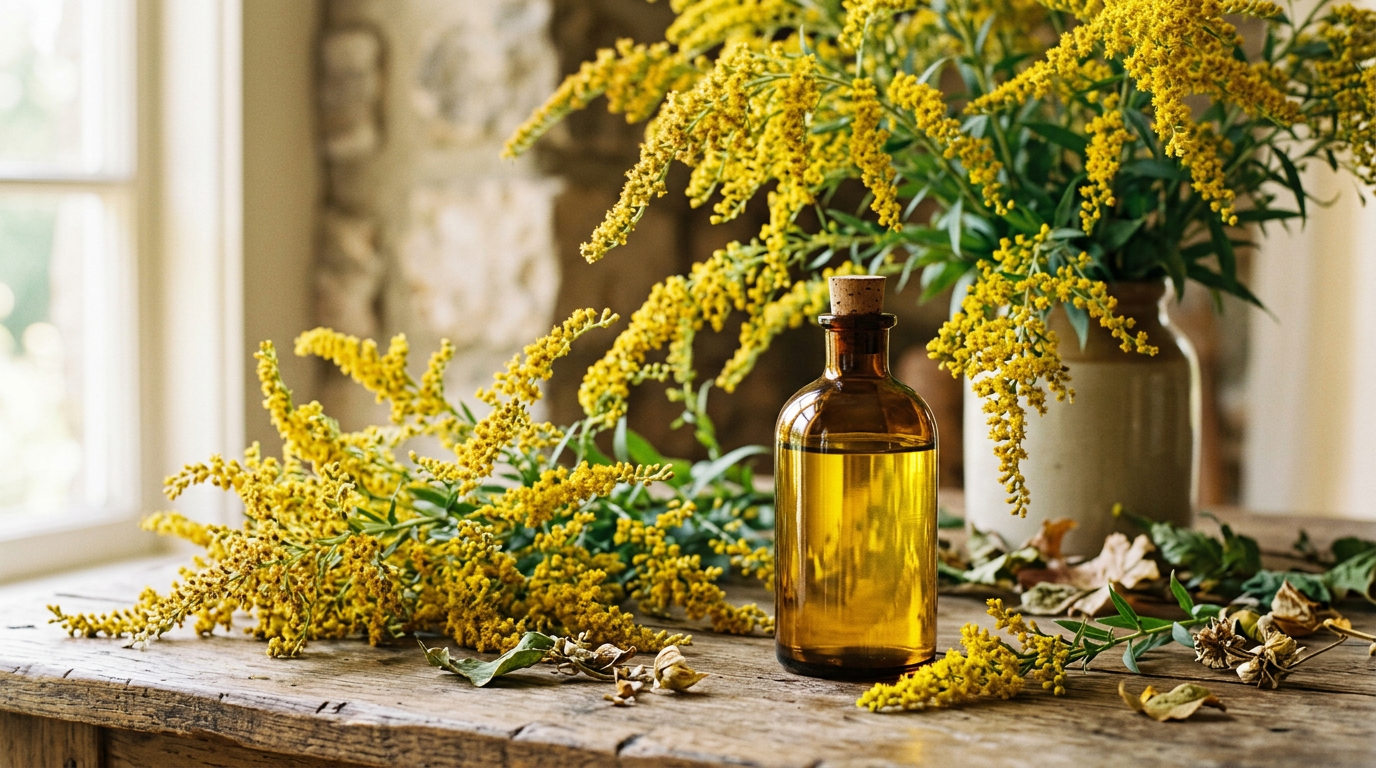
Goldenrod essential oil is one of the more unusual botanicals a soap maker can reach for. Steam-distilled from the flowering tops of Solidago, it carries a scent that's herbaceous, faintly honeyed, and a little green, closer to a meadow after rain than to anything floral or fruity. It doesn't show up in many commercial soap lines, which is part of the appeal: a bar scented with goldenrod essential oil soap stands out on a shelf crowded with lavender and citrus. This guide walks through exactly how to work it into a cold-process batch, from usage rate math to the point in your soap-making process where it should go in.
Goldenrod Essential Oil
Our own Goldenrod Essential Oil, in sizes from 0.5 oz to bulk.
From $15.99
Shop Now →Why Goldenrod Essential Oil Works Well in Cold-Process Soap
Cold-process soap making is an alkaline environment, and not every essential oil holds up to it gracefully. Some fade within weeks; others discolor a bar unpredictably. Goldenrod essential oil tends to be forgiving. Its scent profile leans on herbaceous, slightly woody notes rather than delicate top notes, and herbaceous oils generally have better staying power through saponification and cure than lighter floral or citrus oils do. That doesn't mean it's indestructible. Like any essential oil, it will mellow over a soap's cure time, so the goal is to plan for that fade rather than be surprised by it.
Because it's still a niche choice, a batch of goldenrod soap also gives a maker a chance to write an interesting label story: wild meadow flower, distilled the traditional way, blended into a bar rather than a tincture or a salve. Keep that story grounded in scent and sourcing, not in what the bar might do for the skin beyond ordinary cleansing.
What You'll Need
This list assumes a standard cold-process batch built around a base oil blend of your choosing (olive, coconut, palm or a palm alternative, and a liquid oil are common). Adjust quantities to your own recipe size.
- Your base soap-making oils and butters, measured and ready
- Sodium hydroxide (lye), weighed to a verified recipe
- Distilled water or your chosen liquid (goat milk, tea infusion, etc.)
- Goldenrod essential oil, steam-distilled and from a supplier who provides a batch-specific GC-MS report
- A digital kitchen scale accurate to at least 0.1 gram
- A stick blender
- Heat-safe mixing containers (stainless steel or heavy plastic, not aluminum)
- Silicone or wood soap molds
- Safety gear: goggles, gloves, and long sleeves for handling lye
- A notebook or spreadsheet for recording your exact usage rate and batch notes
- Optional: a natural colorant such as annatto-infused oil or turmeric, if you want to echo the oil's golden name in the bar itself
Buy goldenrod essential oil from a supplier that discloses its distillation method and country of origin. Wild-harvested goldenrod grown in different regions can vary in scent intensity from batch to batch, so a lab report gives you a way to compare what you're actually pouring into the pot, not just what the label promises.
Understanding Essential Oil Usage Rate for Soap Making
Getting the essential oil usage rate for soap making right is the single most important technical step in this whole process. Add too little and the scent disappears by the time the bar cures. Add too much and you risk skin irritation for the end user, plus a soap that seizes or accelerates in the pot before you're ready.
A commonly used starting range for essential oils in cold-process soap is 0.5 to 1 ounce per pound of oils in the recipe (roughly 3 to 6 percent of total base oil weight, though most makers calculate this by ounces per pound rather than percentage). For an herbaceous oil like goldenrod, many soap makers land in the middle of that range, around 0.7 to 0.8 ounces per pound of oils, and adjust up or down after testing a small batch first.
Before committing a full batch, run the essential oil through a fragrance calculator or the supplier's own usage guidelines, and check the oil's maximum recommended dermal use level. Reputable suppliers publish this figure, often expressed as a percentage of the finished product. Stay at or below that ceiling. If your supplier doesn't publish a usage limit, treat that as a gap in their documentation, not an invitation to guess.
It's worth making a small test batch, a single pound of oils or less, before scaling up. Goldenrod's scent behaves a little differently once soap cures for four to six weeks, so a test batch lets you evaluate the goldenrod soap scent honestly before you commit ten pounds of base oils to a recipe you haven't smelled at full cure.
Step-by-Step: Adding Goldenrod Essential Oil to Your Cold-Process Soap Recipe
Follow your usual cold-process method for lye safety and base oil preparation. The steps below focus specifically on where goldenrod essential oil enters a goldenrod oil cold process soap recipe.
- Calculate your usage rate first, before you touch the stick blender. Weigh your total batch of base oils and multiply by your chosen usage rate (for example, 0.7 ounces per pound of oils). Write this number down. Measuring by weight rather than by drops or capfuls is the only way to get a consistent goldenrod soap scent from batch to batch.
- Prepare your lye solution and let it cool to a workable temperature, generally somewhere in the 90 to 110 degree Fahrenheit range depending on your recipe, alongside your melted base oils at a similar temperature.
- Combine the lye solution and base oils and begin stick-blending to trace, following your standard method. Do not add the essential oil yet. Goldenrod essential oil has a moderate viscosity and adding it too early, before the emulsion has begun forming, can slow down or unevenly distribute the scent through the batter.
- Bring the batter to a light to medium trace. This is the point where the mixture has thickened enough to leave a faint trail when drizzled across the surface, but is still pourable.
- Weigh out your pre-calculated amount of goldenrod essential oil directly into a small container rather than pouring straight from the bottle into the batter. This prevents an accidental overpour, which is one of the most common and costly mistakes in scented soap making.
- Add the weighed essential oil to the batter and hand-stir or pulse the stick blender briefly to incorporate it evenly. Avoid prolonged blending at this stage since goldenrod, like many herbaceous essential oils, can accelerate trace once it's mixed in.
- Work quickly once the oil is in. If you're adding a natural colorant to complement the goldenrod name, such as a small amount of annatto-infused oil for a warm yellow tone, swirl it in now before the batter thickens further.
- Pour into your mold promptly, tapping it gently on the counter to release air bubbles.
- Insulate the mold according to your usual method (a towel or box works for most recipes) and let it saponify for 24 to 48 hours before unmolding.
- Cut the loaf into bars once firm enough to handle, then set them on a curing rack with good airflow.
- Cure for a full four to six weeks in a cool, dark, well-ventilated space, turning bars occasionally so each side dries evenly.
Common Mistakes to Avoid
- Eyeballing the essential oil amount. Drops and capfuls vary too much bottle to bottle. Always weigh on a gram scale.
- Adding essential oil at emulsion or false trace. The batter isn't stable yet, and scent can distribute unevenly or separate out later.
- Skipping the small test batch. A full-size batch is expensive to redo if the goldenrod soap scent fades faster than expected or the usage rate feels off.
- Ignoring the supplier's maximum usage level. More essential oil does not mean a stronger, longer-lasting scent; past a certain point it mainly raises the risk of skin irritation.
- Storing finished bars in direct sunlight or a warm, humid bathroom. Heat and light both accelerate scent fade in cured soap, goldenrod included.
- Assuming all goldenrod essential oil smells the same. Distillation method, harvest region, and plant part can all shift the aroma. A GC-MS report and a sample sniff before a big purchase go a long way.
What to Expect From the Finished Bars
A properly cured bar of goldenrod essential oil soap tends to carry a soft, herbaceous, honey-tinged aroma in the first few weeks after cutting, mellowing gradually as the bar finishes its cure. Many soap makers report that the scent settles into something subtler and warmer by week six compared to the sharper aroma right after pouring, which is typical of herbaceous essential oils generally and not unique to goldenrod.
Because usage rates in cold-process soap are already well below the concentrations used in leave-on products, and because the oil is diluted further across the whole batch of base oils, most people find a bar made within recommended usage guidelines comfortable for ordinary hand and body washing. As with any new soap, it's sensible to do a small patch test on the inner forearm and wait 24 hours before using a new bar on the face or on more sensitive skin, and to discontinue use if any irritation appears. People with known plant sensitivities, particularly to ragweed-family plants, may want to be more cautious, since goldenrod is a distant botanical relative. If you have any specific skin concerns, a conversation with a qualified healthcare provider before introducing a new botanical soap is always a reasonable step.
Troubleshooting Scent Fade and Discoloration
If your finished bars smell noticeably weaker than expected after cure, the most likely culprit is an underweighted usage rate or an essential oil that had already lost potency from age or poor storage before it went into the pot. Goldenrod essential oil, like most essential oils, is best stored in a dark glass bottle away from heat, and used within the window your supplier recommends on the lab documentation.
Some makers notice a light tan or amber tint developing in bars scented with herbaceous essential oils over the first few weeks of cure. This is a normal characteristic of many plant-derived oils reacting slowly with the alkaline soap base, not a sign the batch has gone wrong. If you want a lighter, more neutral bar color, a titanium dioxide dispersion added at trace can offset this tendency, though it will also mute any golden hue you were hoping to draw out with a natural colorant.
A Simple Framework for Your Own Batch
Every soap maker's base oil blend differs, so rather than prescribing exact ounces of olive or coconut oil, here's a framework to build your own goldenrod oil cold process soap recipe around:
| Batch Element | Guidance |
|---|---|
| Total base oils | Your standard recipe, unchanged |
| Goldenrod essential oil | 0.5 to 1 oz per pound of oils; start at 0.7 oz for a test batch |
| Addition point | Light to medium trace |
| Optional colorant | Annatto-infused oil or a touch of turmeric, added just after the essential oil |
| Cure time | 4 to 6 weeks, cool and dark, good airflow |
Once you've run a small test batch and confirmed the usage rate and scent hold up to your expectations at full cure, scaling up to a larger batch is simply a matter of multiplying every ingredient, including the goldenrod essential oil, by the same factor. Keep your notes from the test batch. A soap maker's own record of what worked is worth more than any general guideline, including this one, once you've actually smelled the results on your own curing rack.
This article is for general informational and cosmetic use purposes only. Always follow safe lye-handling practices, wear appropriate protective equipment, and consult a qualified healthcare provider with any questions about how a new botanical ingredient may interact with your individual skin.