Goldenrod in a Diffuser: Four Blend Ratios to Try
Most diffuser recipes start with a list of oils. We would start one step earlier, with a question: what do you want goldenrod to do in the room? Once you know that, the ratio nearly writes itself.
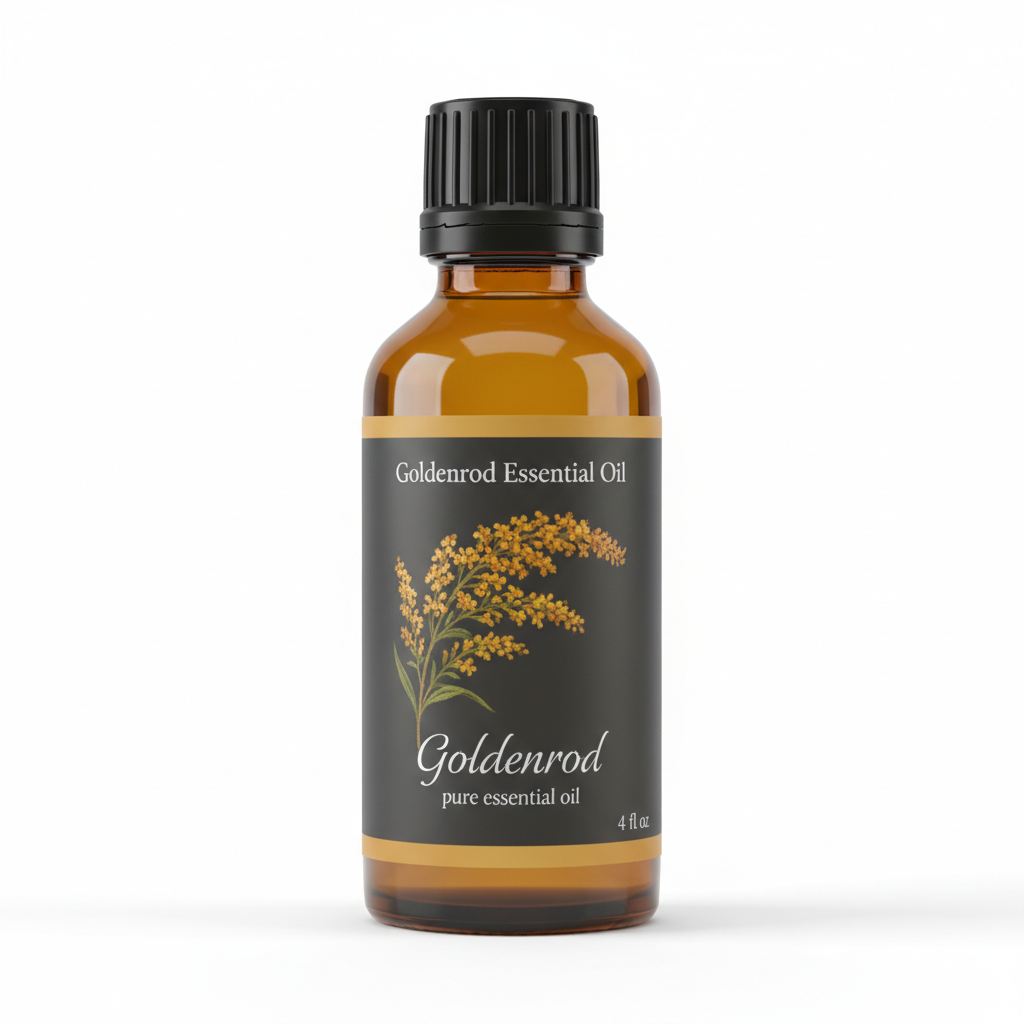
Goldenrod Essential Oil
Our own Goldenrod Essential Oil, in sizes from 0.5 oz to bulk.
From $17.99
Shop Now →Three jobs for goldenrod
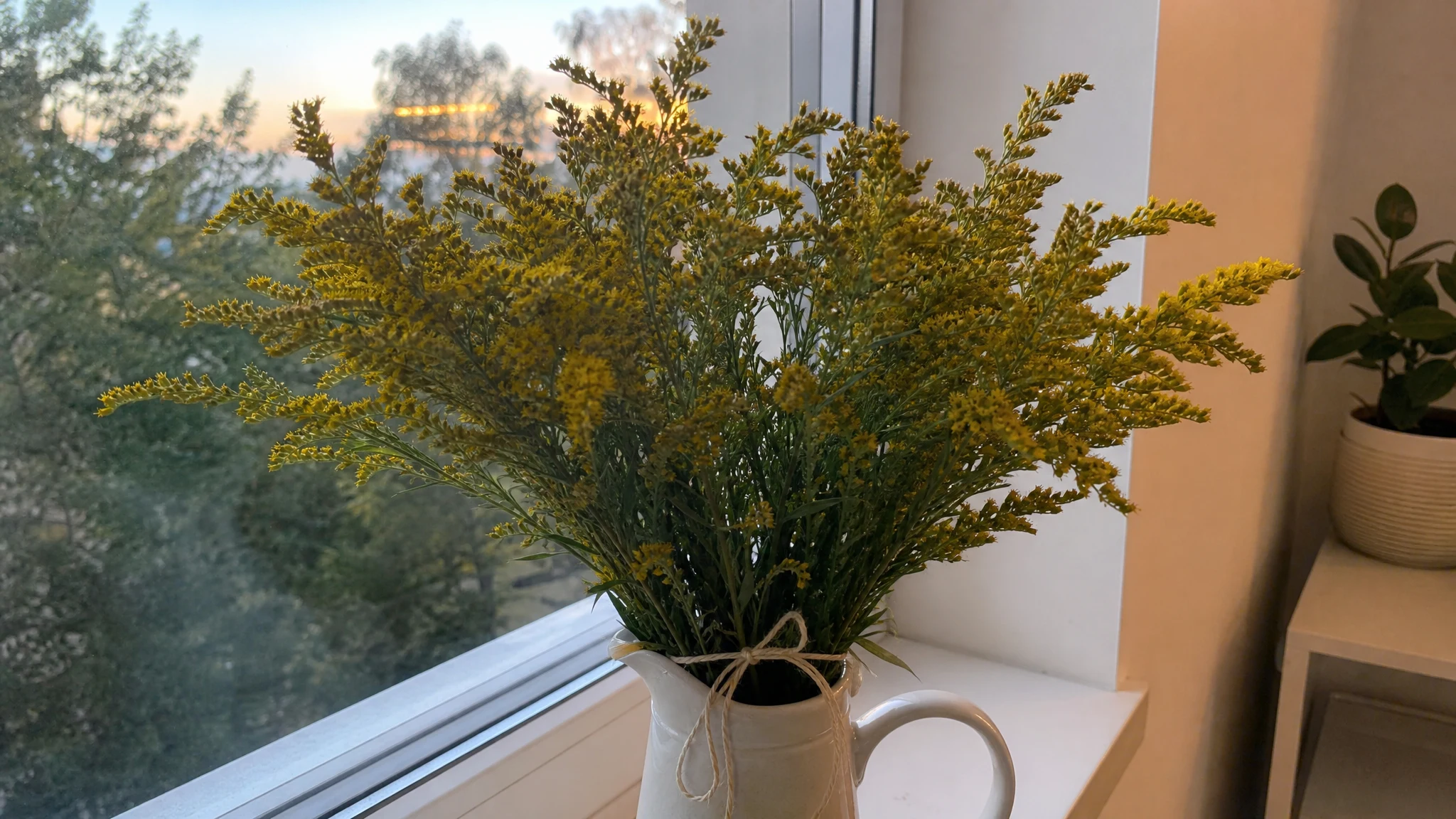
We describe our goldenrod as honeyed, grassy and floral over a faintly balsamic, hay-like base, and as a middle note. It blends well with chamomile, lavender, clary sage, citrus, rose and geranium. It can lead, with a partner in support. It can be the surprise note you catch on the second breath, with the partner out front. Or both can share the stage, which is the hardest to get right. We sell only goldenrod, so every partner below comes from another supplier.
Four patterns
Counts are parts by drop, and the total for your device is in its manual. "No two drops of essential oil are the same," as the Tisserand Institute puts it, so treat the numbers as starting points.
| Pattern | Goldenrod | Partner |
|---|---|---|
| Meadow lead | 3 | 1 lavender |
| Bright lift | 2 | 1 sweet orange or mandarin |
| Floral body | 2 | 1 geranium |
| Dry and resinous | 3 | 1 clary sage |
A 3 to 1 pattern in a six-drop device is not a tidy division, so use 5 and 1 or 4 and 2 and note which you chose.
What each partner brings
Lavender: expect a range
A 2026 Scientific Reports study of four commercial lavender oils from the Egyptian market found linalool and linalyl acetate at 33.61% and 24.72% in one and 46.09% and 32.65% in another. In practice, "lavender" is not one fixed ingredient, so a ratio that sings with one bottle may need a nudge with the next.
Citrus: the loudest shared note
A 2026 Croatian study found limonene up to 81.16% in orange peel oil and 77.50% in mandarin, against about 12.5% in a Slovak goldenrod analysis. At 2 to 1, the citrus will carry most of the limonene in the room, so go lighter on it than seems right if you want goldenrod to stay audible.
Geranium: plenty of room
Two studies of geranium oil report citronellol and geraniol at 28.68% and 5.35% in one and 42.2% and 30.5% in the other. Neither compound is among goldenrod's main constituents in the analysis we know of, so this pairing has the least overlap and the most room for each oil to be heard.
Clary sage: dry and herbal
A 2026 abstract describes clary sage oil as dominated by linalyl acetate and linalool. We found no figures, so we can only say it points toward a dry, herbal partner for goldenrod's sweeter side. Rose and chamomile are also on our blending list; both are worth reading about, though chamomile belongs to the daisy family like goldenrod, so our allergy article is worth a look before doubling up on that family.
Think about the room first
A pattern that works in a small study may vanish in a big living room, and the other way round. Consider the space before the ratio: how large it is, how long you will be in it and whether doors are open. Small rooms need very little, and a short session often tells you more than a long one. Start the diffuser, step out for a few minutes, and walk back in. That first impression in the doorway is the truest test, because your nose has not yet adjusted.
Finding words for what you smell
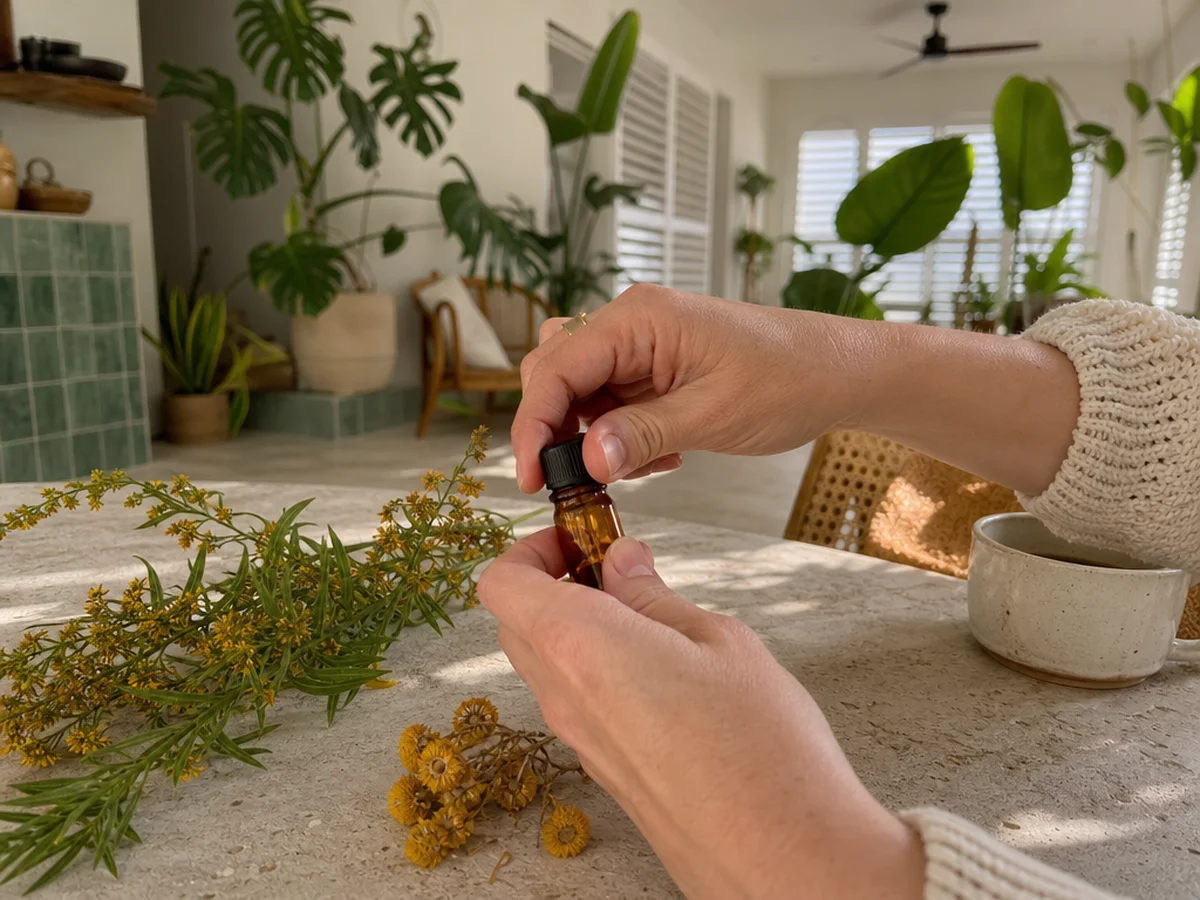
It helps to have words ready. Goldenrod gives you honey, dry grass and a little hay. Lavender adds a clean herbal floral note, citrus a bright, rind-like lift, geranium a rosy greenness, and clary sage a dry, herbal depth. Jot down two or three words per session next to the ratio. A month later you will have a small vocabulary of your own, which makes every tweak quicker and less of a guess.
Keep the device tidy
Follow the maker's cleaning instructions. Scent left behind from the last blend can muddy the next one, so wipe out the reservoir between trials and write the ratio on a sticky note while you wait.
Diffusing sensibly
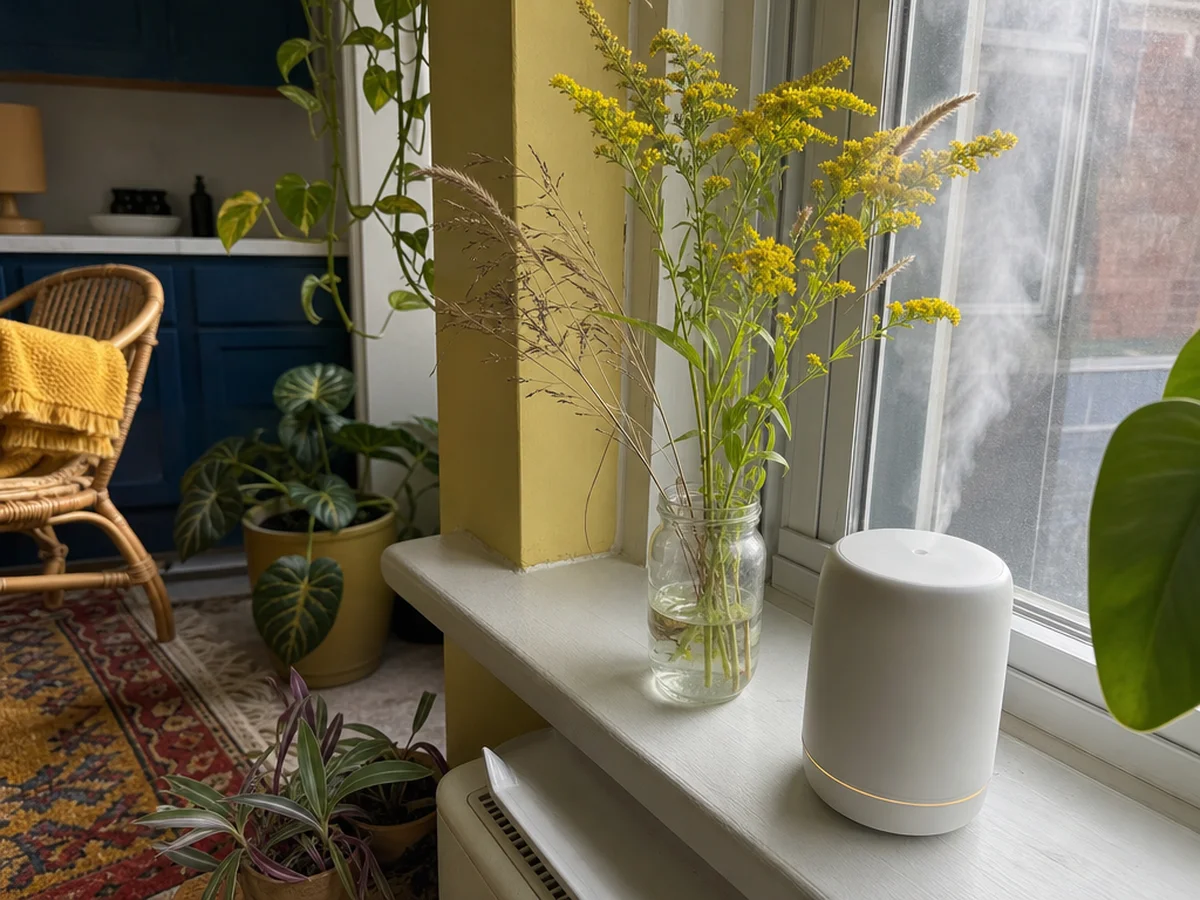
The Tisserand Institute suggests 30 to 60 minutes on and 30 to 60 minutes off, with some fresh air exchange. People with asthma or a lung condition should ask a physician before diffusing anything, and Poison Control advises locking oils away from children and pets; for animals in the house, a veterinarian is the person to ask, and our pets article has more.
Keep your expectations modest. Diffusers throw scent differently, ultrasonic ones softer and heat-based ones differently again, so the same ratio can read a little brighter in one machine than another. If you borrow a friend's device, treat your results as a fresh trial. The notes you take are the thing that carries over.
A simple way to test
- Smell goldenrod and the partner side by side on paper strips. If the partner dominates, trim its share.
- Choose one pattern and make the smallest batch your device allows.
- Run a short session with a window slightly open, and note the lot numbers.
- Change one thing at a time, the ratio or the partner.
If a pattern falls flat, try a different bottle of the partner before rewriting the idea. For method, see our blending guide, and for one worked pairing, goldenrod with frankincense.
The best blend is the one that makes you pause in the doorway, so adjust until yours does.
Goldenrod Essential Oil
Goldenrod Essential Oil from our own shop, in sizes from 0.5 oz to bulk.
From $17.99
Shop Now →Sources & Further Reading
- Elshafie H.S. et al., 2019. Molecules 24(7):1206. pmc.ncbi.nlm.nih.gov
- Abouelela M.B. et al., 2026. Uncovering adulteration and quality variations in commercial lavender essential oils from the Egyptian market using GC-MS and chemometrics. Sci Rep 16:12735. europepmc.org
- Penić M. et al., 2026. Effects of enzymatic pretreatment on yield and volatile composition of citrus peel essential oils. Molecules 31(4):657. europepmc.org
- Benzaid et al., 2026. Pelargonium graveolens essential oil against clinical Candida and reference isolates: insights into virulence inhibition and therapeutic perspectives. Front Fungal Biol. europepmc.org
- Mbanjwa et al., 2025. Efficacy of Melaleuca alternifolia and Pelargonium graveolens Oils Against Staphylococcus aureus and Staphylococcus epidermidis: An In Vitro Study. Microorganisms. europepmc.org
- Tisserand Institute. Safety guidelines. tisserandinstitute.org
- Poison Control. Essential oils. www.poison.org