Best Carrier Oils for Goldenrod: Jojoba or Sweet Almond?
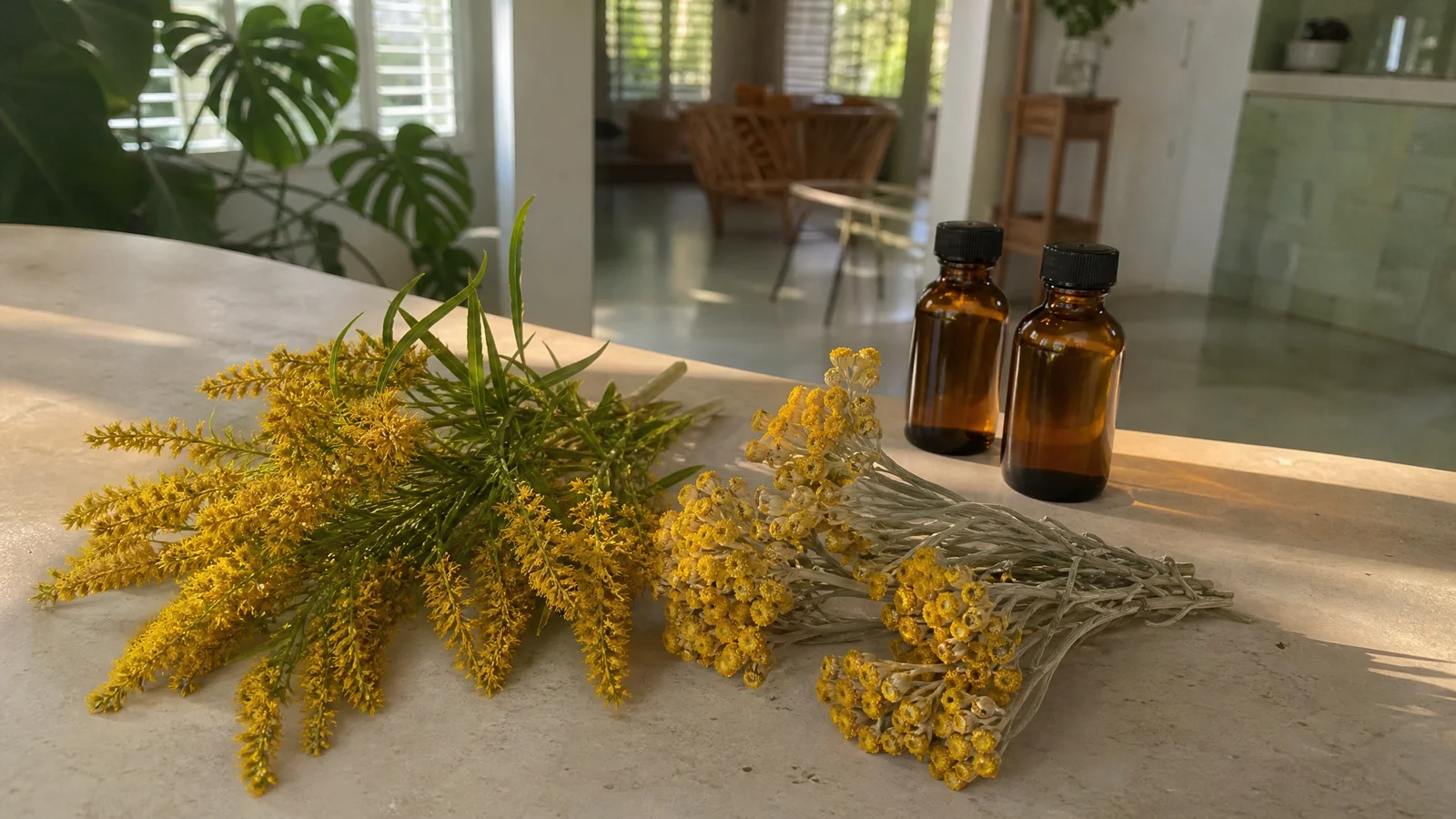
Ask ten people which carrier oil is best and you will get ten confident answers. Here is ours, and it is a little unglamorous: a fresh, dated carrier in a small bottle beats a famous one that has been open for two years. Goldenrod oil is the small part of the blend. The carrier is roughly 98% to 99.5% of what lands on your skin, so its age deserves as much thought as its name.
Goldenrod Essential Oil
Our own Goldenrod Essential Oil, in sizes from 0.5 oz to bulk.
From $17.99
Shop Now →Settle the percentage first
We recommend diluting goldenrod oil to between 0.5% and 2% in a carrier before any skin use, with a patch test first. That decision tells you how much oil goes into a bottle, and it is easier to make it before you shop for a carrier. At about 20 drops to the milliliter, a rough convention (the Tisserand Institute points out that no two drops are quite the same), the numbers look like this.
| Dilution | 10 ml | 30 ml | 100 ml |
|---|---|---|---|
| 0.5% | 1 drop | 3 drops | 10 drops |
| 1% | 2 drops | 6 drops | 20 drops |
| 2% | 4 drops | 12 drops | 40 drops |
Those are small amounts, which is part of the fun. If you want finished recipes with the arithmetic done, see the massage oil math and the roller bottle guide.
Jojoba: the long keeper
Jojoba is a bit of an outsider among carriers, because it is a liquid wax and not a triglyceride oil like most others. That chemistry may be why it has some of the best stability data around. In a 2022 study from Osaka University, Tsuchimoto and colleagues held crude jojoba oil, olive oil and squalene at 60 C for 60 days. Jojoba's acid value did not change, and its peroxide and carbonyl values stayed the lowest of the three, so the authors concluded it was the most stable of the group.
It is one study, comparing three oils, and the authors note that deodorized and refined jojoba showed lower antioxidant activity than crude. Still, we think the conclusion makes sense for a roller bottle that will ride around in a bag for months. It also happens to be a carrier that will comfortably outlast a bottle of goldenrod oil.
Sweet almond: soft and familiar, if it is fresh
Sweet almond oil is a long-time favorite for massage blends. It is mostly oleic acid with a smaller share of linoleic acid: in a study of 31 almond genotypes from Mersin, Turkey, oleic acid ran from about 62% to 76% and linoleic from about 14% to 30%, along with natural vitamin E compounds that help protect the oil. That mix is on the steadier side for a plant oil.
The label is where it gets interesting. Berkkan and colleagues bought 17 marketed almond oils in Turkey and checked them against the European Pharmacopoeia almond oil criteria, and only two met them. That is one country and one period, so it does not describe every supplier. It is a good reason to buy almond oil from someone who will tell you the date, and to note the date you open it.
Almond comes from a tree nut. If anyone who will handle the blend has a tree nut allergy, talk to an allergist or physician first and choose a different carrier in the meantime.
Smell and feel before you commit
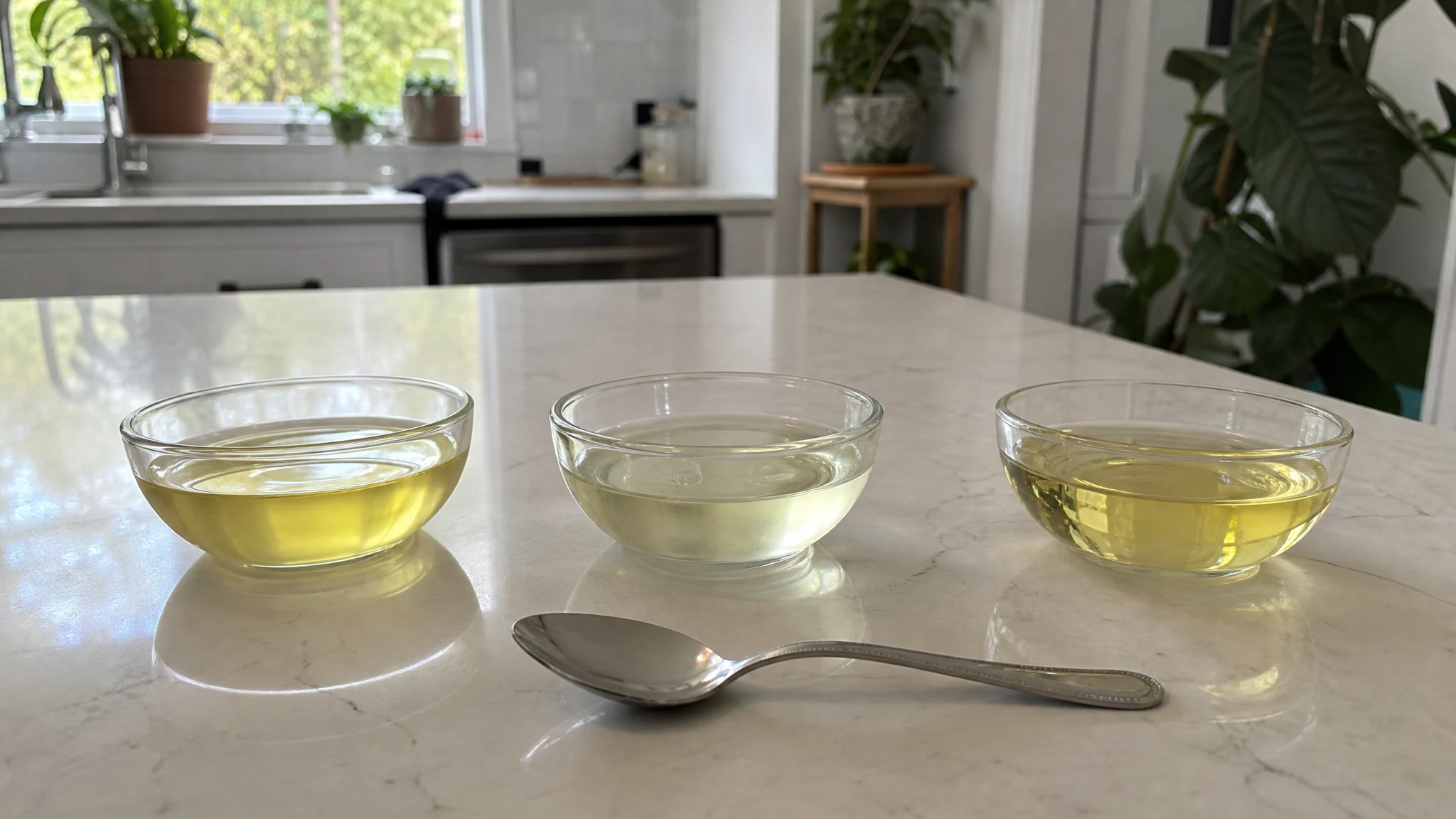
A good carrier barely smells at all. Put a drop on the back of your hand, rub it in and sniff. If you pick up something sharp, crayon-like or stale, the oil is past its best, and it will fight your goldenrod. You want the carrier to step aside and let the honeyed, hay-like scent come through.
Notice how it feels, too. Some carriers feel light, others stay slicker for a while. That is a matter of taste, and a good reason to buy small bottles of two carriers and see which one you keep reaching for.
Other carriers
We sell only our goldenrod oil, so every carrier comes from a craft supplier, a pharmacy or a health-food shop, and there are plenty of good ones. Whatever you choose, apply the same habits: buy a small bottle, check for a date, store it cool and dark, and write the date you opened it on the label. Solid published data on how quickly carriers absorb or how they suit different skin types is thin, so we will not rank them on those points.
Label everything
Write the carrier, the percentage and the date on a strip of tape before you walk away from the bench. It takes ten seconds, and future you will not remember which bottle was which.
If you are mixing for the first time, a good habit is to decant a little of the carrier into a small clean glass bottle and keep the main container sealed. Every time you open a big bottle you let air in, and a small working bottle means the rest stays fresh until you need it. It also keeps your hands, and any trace of goldenrod, out of the main supply.
Our short recommendation
Pick the percentage and the bottle size first, and make 10 ml or 30 ml for a first batch. If you want the longest-keeping base, reach for jojoba from a seller who states a batch date. If you love sweet almond, buy it fresh and keep the batch small. Then patch test the finished blend, as described in our skin basics article, and keep the goldenrod bottle cool and dark with these storage tips. If you are thinking of steeping flowers in oil instead, this comparison explains why that makes a different product.
A carrier is the cheapest part of the blend to get right, and the part people most often forget, so a little care there goes a long way.
Goldenrod Essential Oil
Goldenrod Essential Oil from our own shop, in sizes from 0.5 oz to bulk.
From $17.99
Shop Now →Sources & Further Reading
- Tsuchimoto S., Sakai H., Fukui K., 2022. Oxidative Stability and Antioxidant Activity of Crude Jojoba Oil. BPB Reports 5(6):121-124. jstage.jst.go.jp/article/bpbreports/5/6/5_121
- Ozcan M.M. et al., 2020. Effect of almond genotypes on fatty acid composition, tocopherols and mineral contents and bioactive properties of sweet almond (Prunus amygdalus Batsch spp. dulce) kernel and oils. J Food Sci Technol. pmc.ncbi.nlm.nih.gov/articles/PMC7520497
- Berkkan A. et al., 2022. Evaluation of Marketed Almond Oils (Prunus dulcis (Mill.) D.A. Webb) in Terms of European Pharmacopoeia Criteria. Turk J Pharm Sci 19(3). pmc.ncbi.nlm.nih.gov/articles/PMC9254091
- Tisserand Institute. Essential oil dilution. tisserandinstitute.org/dilution-essential-oils