Goldenrod vs Eucalyptus Oil: Safety in a Busy Household
Eucalyptus is probably the best-known essential oil in the medicine cabinet, and it also has the longest paper trail when something goes wrong. Goldenrod oil is the opposite: a quiet, honeyed oil with almost no published safety history at all. If you are choosing between them for a home with small children, the useful comparison is not which is gentler. It is what each record tells you, and what it leaves out.
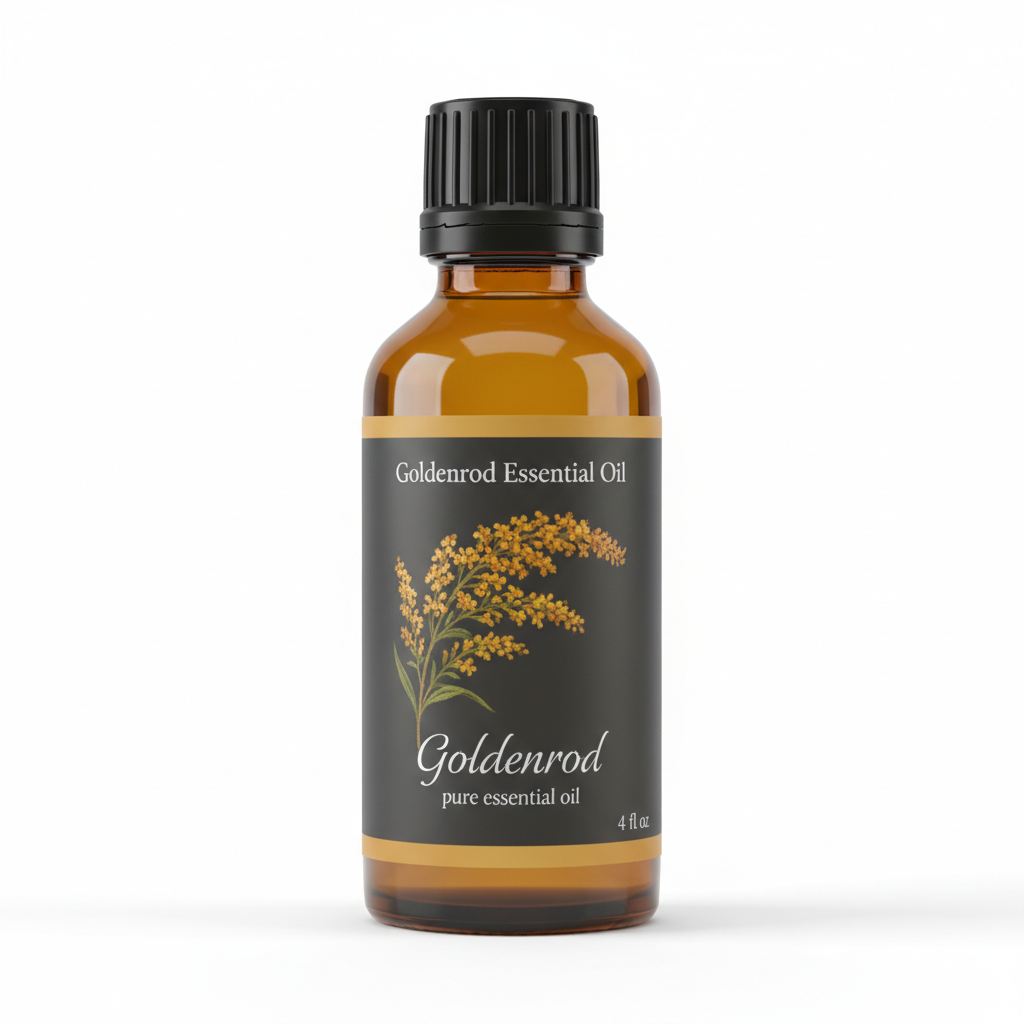
Goldenrod Essential Oil
Our own Goldenrod Essential Oil, in sizes from 0.5 oz to bulk.
From $17.99
Shop Now →What the eucalyptus record shows
The largest dataset we know of is a retrospective review of calls to the New South Wales Poisons Information Centre from July 2014 to June 2018, reported in the Medical Journal of Australia. Of 4,412 essential oil exposures, eucalyptus accounted for 2,049, or 46.4%, well ahead of tea tree, lavender, clove and peppermint. In 63% of cases the exposed person was under 15. These are call counts, not measured doses, and they cover one Australian state, so they tell you which bottles end up in small hands more than how toxic each drop is.
For dose information, the International Programme on Chemical Safety's monograph on eucalyptus oil, citing earlier clinical work, anticipates minor drowsiness after a child swallows 2 to 3 mL and significant effects after more than 5 mL. It also records children who recovered after much larger amounts, and it names aspiration into the lungs as the main risk. So the pattern is loose and volume alone does not settle the outcome. We read it as a reason to store the bottle well, not as a safe amount below a line. If a child swallows any essential oil, call Poison Control at 1-800-222-1222 in the US, or your local poison centre.
A small bottle in perspective
At about 20 drops to the milliliter, a rough convention, 2 mL is roughly 40 drops and 5 mL roughly 100 drops. A half-ounce bottle holds about 14.8 mL, so the smallest retail size of any essential oil holds several times the amounts in that monograph. The Australian authors make a related point: child-resistant closures are only required on containers above 15 mL, and they argue that this does not match a toxicity that can start at a few milliliters. We make no claims about any particular bottle's closure, so check yours and store it as though it had none.
The household walk-through
Here is a simple exercise we would recommend to anyone who keeps essential oils. Walk through your home as if you were a curious four-year-old, or a dog with a nose for new things. Where is the bottle? Can it be reached from a chair? Is it next to a cough syrup, a glass of water or a vitamin gummy jar? You will usually find at least one spot that needs changing.
Then do the same for guests. A visiting grandparent who is looking for a lip balm or a sitter who is looking for a pain reliever should never come across an unlabeled oil. A latch on a high cupboard solves most of it, and it costs very little.
Where goldenrod fits
Goldenrod is a different oil chemically. In the one detailed analysis of Solidago canadensis oil we have read, wild plants from Slovakia gave germacrene D at about 35% as the leading component, with limonene, alpha-pinene and others behind it, and the authors note composition depends on climate and harvest. Eucalyptus oil's familiar camphor-cool character comes from cineole. Different chemistry means eucalyptus dose figures cannot simply be copied across to goldenrod, and no published child toxicology for goldenrod oil has turned up. Both facts point the same way: treat the two exactly alike. We offer goldenrod as an external cosmetic oil, and our guidance is to keep it away from children and pets and not to take it internally.
Our own dilution recommendation for skin use is 0.5% to 2% in a carrier with a patch test first, and our article on children and our pets article go further into households with little ones and animals. For basic habits, the safety overview is a good place to start.
Habits that work for any oil in the house
The Poison Control guidance on essential oils is simple and applies to every bottle: keep them locked up and out of sight and reach of children and pets, dilute before using on skin, and do not use them on damaged skin. A high shelf is not a lock. We would add one more practice of our own, which is to keep oils in their original labeled bottles so a visitor, a sitter or a curious child never mistakes one for something else. The Australian study found that some of its cases were therapeutic mix-ups, such as an oil mistaken for a cough liquid, which is why labels and separate storage matter. If you are comparing aromas instead, this comparison and our tea tree match-up look at them by chemistry.
Choosing by scent first
Once storage is sorted, the choice between these two often comes down to how you like a room to smell. Eucalyptus is sharp and cool. Our goldenrod is honeyed, grassy and floral with a soft, hay-like finish, more of a late-summer porch than a bathroom shelf. Open each bottle on a paper strip on a different day, so the first does not crowd the second, and trust whichever one makes you reach for the strip again.
Both oils are lovely in their own way, and both deserve the same respectful, well-locked storage.
Goldenrod Essential Oil
Goldenrod Essential Oil from our own shop, in sizes from 0.5 oz to bulk.
From $17.99
Shop Now →Sources & Further Reading
- Swannell C., 2019. Essential oil poisoning calls increase; children most affected. Medical Journal of Australia (InSight). mja.com.au
- International Programme on Chemical Safety. Eucalyptus oil (PIM 031). inchem.org/documents/pims/pharm/pim031.htm
- Poison Control (National Capital Poison Center). Essential oils: Poisonous when misused. poison.org/articles/essential-oils
- Elshafie H.S. et al., 2019. Antimicrobial Activity and Chemical Composition of Essential Oil Extracted from Solidago canadensis L. Growing Wild in Slovakia. Molecules. pmc.ncbi.nlm.nih.gov/articles/PMC6479883