Goldenrod vs Fir and Pine Oil: Field or Forest?
Goldenrod and the conifer oils share one famous molecule, alpha-pinene, which is why they sometimes get lumped together as "woodsy." Look at everything else in the bottle and they turn out to be quite different characters. Here is how we would explain the overlap to a customer deciding which one belongs in a blend.
Goldenrod Essential Oil
Our own Goldenrod Essential Oil, in sizes from 0.5 oz to bulk.
From $17.99
Shop Now →One shared molecule, two different recipes
Balsam fir oil is built almost entirely from small, light molecules called monoterpenes. In one analysis, more than 96% of the oil was monoterpenes, led by beta-pinene (29.9%), delta-3-carene (19.6%) and alpha-pinene (14.6%).
A published analysis of wild Solidago canadensis from a Slovak meadow reads very differently. Its biggest constituent was germacrene D at 34.9%, a larger sesquiterpene, followed by limonene (12.5%) and alpha-pinene (11.6%). So the pinene is there, but it is a supporting player rather than the lead. Both figures describe a single sample from a single place, so treat them as a sketch of each oil's character, not a spec sheet for any bottle.
Why that changes how they smell and behave
Here is some reasoning from chemistry rather than a lab result. Light molecules tend to leave a smelling strip quickly, and heavier ones hang around longer. A fir oil weighted toward small monoterpenes should announce itself early, while an oil with a big sesquiterpene component should linger and round out. That fits how we place goldenrod, as a middle note, and how we describe it: honeyed, grassy and floral, with a soft sweetness settling into a faintly balsamic, hay-like base. There are no needles or resin in that description, and none of it is meant to compete with a conifer's crisp opening.
So if the picture in your head is a cut-wood, evergreen scent, a fir or pine oil is the right tool. If you want warmth and a late-summer meadow feel behind a conifer top, goldenrod can sit underneath it.
Picture the scene first
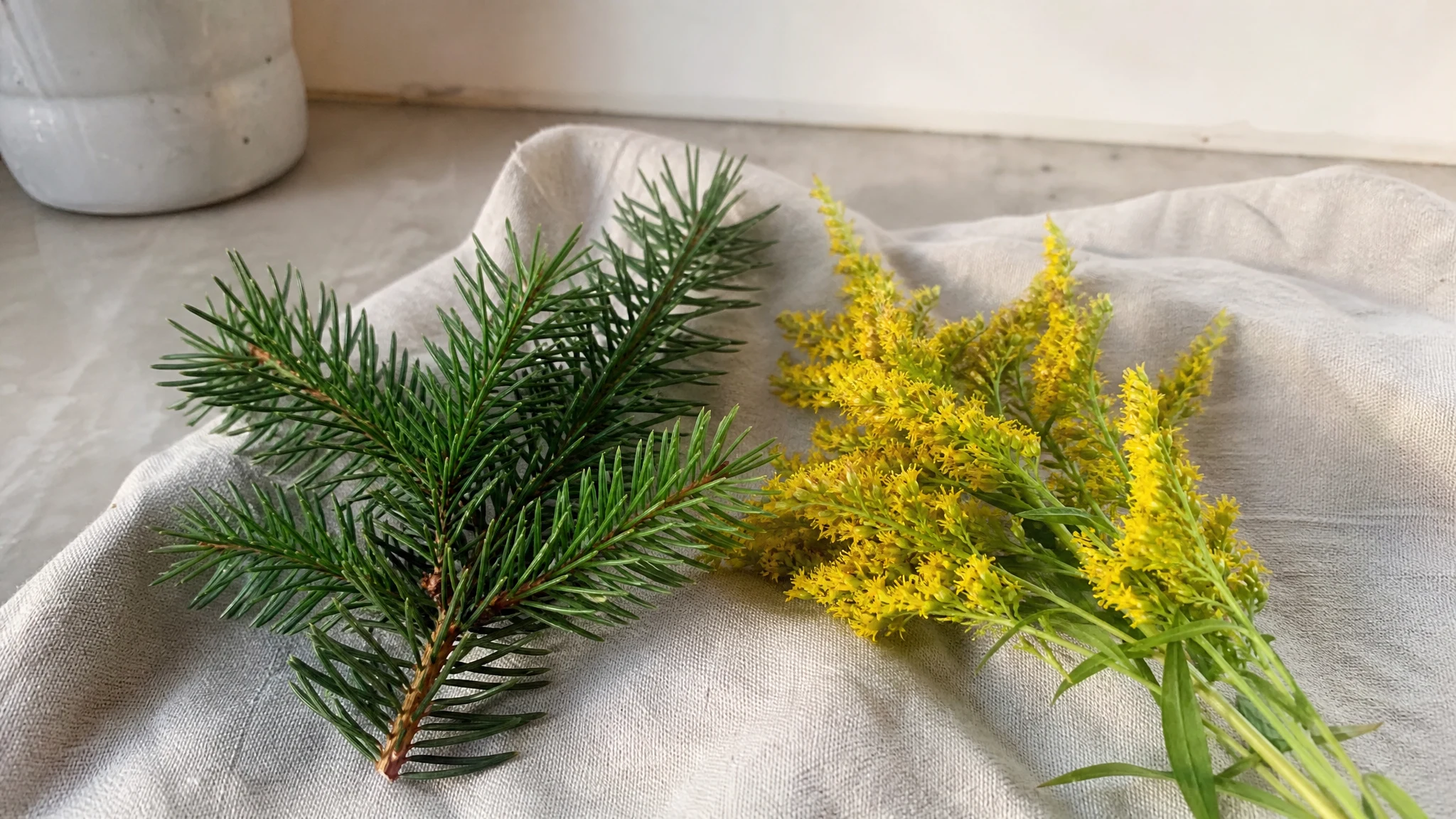
We find it helps to decide on a scene before you reach for any bottle. Are you after a cabin in winter, with cold air and cut branches? Or a country lane at the end of summer, with warm grass and dry flowers along the verge? The first is conifer territory. The second is where goldenrod belongs, and a small amount underneath a conifer lets you stand at the edge of both.
Writing the scene down in a sentence sounds silly, but it keeps you from adding a third and fourth oil because they happened to be on the table. Most good blends are small in number and clear in intention.
Which "pine" are you buying?
"Pine oil" and "fir oil" cover a lot of ground, with several species, plant parts and distillation styles all sold under those names. Without a Latin name and some lot information, you cannot know which material you have, and the same goes for goldenrod. It is why we suggest checking the species and lot on any oil you buy, and why our seller-vetting guide leads with those questions.
A word on restraint
It is tempting, when two oils sound complementary, to pour generously and see what happens. Resist that. Start with the smallest batch you can make, perhaps a teaspoon of carrier or a single diffuser session, and write down exactly what went in. A conifer oil can be loud, and a blend that seemed delicate on the strip may feel heavy in a closed room. Keeping notes lets you repeat what you like and quietly forget what you do not.
How to smell them side by side
If you can get a small bottle of a fir or pine oil from a supplier, set up a simple comparison. Put a drop of each on its own paper strip, label the strips in pencil, and smell them straight away. Come back after ten minutes and again after an hour. You will notice which one fades first and which one lingers, and you will have an honest answer to the question of how the two sit together. A cup of coffee beans on the table gives your nose a rest between sniffs.
Putting them in one bottle
We sell only goldenrod oil, so the conifer half comes from an aromatherapy or perfumery supplier. A few practical notes for pairing them:
- Work out your total percentage first. We recommend diluting goldenrod to 0.5% to 2% in a carrier oil for skin use and patch testing first. At roughly 20 drops per milliliter, that is about 3 to 12 drops of essential oil in total per fluid ounce of carrier, so count the conifer oil toward the same total unless its supplier gives a different limit.
- Let the conifer lead and add goldenrod in small steps. Because the conifer notes arrive first, one drop of goldenrod goes a long way in a first trial.
- Patch test the finished blend, not only each oil on its own, and keep it away from eyes, children and pets. Our skin basics post walks through the steps.
For goldenrod partners we do name, such as chamomile, lavender, clary sage, citrus, rose and geranium, see our partners guide, and our diffuser blends post shows how to build a ratio on paper before you pour anything.
The simplest way to think about it is that fir and pine give you the trees, and goldenrod gives you the field beside them. Pick the one that matches the scene you are trying to create.
Goldenrod Essential Oil
Goldenrod Essential Oil from our own shop, in sizes from 0.5 oz to bulk.
From $17.99
Shop Now →Sources & Further Reading
- Pichette A, Larouche PL, Lebrun M, Legault J. Composition and antibacterial activity of Abies balsamea essential oil. Phytotherapy Research, 2006. europepmc.org/article/MED/16619365
- Elshafie HS et al. Antimicrobial Activity and Chemical Composition of Essential Oil Extracted from Solidago canadensis L. Growing Wild in Slovakia. Molecules, 2019. pmc.ncbi.nlm.nih.gov/articles/PMC6479883