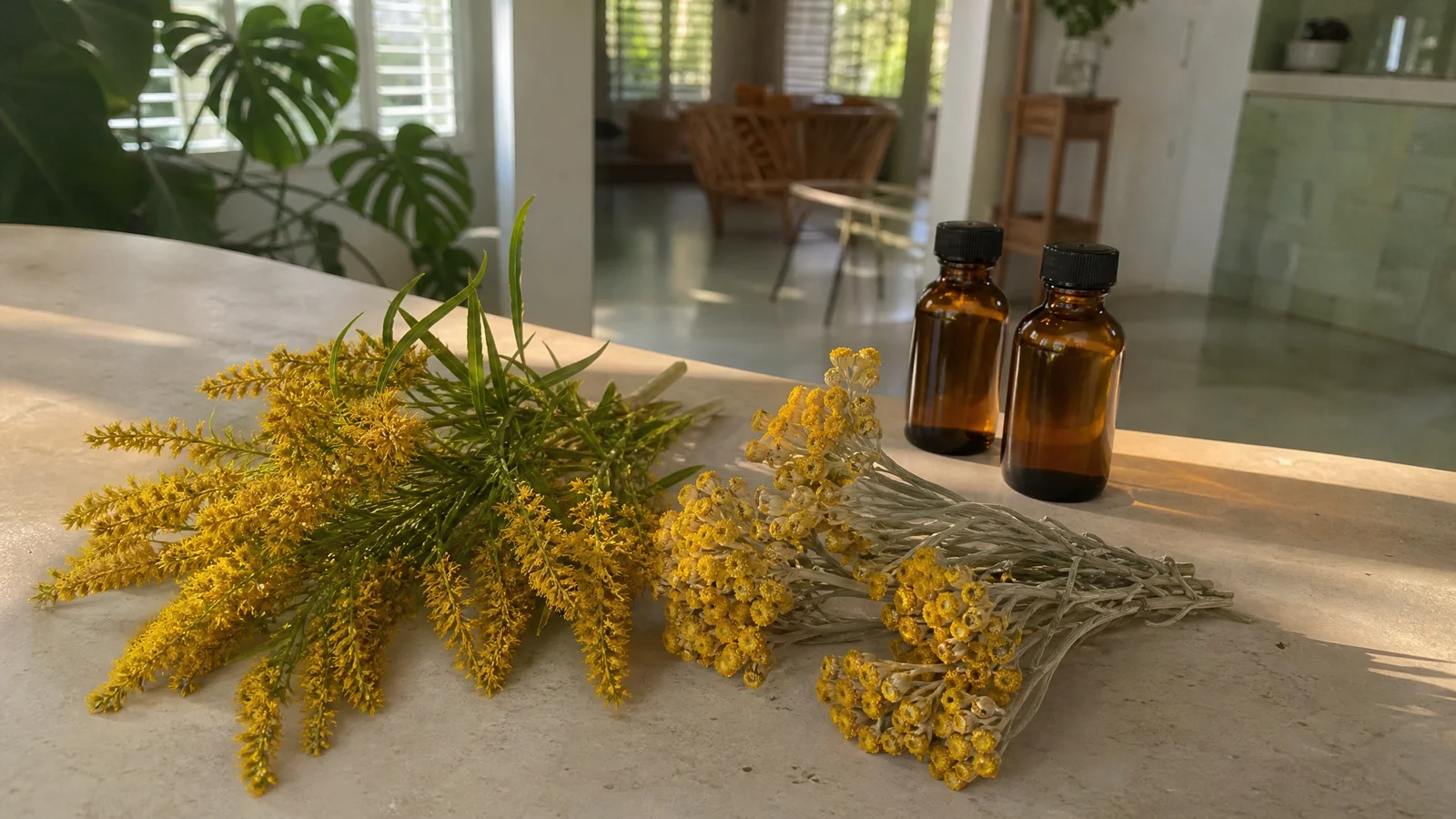
Is Goldenrod Oil Like Helichrysum? Key Differences
Goldenrod and helichrysum both have "golden" in their reputations, and both get described as sunny flowers with a warm scent. That is about where the resemblance ends. One is a North American wildflower, the other a Mediterranean shrub, and the oils analysed from them are built quite differently.
Goldenrod Essential Oil
Our own Goldenrod Essential Oil, in sizes from 0.5 oz to bulk.
From $17.99
Shop Now →Cousins with different chemistry
Goldenrod (Solidago canadensis) and helichrysum or immortelle (Helichrysum italicum) both belong to the daisy family, Asteraceae. Beyond that family tie, the published analyses part ways. In one wild Slovak goldenrod sample, the lead compound was germacrene D at 34.9%, with limonene and alpha-pinene behind it. Helichrysum studies tell a different story. A Slovenian analysis of plants distilled from stems and leaves found alpha-pinene up to about 19% alongside oxygenated sesquiterpenes, and an Italian sample was dominated by oxygenated sesquiterpenoids (73.6% of the oil), led by iso-italicene epoxide.
Alpha-pinene turns up in both, but it also turns up in hundreds of other oils, so it is a thin thread to hang a "same oil" claim on. If you have heard the two are interchangeable, the numbers do not back that up. Our substitutes guide covers the question in more depth.
Why the lot matters as much as the plant
Helichrysum is a good example of how much a plant's oil can move around. In the Slovenian study, plants distilled in their first year held 32% monoterpenes, while two-year-old plants from the same site held about 19%, with sesquiterpenes rising to compensate. Same species, same still, different age, different oil. Goldenrod behaves similarly: other studies cited in the Slovak paper put germacrene D anywhere between roughly 20% and 39%.
For a perfumer or a hobbyist, that makes the label name only half the story. The species, the plant part, the origin and the lot decide what you actually smell, and a second purchase of either oil is a fresh introduction.
It is also worth reading the product type. The same helichrysum research distilled the plant's hydrosol and found a completely different profile from the oil, so "helichrysum" on a listing could mean either one.
Two names that sound alike
Names do a lot of work in the oil world, and "golden" is a very attractive word. Helichrysum is sometimes called the everlasting or immortelle flower, and goldenrod is simply a yellow plume at the roadside. It is easy to see why a shopper might hear both in the same sentence and assume they are related in some way beyond the family tie.
Our advice is to ignore the poetry for a minute and read the first line of any listing: Latin name, plant part, origin. If those three things are there, you are dealing with a seller who knows what they have, whichever oil you pick.
Scent and role
We describe our goldenrod as honeyed, grassy and floral, with a soft sweetness settling into a faintly balsamic, hay-like base, and we place it as a middle note. None of the helichrysum papers measured scent, so we will not try to rank the two by richness or strength. If aroma is your deciding factor, smell both from the smallest sizes you can find. We sell only goldenrod, so the helichrysum side of that test comes from another supplier. If you build blends with goldenrod, our partners guide is a good starting point.
Smelling them fairly
When you finally get both bottles in hand, give your nose a fair chance. Do not smell them straight after each other, and do not smell them when you are tired or have just eaten. Choose a quiet moment, put a drop on separate paper strips, and note in a few plain words what you notice at the start, after ten minutes and after an hour. Words like "grassy," "sweet," "dry" or "warm" are plenty. Those notes will tell you far more than any listing.
One shared family trait worth knowing
Because both plants are in the daisy family, anyone with a known Compositae allergy should check with an allergist before buying either. DermNet lists goldenrod among the plants in that family and names sesquiterpene lactones as the most important allergens. It reports that people who react to one plant often react to others, and it does not discuss helichrysum or essential oils specifically. So there is no way to say that a reaction to one predicts a reaction to the other, and no way to say it does not. For anyone without a known allergy, our guidance for goldenrod on skin is 0.5% to 2% in a carrier oil with a patch test first. Our Asteraceae guide covers the wider family.
Start small with both
If you are curious about both, resist the urge to order the biggest bottles. A small size of each costs you very little room on the shelf and lets you smell the oils over several weeks, on different days and in different moods. Scents change with the weather and with your own state of mind, and it can take a few visits before you know whether you truly like something.
Choosing between them
- If you want a honeyed, hay-like middle note for a blend or a diffuser, goldenrod is the oil we offer, and a small size is a good way to get acquainted with it.
- If you want helichrysum, ask the seller for the origin, the plant part and a lot analysis, since the studies show all three change the oil.
- If you are curious how goldenrod compares with other oils more broadly, the comparison hub collects the cited numbers in one place.
Two golden flowers, then, and two oils with their own personalities. The best way to know which suits your project is to start small with each and see.
Goldenrod Essential Oil
Goldenrod Essential Oil from our own shop, in sizes from 0.5 oz to bulk.
From $17.99
Shop Now →Sources & Further Reading
- Elshafie HS et al. Antimicrobial Activity and Chemical Composition of Essential Oil Extracted from Solidago canadensis L. Growing Wild in Slovakia. Molecules, 2019. pmc.ncbi.nlm.nih.gov/articles/PMC6479883
- Kunc N et al. Essential Oil and Hydrosol Composition of Immortelle (Helichrysum italicum). Plants, 2022. pmc.ncbi.nlm.nih.gov/articles/PMC9570752
- Mancini E et al. Chemical composition and possible in vitro phytotoxic activity of Helichrsyum italicum (Roth) Don ssp. italicum. Molecules, 2011. pmc.ncbi.nlm.nih.gov/articles/PMC6264769
- DermNet. Compositae allergy. dermnetnz.org/topics/compositae-allergy