Goldenrod Oil Substitutes: What to Use Instead
Goldenrod oil has a scent that is hard to match: honeyed and grassy, floral up top, and settling into a faintly balsamic, hay-like base. Anyone hunting for a stand-in quickly learns that no single oil copies it. The good news is that you can usually find something that works once you are clear about why you are looking.
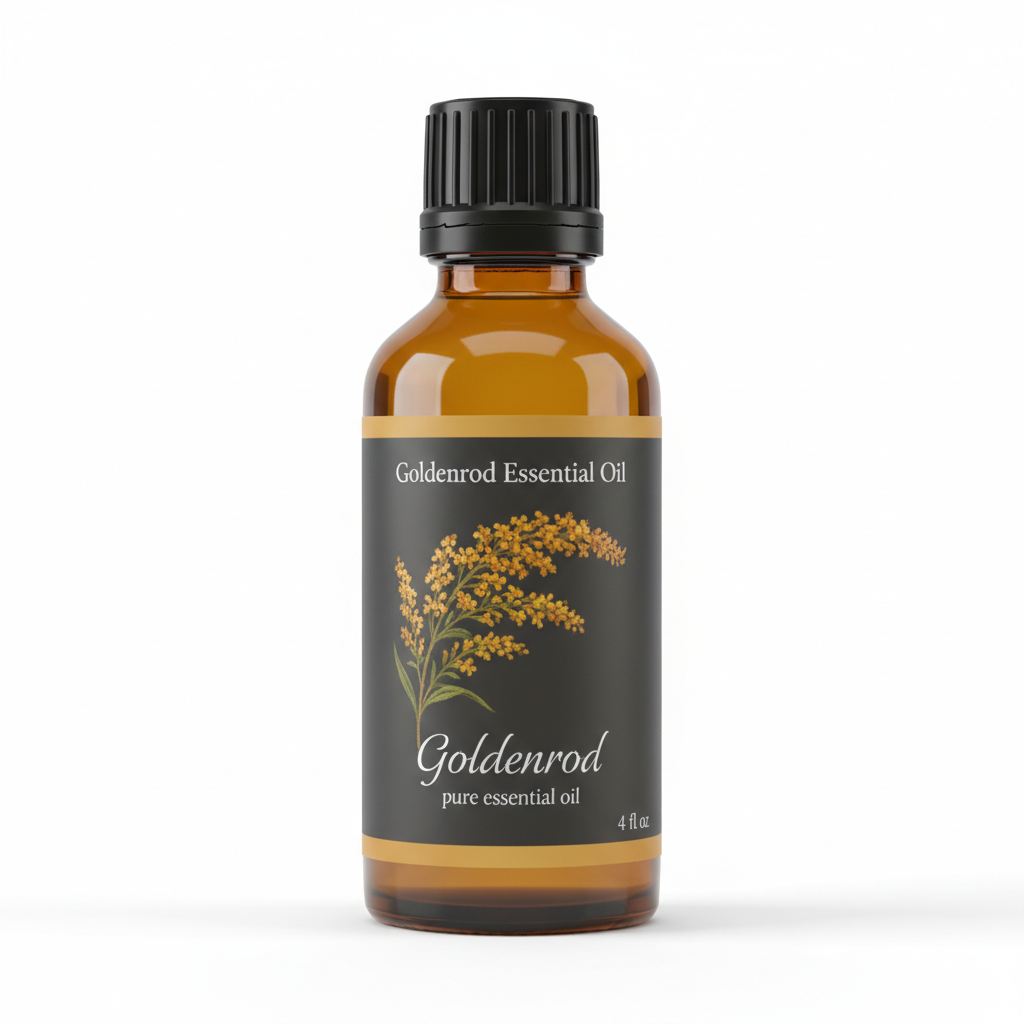
Goldenrod Essential Oil
Our own Goldenrod Essential Oil, in sizes from 0.5 oz to bulk.
From $17.99
Shop Now →Start with the reason
People ask for a substitute for three quite different reasons, and each has a different best answer.
- The bottle is out of stock. Our oil comes in limited seasonal batches because late-summer yields are modest, so a gap between batches is part of the rhythm. Patience is often the best answer, and a bottle you already own can bridge it.
- You want the scent. That is where a stand-in is most interesting, and we go through it below.
- You want to avoid goldenrod because of an allergy. Then the plant family matters more than the scent, and we come to that too.
It is worth knowing what you are missing before you choose a replacement. The smell of our goldenrod oil is honeyed and grassy up top, floral in the middle, and quietly hay-like at the bottom. Hold a paper strip to it for a minute and write down which of those three parts you care about most. If it is the honey, you will pick differently than if it is the hay.
Matching the balsamic side
For scent, the nearest neighbor we can reason toward is fir needle. A published analysis of commercial silver fir oil found bornyl acetate as its largest component at about 30%, and bornyl acetate is also present in goldenrod oil, at about 6% in one Slovak sample. It is a compound described as woody, pine-like and herbal. So fir shares goldenrod's balsamic, resinous undertone, though without the honeyed, floral top. This is reasoning from composition tables, since neither paper assessed odor, so the dependable test is simple: smell both on paper strips side by side.
What about the other golden flowers?
Helichrysum is a tempting match because of its golden flowers, but its oil is a moving target. Two studies of helichrysum oil found very different leading compounds. One had alpha-pinene as a main component with no neryl acetate detected, and the other reported iso-italicene epoxide at 16.8% in material from southern Italy. If an oil changes that much by origin, a substitution is a gamble unless you can smell the exact lot. Mimosa absolute, chamomile and the rest each have their own character and are better thought of as companions than twins.
That fits how we think about blending. Our product page names chamomile, lavender, clary sage, citrus, rose and geranium as oils that sit well with goldenrod. We sell only goldenrod, so you will find those at a craft or supply shop. Treat each as a partner that changes the scent, not a replacement for it, and check each oil's own dilution guidance rather than reusing ours.
If allergy is the reason
Here it is worth slowing down. Goldenrod, chamomile, yarrow and helichrysum all sit in the daisy family (Asteraceae, or Compositae). DermNet NZ explains that sesquiterpene lactones are the main allergens in that family and that cross-reaction between its members is common. So if ragweed, daisies or chamomile bother your skin, another daisy-family oil is not an escape route, and a dermatologist is the right person to ask. Our Asteraceae oils guide has more. A conifer like fir sits outside that family, though it has its own skin guidance to follow.
Keep what you have in good shape
While you wait, look after your last bottle. Keep the cap tight, store it somewhere cool and dark, and decant a working amount into a small airtight bottle so the main one is opened less often. A few small habits like these stretch a bottle across a long gap between seasons, and they mean the oil you do have smells the way it did on the first day.
Try the blotter test before you swap
Whatever you pick, do not trust a name on a label. Put the old oil and the candidate on two paper strips, label them in pencil, and smell them side by side after a minute, ten minutes and half an hour. You will quickly hear whether they share anything beyond a shade of green. Do this before you commit a whole recipe, because the strip costs you one drop.
When a different scent is actually the answer
Sometimes the honest answer is to change the plan. A recipe built around goldenrod's meadow sweetness can turn into something just as nice with a different centerpiece, and a diffuser blend or room spray does not need a copy of the original. Treat the gap as a chance to write a new recipe, not to chase a clone.
If the issue is stock, wait or compare
When the question is timing, a few small moves help. Store what you have well, since we describe a typical shelf life of two to three years kept cool and dark (our storage guide shows how). Watch for the next seasonal batch. And if the fragrance-oil route tempts you, our comparison of essential and fragrance oil explains what changes.
Our own favorite answer to "what can I use instead?" is often "a little patience". Goldenrod only blooms for a few weeks each year, and an oil with that kind of calendar is worth waiting for.
Goldenrod Essential Oil
Goldenrod Essential Oil from our own shop, in sizes from 0.5 oz to bulk.
From $17.99
Shop Now →Sources & Further Reading
- Elshafie et al., 2019. Antimicrobial activity and chemical composition of essential oil extracted from Solidago canadensis L. growing wild in Slovakia (Molecules)
- Silver fir (Abies alba) essential oil composition, J Clin Biochem Nutr 2009. PMC2675024
- Kunc et al., 2022. Helichrysum italicum essential oil and hydrosol composition (Plants 11(19):2573)
- Mancini et al., 2011. Helichrysum italicum essential oil composition (Molecules)
- DermNet NZ. Compositae allergy