How Goldenrod Essential Oil Is Made: Yield and Still
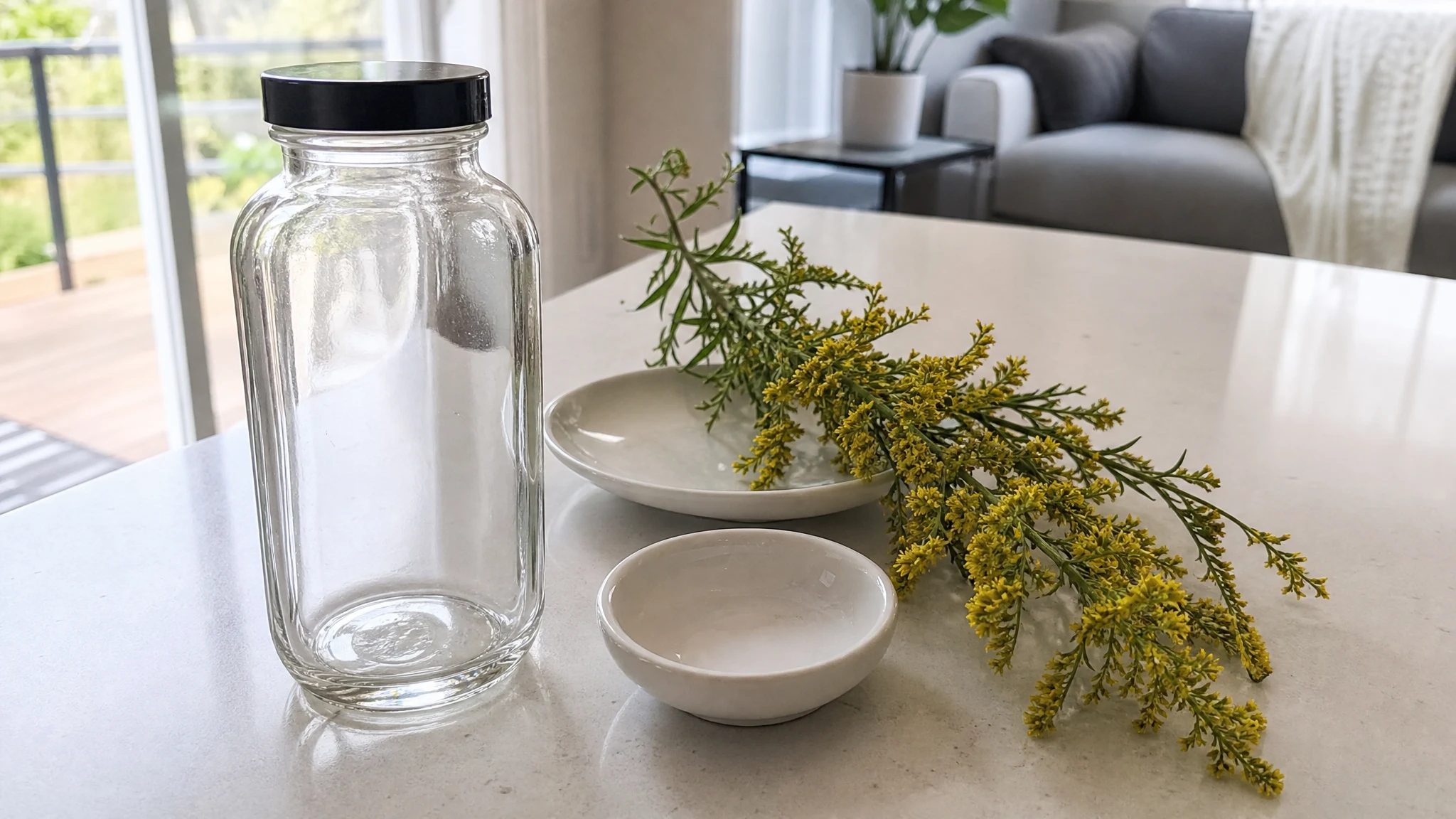
It takes a startling amount of goldenrod to make a small bottle of oil. Studies that distill the plant in the laboratory find that oil makes up well under 1% of dried plant material in most cases, and that fact explains a lot about why goldenrod oil arrives in limited seasonal batches. Goldenrod blooms for only a few weeks each late summer, and the yield from those weeks is modest.
Goldenrod Essential Oil
Our own Goldenrod Essential Oil, in sizes from 0.5 oz to bulk.
From $17.99
Shop Now →Where the oil is in the plant
Two published studies give usable numbers. Elshafie and colleagues distilled the dried aboveground parts of wild Solidago canadensis and got 0.27% of dry weight as oil. Yang and colleagues in China separated flowers, leaves and stems before distilling, and the split is striking.
| Plant part (dried) | Oil, % of dry weight | Oil from 1 kg |
|---|---|---|
| Flowers | 1.00 | about 10 g |
| Leaves | 0.76 | about 7.6 g |
| Stems | 0.05 | about 0.5 g |
Stems add bulk and almost no oil, and Yang's group attributes that to stems being mostly structural material with few volatile compounds. These were laboratory flasks and single populations, so they show a pattern, not a forecast for any producer. Still, the pattern is a good guide to why flower-rich plant material matters.
What that means for one bottle
The Certificate of Analysis we publish for one batch gives a relative density of 0.880, so a half-ounce bottle (14.79 ml) holds about 13 g of oil. At Elshafie's whole-plant yield, that works out to about 4.8 kg of dried goldenrod for a single small bottle. Flower-rich material would need less and stem-heavy material more, so treat the figure as a sense of scale rather than a claim about any particular lot. Either way, a little goldenrod oil stands for a lot of meadow.
Inside the still
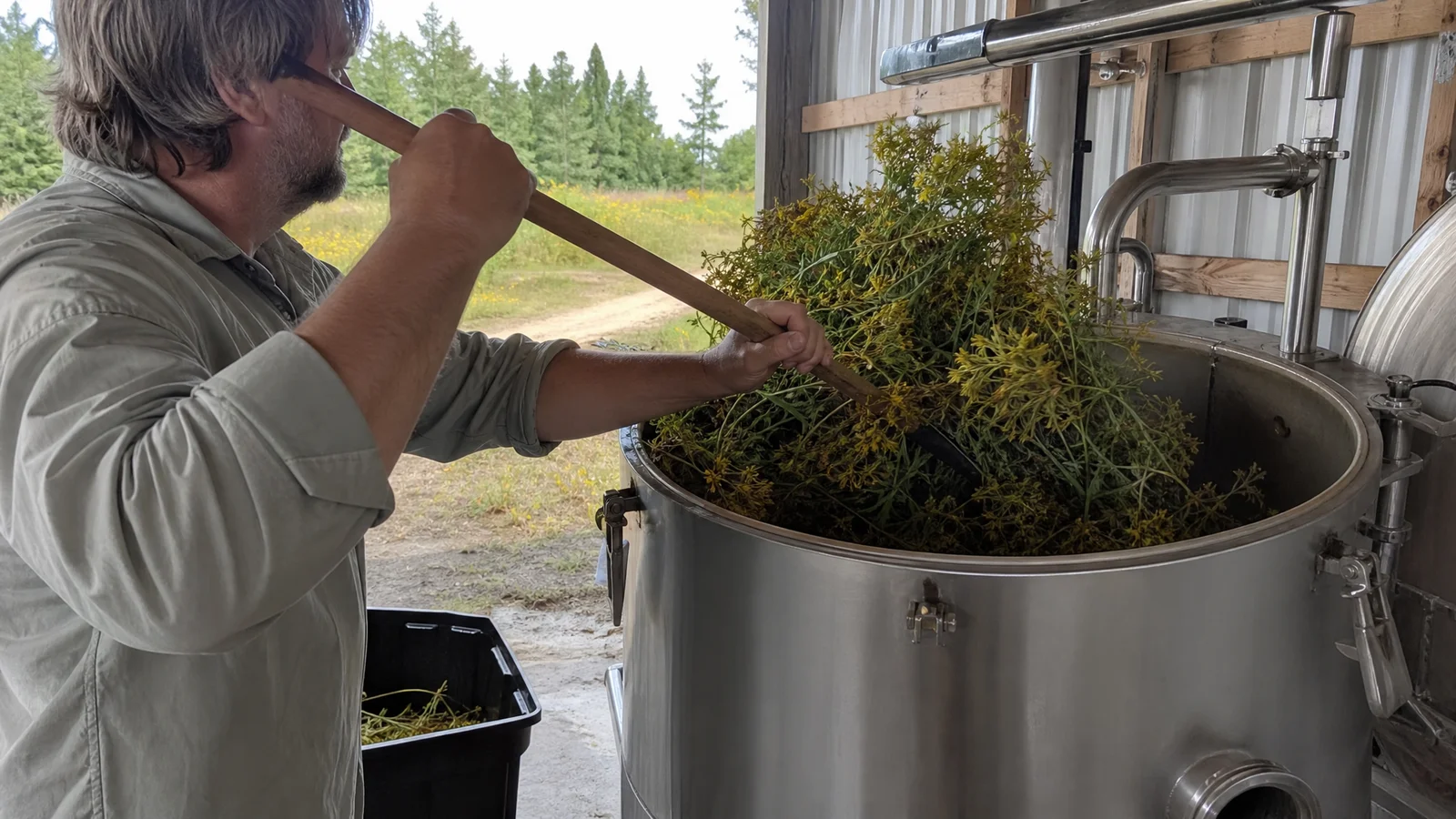
Steam distillation is an elegant idea. Steam passes through the plant material and carries the oil's vapors along to a condenser, where steam and oil turn back into liquid. Because oil and water do not mix, the oil forms its own layer and can be drawn off. Our certificate lists the extraction as steam distilled.
The oil layer floats, and the numbers say why. Our certificate gives 0.880 g/ml at 20 C, and Yang's group measured 0.86 g/ml for oil from every plant part, both lighter than water. The water left underneath, the hydrosol, is a separate product, and we do not sell one.
What the process asks of people
Even from the outside, you can feel how patient this kind of work is. A still has to be loaded, sealed and watched, the heat adjusted, the condensed water and oil drawn off, and the whole thing cleaned out before the next charge. Nothing about it can be hurried, and the season will not wait. If you have ever made jam in a short fruit season, you know the feeling: a lot of effort packed into a few weeks, and a handful of jars at the end.
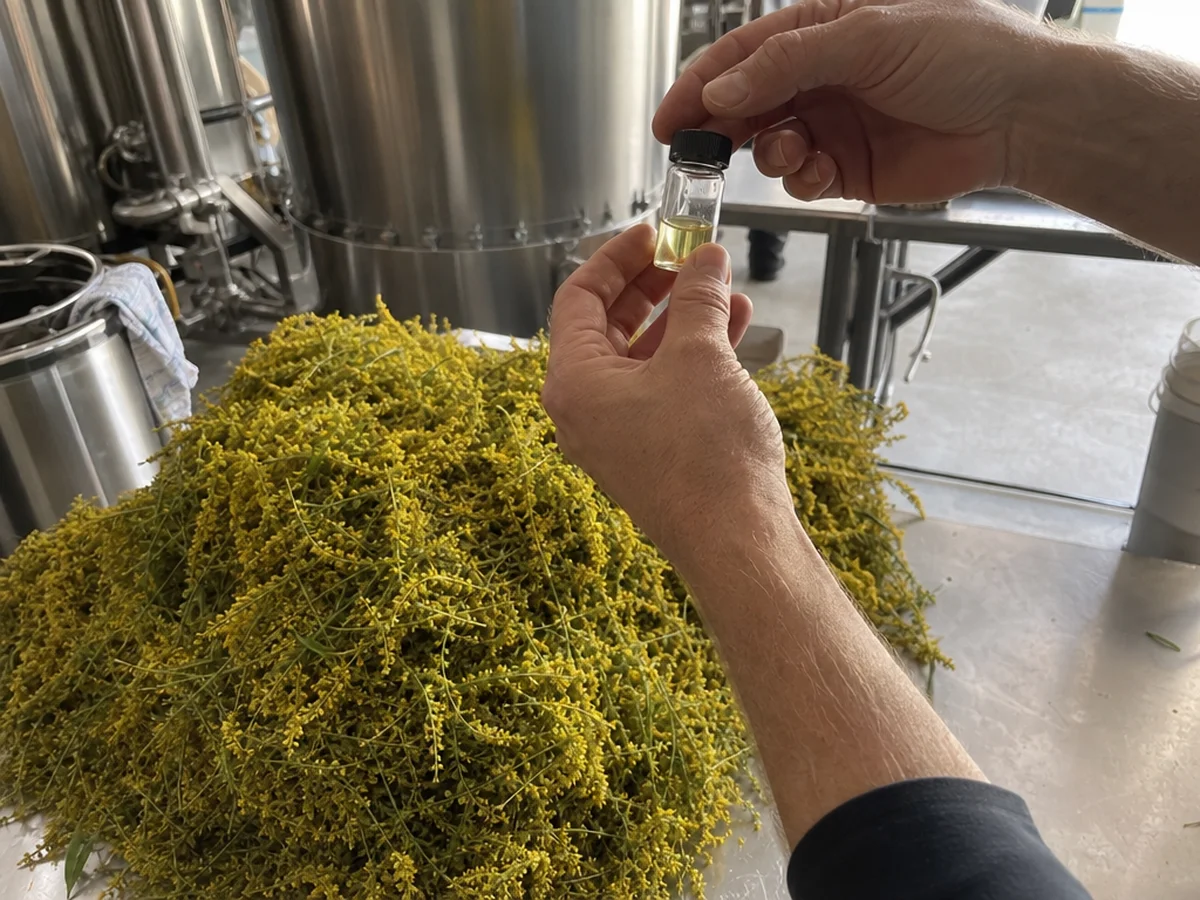
It is also a gentle reminder that a small bottle is the end of a long chain of decisions. Each choice along the way, from what is cut to how long the run lasts, leaves its fingerprint on what you smell.
Why method matters to the finished oil
How the plant is treated before and during distillation shapes the oil. A 2026 comparison by Leva and Gal looked at seven other plants processed two ways, in the lab with dried, ground material and in a semi-industrial steam still with fresh material. They found the lab method gave higher yields, which they attributed mainly to the drying and grinding, and a somewhat different balance of compounds. They compared two whole pipelines, so drying, grinding and still type cannot be separated, but the lesson for readers holds: percentages from a flask paper describe that flask oil, not every bottle. The composition figures in published goldenrod studies, for instance germacrene D at 34.9% in one Slovak sample, are portraits of one plant population and method.
Our certificate gives three physical constants for its batch: relative density 0.880, refractive index 1.487 and optical rotation of -8.16 degrees. If you would like a constituent profile for a particular lot, ask us in writing through the contact page before you order.
What you will notice on opening a bottle
The first thing is the smell, and it will not shout. Hold the open bottle a hand's width from your nose and breathe in slowly. We describe our oil as honeyed, grassy and floral, with a soft sweetness settling into a faintly balsamic, hay-like base. Give it a minute and come back. Aromas like this tend to open as you let them breathe, and one drop on a paper strip tells you much more than a quick sniff from the neck of the bottle.
Four good questions for any goldenrod oil
Which part of the plant went into the still? Was it fresh or dried first? How long did the run last? What does the constituent profile of your lot show? An oil whose seller can answer all four is an oil you can compare properly, and our label-reading article shows what else to look for. If you are curious about the scarcity side, our article on why goldenrod oil is hard to find takes the arithmetic further.
Thinking of distilling your own? The yield math is a gentle reminder to start with permission and plant identification, which our foraging guide covers. If it is the gold color and a mild plant scent in a carrier you are after, an infused oil is a different product altogether, as our comparison explains.
Next time you see a tiny bottle, picture the meadow behind it: a few late-summer weeks of blooms, a still, and a patient hand drawing off the lighter layer.
Goldenrod Essential Oil
Goldenrod Essential Oil from our own shop, in sizes from 0.5 oz to bulk.
From $17.99
Shop Now →Sources & Further Reading
- Elshafie et al., 2019. Antimicrobial activity and chemical composition of essential oil extracted from Solidago canadensis L. growing wild in Slovakia (Molecules)
- Yang et al., 2026. Solidago canadensis essential oil from flowers, leaves and stems (Int J Mol Sci 27(1):49)
- Leva and Gal, 2026. Laboratory hydrodistillation compared with semi-industrial dry steam distillation (Molecules 31(12):2105)
- Wikipedia. Steam distillation