Goldenrod Oil in Cold-Process Soap: How Much to Add
Most scenting questions in soap making come down to one: how much? With goldenrod oil the answer starts from skin, not from the soap pot. A bar rinses off, but it still touches skin, so we begin with a ceiling for how much oil belongs in the finished bar and then turn that into grams you can weigh.
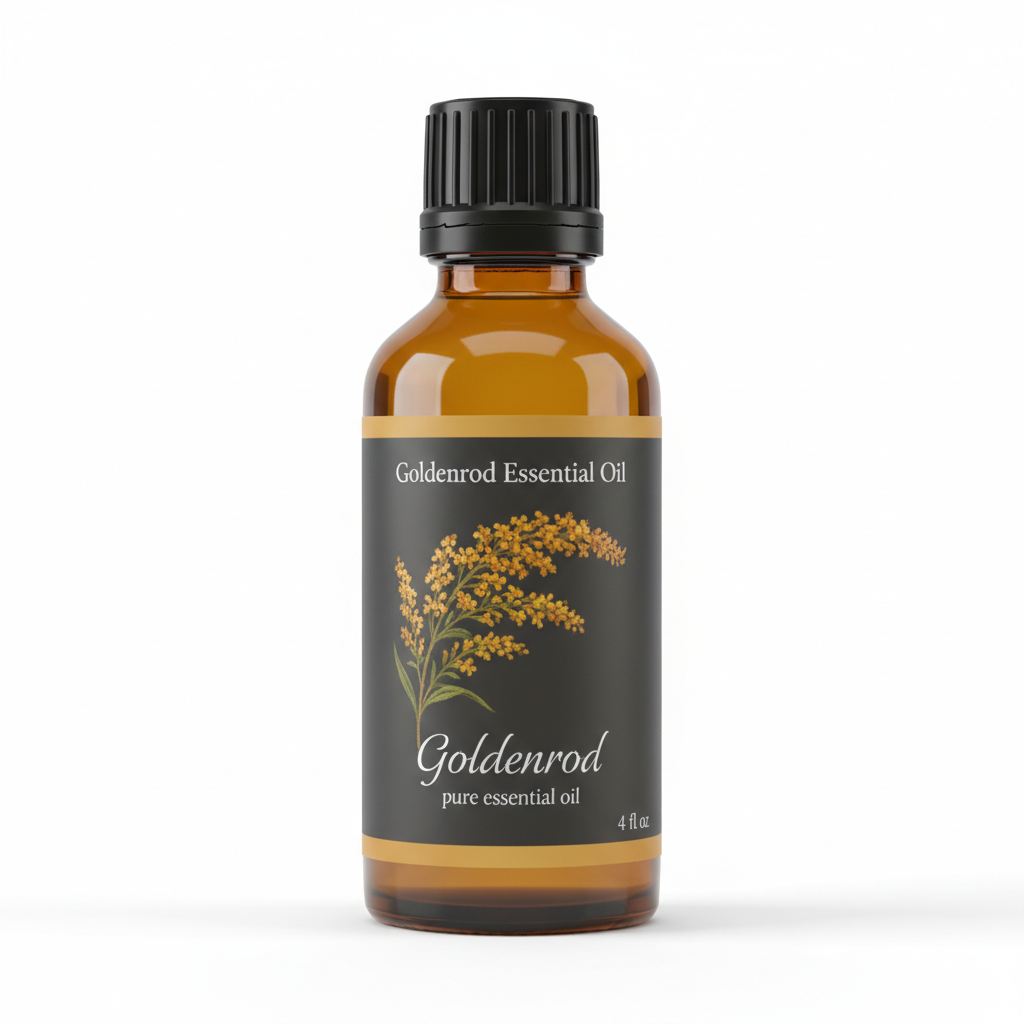
Goldenrod Essential Oil
Our own Goldenrod Essential Oil, in sizes from 0.5 oz to bulk.
From $17.99
Shop Now →Start from a ceiling, in grams
We recommend diluting goldenrod oil to 0.5% to 2% in a carrier before skin use, with a patch test first. For wash-off products, the Tisserand Institute gives 2% to 4% and says that range includes soap and body wash, again for oils without specific restrictions; it lists no goldenrod figure. A bar is on skin for a wash and not for a day, which would explain the higher wash-off range. We still take the lower of the two, 2%, as the most we would put in a bar, and we suggest starting at half that.
Soap makers often quote scent as a share of the oils in the recipe, while skin guidance is about the finished product, so decide which you mean before comparing notes with anyone. The table below works per 1,000 g of finished batter (oils, water and lye together), using the relative density of 0.880 from the Certificate of Analysis we publish for one batch. That batch's best-by date, 01/31/2026, has passed, so treat the density as a planning number.
| Share of batter | Goldenrod oil | Volume at 0.880 |
|---|---|---|
| 0.5% | 5 g | 5.7 ml |
| 1% | 10 g | 11.4 ml |
| 1.5% | 15 g | 17.0 ml |
| 2% | 20 g | 22.7 ml |
Nobody wants to count several hundred drops, so weigh the oil. And mind the two ways of stating the same bar: if your recipe has 650 g of oils in that 1,000 g of batter, 20 g of goldenrod is 2% of the batter but about 3.1% of the oils.
A small chemistry question
Saponification is the reaction that turns fats into soap. As Wikipedia's entry puts it, lye cleaves the ester bonds in triglycerides, releasing fatty acid salts and glycerol. Since lye attacks esters generally, it is natural to wonder about the esters inside an essential oil. In the 2019 analysis of Slovak Solidago canadensis oil, the esters were bornyl acetate (6.3%) and alpha-terpinyl acetate (0.8%), a little over 7% of the oil, while the terpene hydrocarbons made up around 88%.
Reasoning from that, most of goldenrod oil is not the kind of molecule lye goes after, and the part that is makes up a small slice of the oil. That is a hypothesis about where losses could occur, not a measurement of any. How much scent a cured bar keeps depends on your recipe and your cure, and a small test batch is the honest way to find out before you commit a big one.
Lye comes first
The most hazardous thing on your bench is not the essential oil. The CDC's NIOSH Pocket Guide entry for sodium hydroxide lists eye and skin burns and mucous membrane irritation, notes that contact with water can generate enough heat to ignite combustible materials, and advises preventing skin and eye contact, having an eyewash and quick drench available, flushing immediately, and getting medical attention at once if it is swallowed. Work from a soap-making reference you trust for temperatures, trace and cure times, and keep children and pets out of the workspace.
Skin, allergy and age
Goldenrod is a daisy-family plant. DermNet NZ lists it among the Compositae and names sesquiterpene lactones as the family's most important allergens, adding that monoterpenes such as pinene and limonene can also be involved. If you react to ragweed, daisies or chamomile, a goldenrod bar is one to skip or to run past an allergist first, and the same goes for broken or eczema-prone skin, where a doctor is the right person to ask. Our article on pollen versus skin allergy explains why hay fever and skin allergy are separate matters.
It also pays to use fresh oil. The Tisserand Institute notes that heat, light and extra air speed oxidation, and that oxidation products raise the chance of skin reactions. Our oil typically keeps two to three years in a cool, dark place, and if you buy a larger size, decanting a working amount into a smaller airtight bottle keeps the rest sealed. Our storage article goes through the practical steps.
If you sell the soap
The FDA draws a line that is easy to miss. In its guidance on cosmetics, drugs and soap, "soap" means a product whose nonvolatile matter is mostly alkali salts of fatty acids, which cleans because of those compounds, and which is labelled and sold solely as soap. Those products fall to the Consumer Product Safety Commission. Add a cosmetic claim such as moisturising and it is regulated as a cosmetic; add disease-related claims and it may be treated as a drug. Keeping label copy to scent and cleansing keeps things simple. Ingredient lists follow 21 CFR 701.3, which lets fragrance be declared as "fragrance". We do not publish an IFRA certificate or allergen declaration, so if your market needs lot documents, ask us in writing through our contact page.
For ideas on what to scent alongside, we suggest chamomile, lavender, clary sage, citrus, rose and geranium, none of which we sell; our blend partners article covers the logic.
Whatever you decide, make notes as you go: batch weight, oil percentage, the day you cut the bars and the day you first sniff one after curing. In soap making, a notebook is as useful as a thermometer.
A sensible first step is a 100 g test batch at 1%, which is 1.0 g of oil and needs a scale that reads to 0.01 g, then a second smell once you consider the cure finished.
Goldenrod Essential Oil
Goldenrod Essential Oil from our own shop, in sizes from 0.5 oz to bulk.
From $17.99
Shop Now →Sources & Further Reading
- Tisserand Institute. Essential oil dilution. tisserandinstitute.org/dilution-essential-oils
- Wikipedia. Saponification. en.wikipedia.org/wiki/Saponification
- Elshafie HS et al., 2019. Antimicrobial Activity and Chemical Composition of Essential Oil Extracted from Solidago canadensis L. Growing Wild in Slovakia. Molecules. PMC6479883
- CDC NIOSH. Pocket Guide to Chemical Hazards: Sodium hydroxide. cdc.gov/niosh/npg/npgd0565
- DermNet NZ. Compositae allergy. dermnetnz.org
- Tisserand Institute. Oxidized essential oils. tisserandinstitute.org/learn-more/oxidized
- US FDA. Is it a Cosmetic, a Drug, or Both? (Or Is It Soap?). fda.gov
- 21 CFR 701.3, Designation of ingredients. law.cornell.edu/cfr/text/21/701.3