How to Blend Goldenrod Oil: Start With the Percentage
Most blending advice opens with a list of partner oils. We would start a step earlier, with how much oil goes into whatever you are making, because that choice comes before taste. Get the percentage right and the rest is play. This is the order we would work in with a bottle of goldenrod.
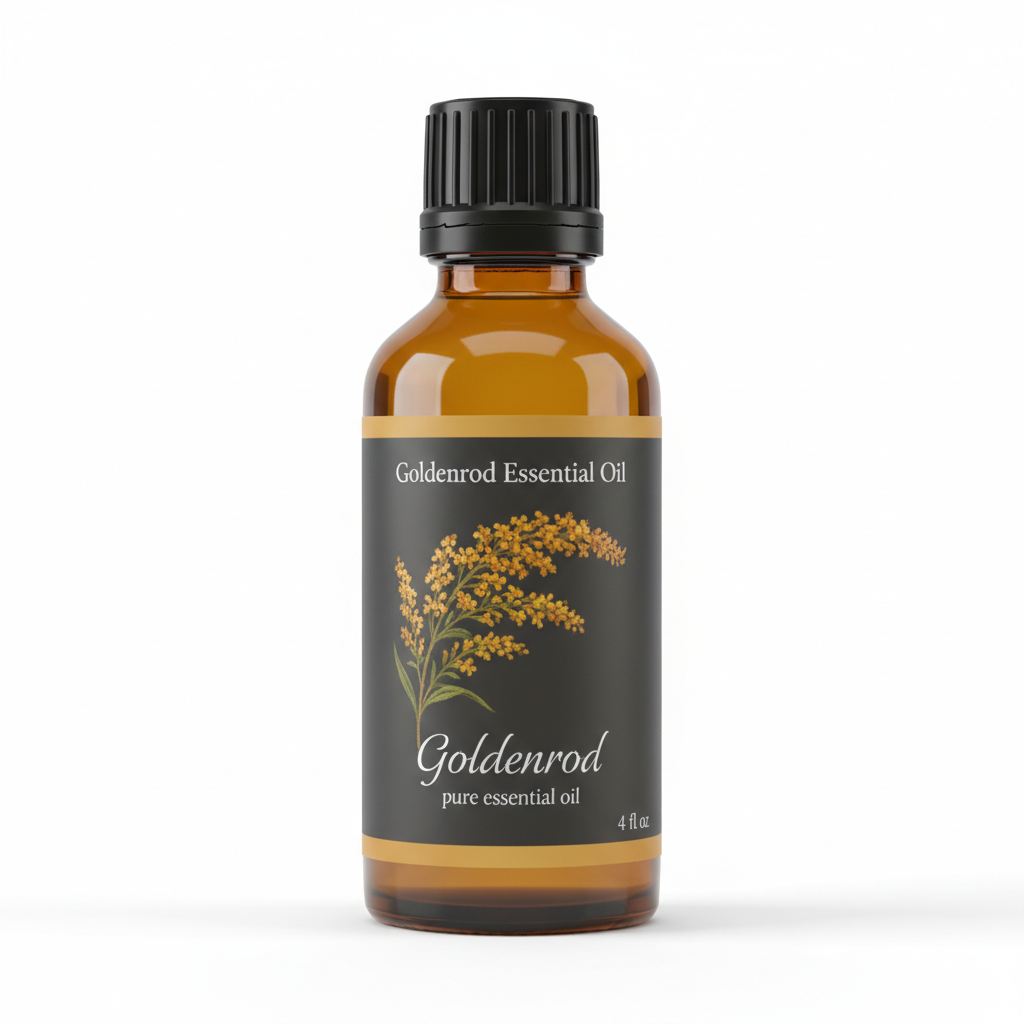
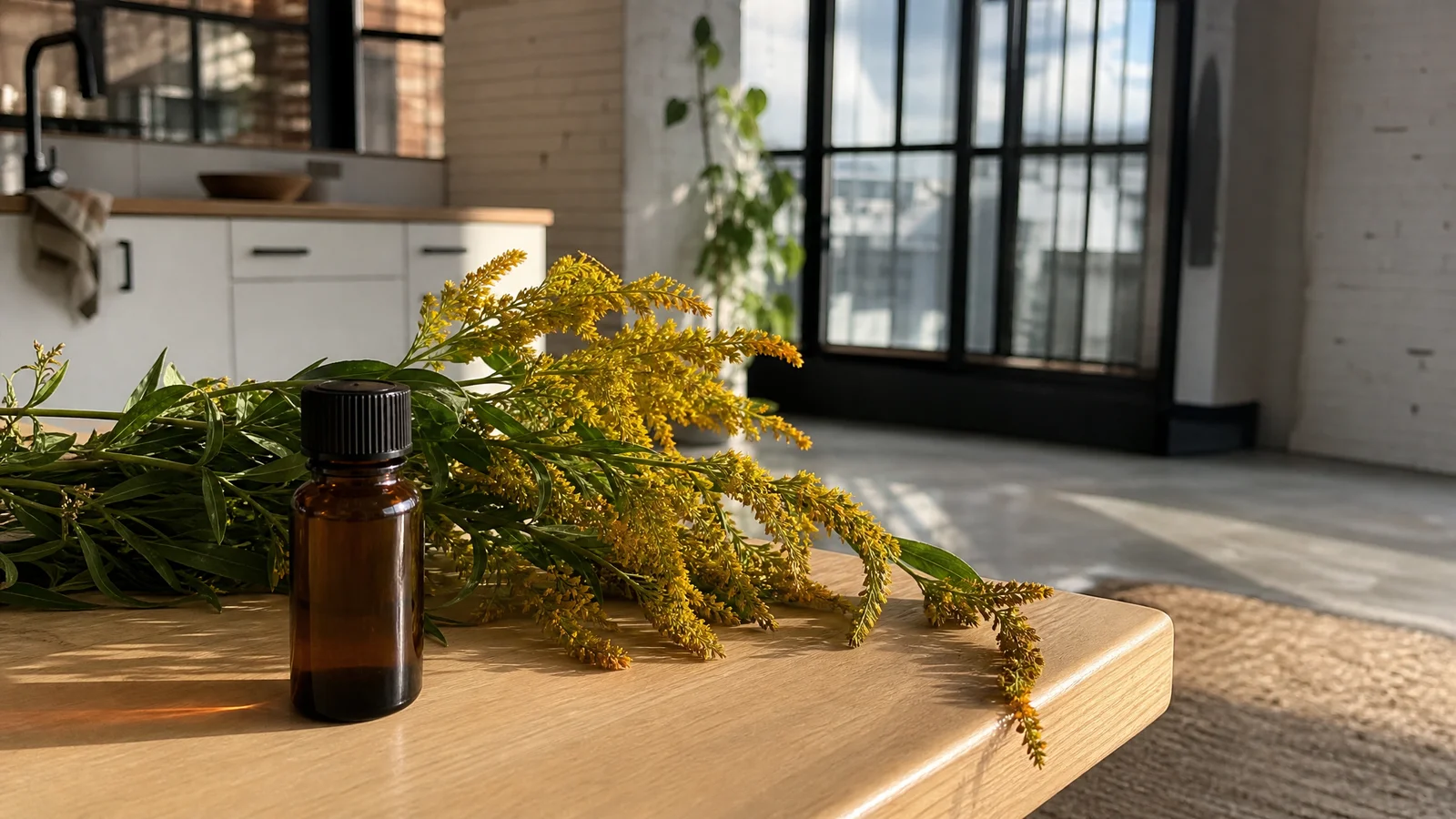
Goldenrod Essential Oil
Our own Goldenrod Essential Oil, in sizes from 0.5 oz to bulk.
From $17.99
Shop Now →Pick the percentage for the use
For skin, we recommend diluting goldenrod to 0.5% to 2% in a carrier oil and patch testing first. The Tisserand Institute publishes general guidelines by product type: 0.2% to 1% for sensitive or compromised skin, 0.5% to 1.2% for facial products and deodorants, 1% to 3% for body oils and lotions, and 2% to 4% for bath and wash-off products. That page does not mention goldenrod specifically, so we treat it as a general frame, and for anything near the face the lower end of our range is the sensible choice.
The percentage applies to the total essential oil, not each oil separately. If goldenrod shares the bottle with other oils, they all count toward the same ceiling.
Do the sums in weight if you can
Drops vary with the bottle and the oil, and about 20 to a milliliter is only a convention. A scale that reads to 0.01 g is kinder to your accuracy. The oil on our certificate has a relative density of 0.880, so a milliliter weighs roughly 0.88 g. The table is a starting point.
| Batch size | 0.5% | 1% | 2% |
|---|---|---|---|
| 10 ml | 0.05 ml (about 1 drop) | 0.1 ml (about 2 drops) | 0.2 ml (about 4 drops) |
| 30 ml | 0.15 ml (about 3 drops) | 0.3 ml (about 6 drops) | 0.6 ml (about 12 drops) |
| 100 ml | 0.5 ml (about 10 drops) | 1 ml (about 20 drops) | 2 ml (about 40 drops) |
In a 10 ml roller, one drop either way moves the strength a lot, which is why small batches are trickier than they look. We sell only the goldenrod, so carriers, scales and bottles come from a craft or carrier-oil supplier.
Know what goldenrod brings
One published analysis of a Slovak Solidago canadensis lot found sesquiterpene hydrocarbons at 55.5% of the oil (germacrene D at 34.9%), monoterpene hydrocarbons at 32.9% (limonene and alpha-pinene the biggest) and a small share of esters such as bornyl acetate. That is one lot, so take it as a sketch. It does suggest that goldenrod shares some compounds with citrus and conifer oils, so in those blends it may read as part of the chorus. That is one reason we like to add goldenrod last, in small steps, and listen for its honeyed, hay-like depth to show up.
Trust your nose as well as your scale
Numbers get you to a safe place, and your nose gets you to a blend you love. Dip one paper strip in your base accord and another in goldenrod alone, wave each gently under your nose, then hold them together. Pay attention to the first few seconds, to what is left after ten minutes, and to what still lingers on the strip the next morning. Goldenrod's honeyed sweetness tends to step forward as the brighter notes fade, so be patient with it.
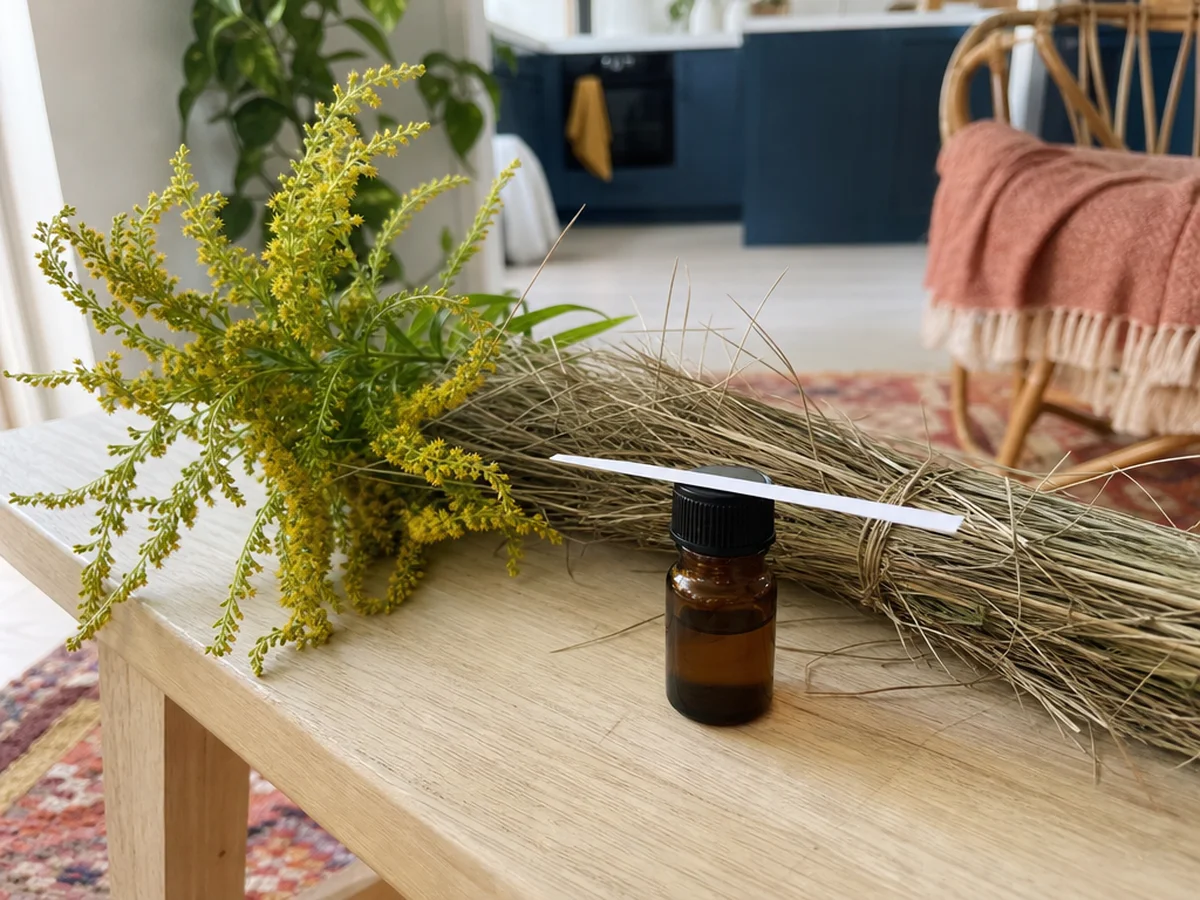
If you do not notice much at first, resist the urge to add more drops. Wait, sniff again, and only then adjust. A small amount smelled carefully teaches you more than a large amount smelled in a hurry.
Change one thing at a time
- Start with a base accord you already like.
- Add goldenrod at the smallest weight you can measure and smell it beside the base alone on a strip.
- Change one variable per trial, either the amount of goldenrod or the partner oil, and write down weights.
- Let the blend rest a few days in a closed amber bottle before judging it, which is common blender practice.
- Only when it smells right, scale to your real batch and recalculate the total percentage.
We recommend goldenrod with chamomile, lavender, clary sage, citrus, rose and geranium, none of which we sell. Chamomile is also a daisy-family plant, so anyone avoiding Asteraceae should skip it. Our partners guide weighs ten candidates, and the diffuser blends and massage oil posts put numbers on a few starting points.
A few ground rules
- Repeat the patch test whenever the blend changes. Our allergy article explains why goldenrod's daisy-family roots call for it.
- Skip dosing for children, pregnancy and pets, and ask a pediatrician, an obstetric clinician or a veterinarian instead.
- Do not take it internally. See why we say no.
- We make no health claims for this oil, so a blend is for aroma.
It also helps to decide the mood in advance. Are you after a meadow in late summer, a warm kitchen, a clean linen cupboard? A single picture in your head keeps you from adding oil after oil just because the bottle is there. When a blend starts to feel crowded, the fix is almost always to take something out, not to put something in.
Keep a log
A blend you can remake is worth more than one you got lucky with. Note the date, lot number, weights, carrier, percentage and a line of smell notes at fresh, one hour and one day. If your lot changes, repeat the trial before assuming it carries over, as our lot comparison guide explains.
One small tip from the bench: keep a plain notebook and a pencil beside the scale. Pencil survives a drop of oil far better than most pens, and a notebook propped against the scale makes you actually write the numbers down before you forget them.
Blending is slow, happy work, and goldenrod rewards patience. Weigh carefully, change one thing at a time, and let the meadow in a drop at a time.
Goldenrod Essential Oil
Goldenrod Essential Oil from our own shop, in sizes from 0.5 oz to bulk.
From $17.99
Shop Now →Sources & Further Reading
- Tisserand Institute. Dilution for essential oils. tisserandinstitute.org/dilution-essential-oils
- Elshafie HS et al. Antimicrobial Activity and Chemical Composition of Essential Oil Extracted from Solidago canadensis L. Growing Wild in Slovakia. Molecules, 2019. pmc.ncbi.nlm.nih.gov/articles/PMC6479883