Goldenrod Essential Oil Benefits: It Starts With Scent
Ask what goldenrod essential oil is good for and the honest, happy answer starts with the smell. It is a honeyed, grassy, floral oil with a soft sweetness settling into a faintly balsamic, hay-like base, and it brings the feeling of a late-summer meadow to a diffuser, a perfume or a candle. That is the benefit we sell it for, and we make no health claims beyond it.
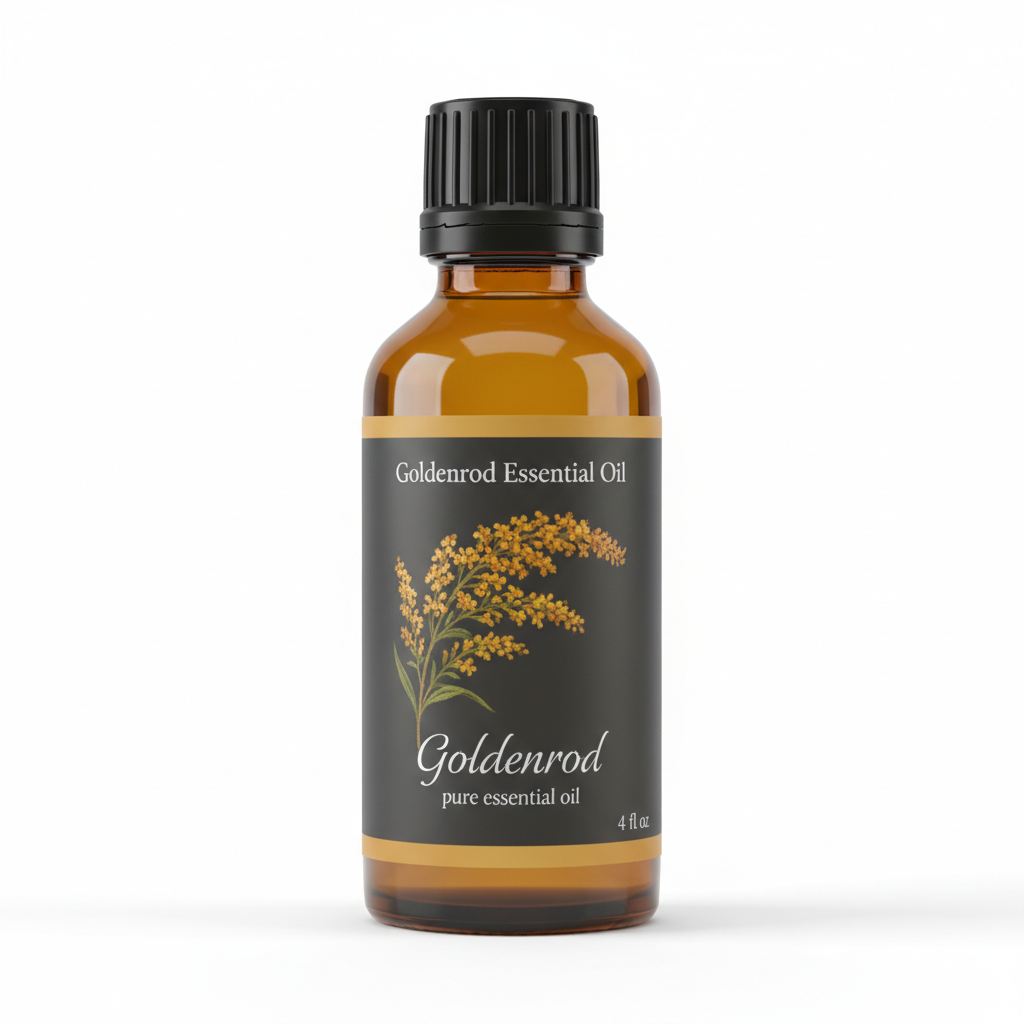
Goldenrod Essential Oil
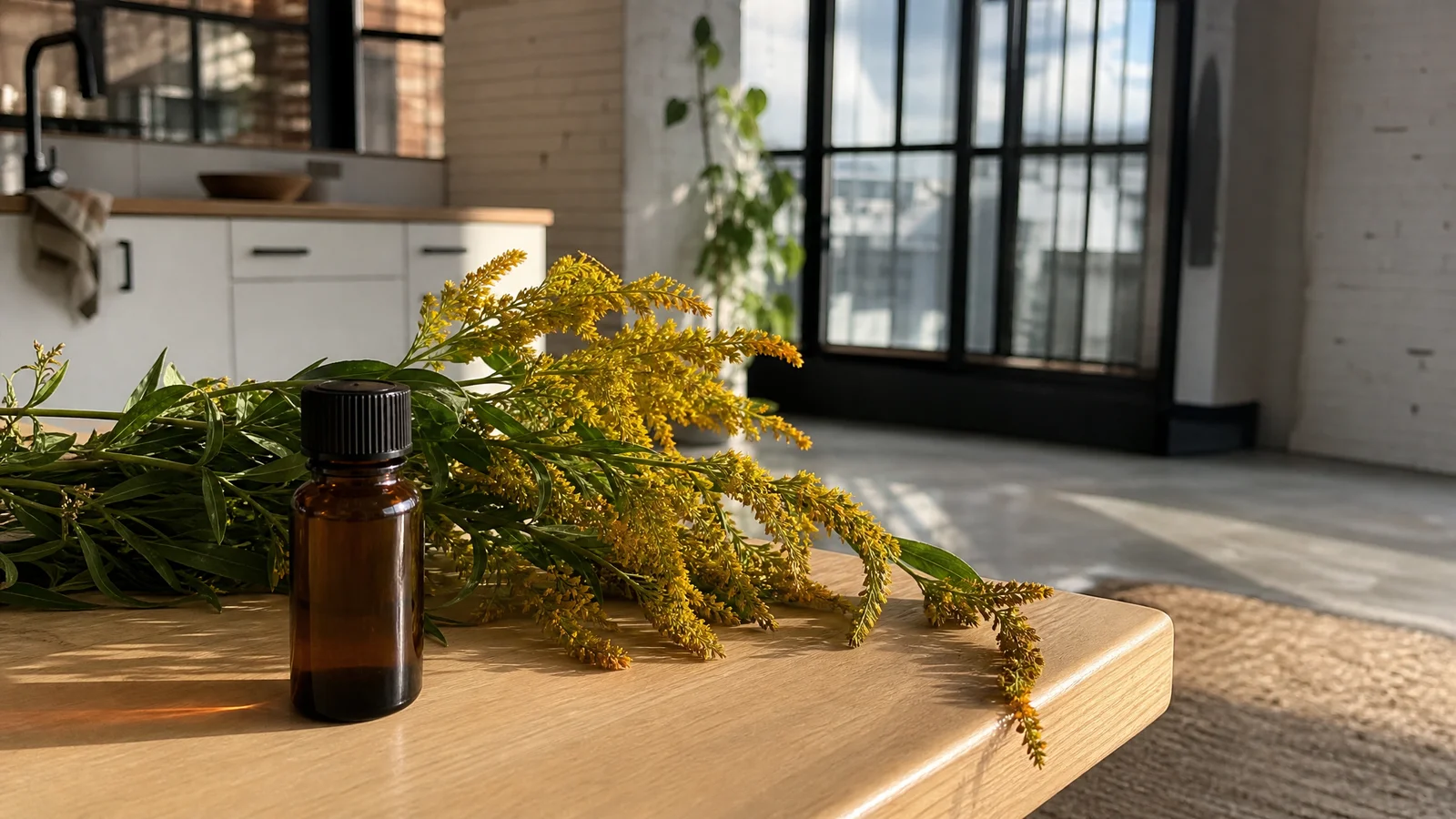
Our own Goldenrod Essential Oil, in sizes from 0.5 oz to bulk.
From $17.99
Shop Now →The benefit we do stand behind: aroma
Goldenrod is a middle note, which means it works in the heart of a blend rather than at the sparkling top or the lingering base. We recommend it alongside chamomile, lavender, clary sage, citrus, rose and geranium, and it suits meadow-inspired home fragrance, late-summer diffusing and perfumery. Our scent profile goes into more detail, and the partners guide shows how to build around it.
What the scent is like in use
Open the bottle and the first thing you will probably notice is sweetness, something like warm honey, followed by dry grass and then a soft, hay-like depth. In a diffuser it makes a room smell like a meadow on a late-summer afternoon. In a perfume it sits in the heart, between the bright opening and the lingering base. For candle makers and soap makers it is a quiet, natural-smelling option when the goal is a meadow-inspired home fragrance, though we sell only the oil and none of the bases.
How to get to know it
The best way to understand an aroma is slowly. Put a drop on a paper strip and smell it fresh, again after ten minutes, and again after an hour. Write down plain words: honey, hay, green, floral, whatever comes to mind. Do it on another day too, since your nose is not the same every morning. If you are new to the oil, start with our smallest bottle, because a scent you love is worth far more than a big bottle you are unsure about.
Why web "benefits" lists confuse three different things
Search for goldenrod benefits and you will find claims that mix up three quite different materials.
- Goldenrod herb taken as a tea or extract. This is where most of the traditional-use reputation comes from. European regulators list Solidago virgaurea herb as a herbal medicinal product. That is a different species and a different material from our external aroma oil.
- The essential oil in laboratory studies. The published work we have read on Solidago canadensis oil is bench science. One study analysed a wild Slovak sample, where germacrene D led at 34.9%, and tested the oil against crop-spoiling fungi and bacteria in dishes. Another compared flowers, leaves and stems and tested the oil against a mulberry pathogen. Neither involved a person.
- The oil on skin or in the air. We know of no study of goldenrod oil here, and the general aromatherapy literature does not single it out.
Put simply, the studies are about different things from the bottle on your shelf, and we would not want anyone to read a result about a fungus on an agar plate as a promise about a person.
What the aromatherapy authorities say in general
The US National Center for Complementary and Integrative Health describes aromatherapy as oils most often inhaled or applied diluted to the skin, and notes that for sleep, little rigorous research has been done. Goldenrod is not among the oils it names. We mention this because it is a sensible general frame for any essential oil: pleasant aroma is real, and bigger claims need evidence we do not have.
If you are buying the oil as a gift, a piece of advice: tell the recipient it is a scent oil for diffusing and perfumery work, not a remedy, and pass along the dilution and patch test guidance below. Honest descriptions make for happier gifts.
It is worth saying that scent is a personal thing. Two people can smell the same bottle and describe it quite differently, one finding it sweet and honeyed and the other mostly grassy and dry. Neither is wrong. If a friend smells it and wrinkles their nose, that tells you about their nose, and nothing about the oil.
Using it well
If you want to enjoy goldenrod, here is how we would go about it.
- Dilute to 0.5% to 2% in a carrier oil before any skin use, and patch test first. That is about 3 to 12 drops per fluid ounce of carrier, at roughly 20 drops per milliliter. Our skin basics post walks through it.
- Keep it away from eyes, children and pets, and do not take it internally.
- Know the family. Goldenrod belongs to the daisy family, Asteraceae, which DermNet describes as a source of a well-known contact allergy. If you react to ragweed, daisies or chamomile, ask an allergist or dermatologist before using it on skin. Our allergy article covers it.
If you have a symptom or a health question, a physician or pharmacist is the right person to ask, not a product page. Goldenrod tea and extracts are herb products sold by herb suppliers, and we sell only the essential oil.
We would rather you love the smell than take our word for anything. That is the whole offer, and it is why we keep the promises small.
What is left, when you set the health talk aside, is a lovely and unusual oil that smells like the end of summer. For many people that is plenty, and it is exactly what the uses guide is built around.
Goldenrod Essential Oil
Goldenrod Essential Oil from our own shop, in sizes from 0.5 oz to bulk.
From $17.99
Shop Now →Sources & Further Reading
- Elshafie HS et al. Antimicrobial Activity and Chemical Composition of Essential Oil Extracted from Solidago canadensis L. Growing Wild in Slovakia. Molecules, 2019. pmc.ncbi.nlm.nih.gov/articles/PMC6479883
- Yang JX et al. Multivariate Statistical Analysis of Solidago canadensis L. Essential Oil and Its Antifungal Mechanism Against Mulberry Sclerotinia Diseases. 2025. europepmc.org/article/MED/41515927
- European Medicines Agency. Solidaginis virgaureae herba, herbal medicinal product. ema.europa.eu/en/medicines/herbal/solidaginis-virgaureae-herba
- National Center for Complementary and Integrative Health. Aromatherapy. nccih.nih.gov/health/aromatherapy
- DermNet. Compositae allergy. dermnetnz.org/topics/compositae-allergy