Is Goldenrod Essential Oil Safe to Ingest? What to Know
No, and we would rather say it before anything else. Goldenrod essential oil is a concentrated aroma material, and it does not belong in food, drinks or capsules. If someone has already swallowed some, jump to the section just below and call a poison center now.
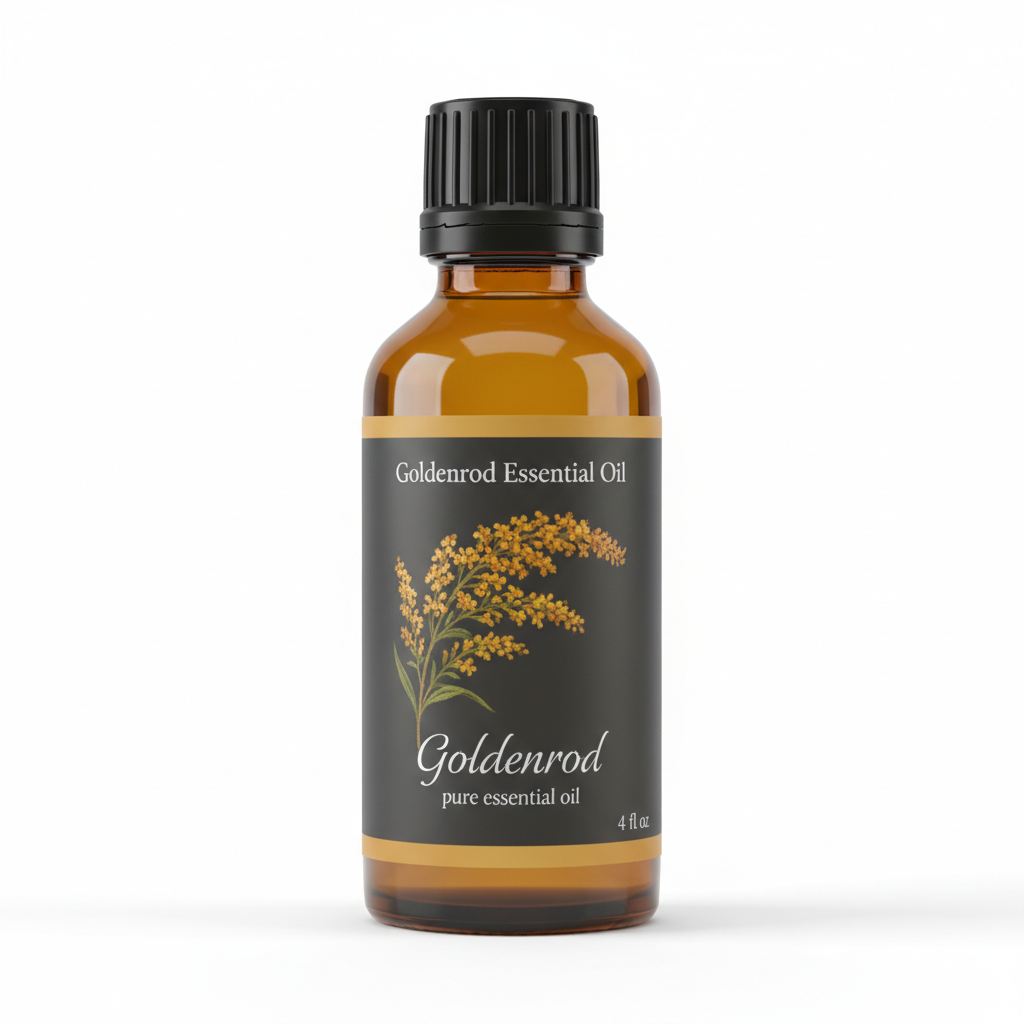
Goldenrod Essential Oil
Our own Goldenrod Essential Oil, in sizes from 0.5 oz to bulk.
From $17.99
Shop Now →If it has already happened
The Missouri Poison Center's essential oil page gives the first steps: take the bottle away, wipe out the mouth with a soft wet cloth, and give a serving-size amount of water to drink. If there was any coughing, gagging or choking, call the poison center right away, because oil that slips into the lungs can cause serious problems. The number is 1-800-222-1222, open around the clock. Keep the bottle nearby so you can read the oil name and size aloud to whoever answers. For anyone struggling to breathe or unresponsive, use your local emergency number instead.
Why concentration is the whole story
The same page explains that the danger from swallowing comes mainly from undiluted oil. It irritates the back of the throat and sets off coughing, gagging and choking, and during that choking some oil can reach the lungs and lead to chemical pneumonia. Even a small taste can cause vomiting, and some oils are more hazardous than others. No one has published a safe amount to quote for goldenrod, so we will not invent one.
How common this is shows up clearly in Australian data. Researchers looked at essential oil calls to the NSW Poisons Information Centre between July 2014 and June 2018: 4,412 exposures, 63% of them in children under 15, and roughly half in toddlers aged 1 to 4. About 80% were accidental. Eucalyptus, tea tree and lavender led the list, and goldenrod was not among the top five. It is a call-center tally, so it cannot say how many cases were swallowing rather than spills or skin contact, but it describes the pattern well: small children and open bottles.
Why the question keeps coming up
We understand why people ask. Goldenrod tea has been written about for a long time, wellness pages are full of oils in water bottles, and the word "natural" sounds reassuring. Putting those ideas together, it is a short hop to wondering about a drop in a glass.
Our answer stays the same, and it is a kind one: we sell an aroma oil, and we would rather you enjoy it through the nose and on well-diluted skin than take a chance you do not need to take. If your real interest is the taste of the plant, that is a conversation to have with a pharmacist about a proper dried herb.
"But it is only one drop in water"
This is the version people usually reach for, and a little physics speaks against it. The certificate we publish for one batch gives a relative density of 0.880, lighter than water, and essential oils do not dissolve in water in any useful amount. A drop in a glass floats on top as a film, so the first sip meets the oil at close to full strength on the lips and throat. That is reasoning from documented properties rather than from a test of the trick itself, but it points the same way as the poison center's account of what goes wrong.
Why "food grade" does not settle it
FDA's aromatherapy page makes a helpful point from the other side. Many plant materials are irritating or allergenic on the skin, and cumin oil, which is used safely in food, can blister skin. Every cosmetic must meet the same safety requirement whatever its source. The page does not discuss swallowing essential oils, so we do not read it as saying anything about that. It simply shows that "comes from a plant" and "fine on the body" are separate questions.
Goldenrod tea is a different thing
Search results blur two materials. Goldenrod tea is made from dried herb, usually of a European species, Solidago virgaurea, and it has its own rules, which we cover in our tea article. A 2020 review of that plant notes that most pharmacological findings come from extracts, fractions or isolated compounds rather than the oil. So tea is not a small dose of the oil, and the oil is not a strong tea. Our herb versus oil article has more.
A few kitchen habits that help
- Keep essential oils out of the kitchen cupboard that holds spices and flavorings, since small bottles look alike on a busy shelf.
- Put the cap back on straight away, even if you are only stepping out of the room.
- Never decant oil into a drinking glass, a food jar or an unlabeled bottle, even for a minute.
- Tell everyone who lives with you where the oils are kept and why.
What we recommend instead
Our guidance for the oil is simple. Never apply it undiluted. For skin, dilute to 0.5% to 2% in a carrier oil and patch test first. Keep it away from eyes, children and pets, and do not take it internally. Store it cool and dark. If you love the scent, enjoy it in the air with the ideas in our diffuser blend article, or diluted on skin following our skin basics guide. For questions about pregnancy, a child or a pet, a physician, pediatrician or veterinarian is the right person.
Cap the bottle, put it up high, and keep the poison center number somewhere you can find it before you need it.
Goldenrod Essential Oil
Goldenrod Essential Oil from our own shop, in sizes from 0.5 oz to bulk.
From $17.99
Shop Now →Sources & Further Reading
- Missouri Poison Center. Essential Oils. missouripoisoncenter.org/is-this-a-poison/essential-oils
- Lee K.A.Y.R., Harnett J.E., Cairns R., 2020. Essential oil exposures in Australia: analysis of cases reported to the NSW Poisons Information Centre. Medical Journal of Australia. mja.com.au
- U.S. Food and Drug Administration. Aromatherapy. fda.gov/cosmetics/cosmetic-products/aromatherapy
- Fursenco C. et al., 2020. Solidago virgaurea L.: A Review of Its Ethnomedicinal Uses, Phytochemistry, and Pharmacological Activities. Biomolecules 10(12):1619. PMC7761148