Goldenrod Oil FAQ: 10 Questions Before You Buy
Before a first bottle of goldenrod oil comes home, ten questions tend to matter most: what it is, how it smells, how to keep it, where it goes on skin and where it does not. We sell one product, a goldenrod essential oil (Solidago canadensis), sold undiluted, so we answer plainly and point you to the right professional where a question belongs to a doctor, a vet or the kitchen.
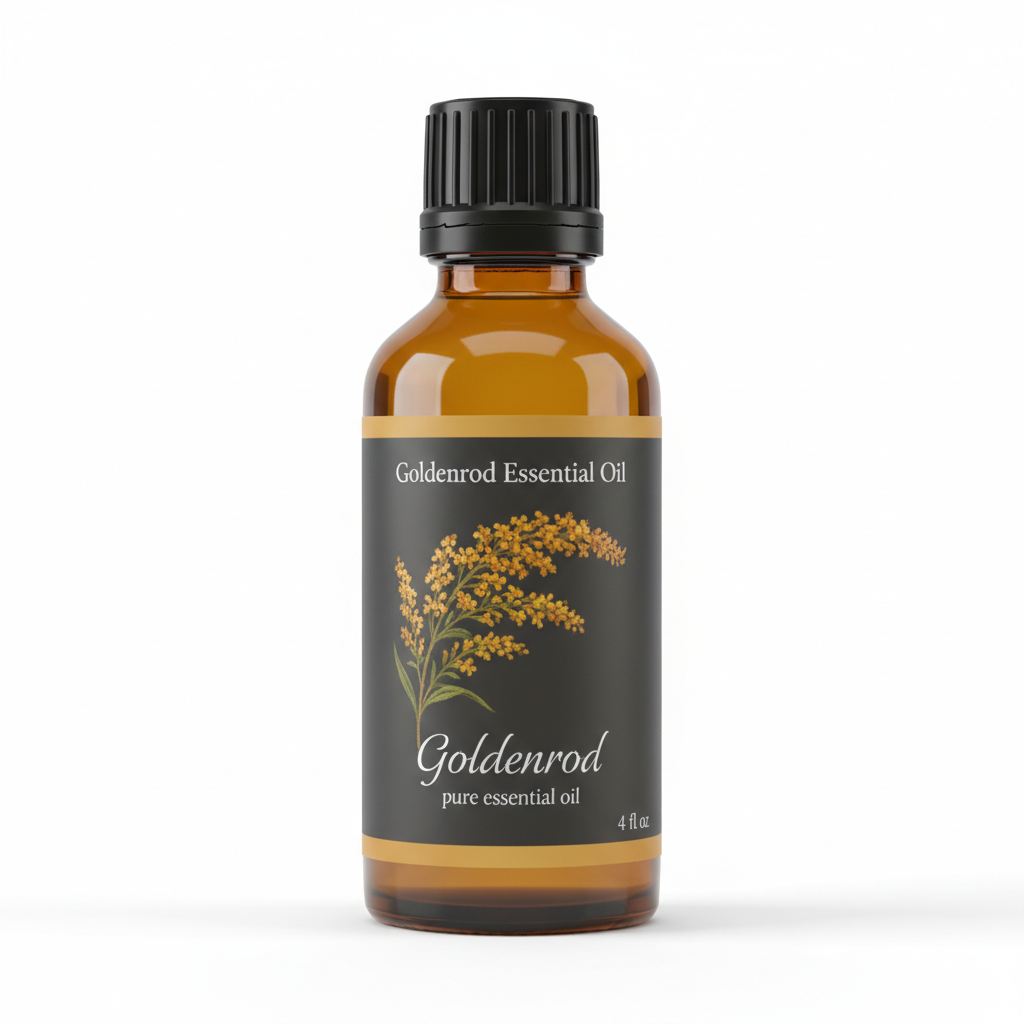
Goldenrod Essential Oil
Our own Goldenrod Essential Oil, in sizes from 0.5 oz to bulk.
From $17.99
Shop Now →Before you buy
What is goldenrod essential oil?
Ours is steam-distilled and sold undiluted with no additives or fillers, in limited seasonal batches because late-summer yields are modest. It is not goldenrod fragrance oil (a composed scent), not an infused oil (flowers steeped in a carrier), not tea, not goldenseal and not the pump oiler sold under the Goldenrod brand. We sell none of those. Our complete guide sorts them out at length.

What does it smell like?
Honeyed, grassy and floral, with a soft sweetness settling into a faintly balsamic, hay-like base. It sits in the middle of a perfume's structure. Scent is personal, so a small bottle is a sensible first step. Chamomile, lavender, clary sage, citrus, rose and geranium all blend well with it; those come from a perfumery-supplies seller, as we sell only goldenrod.
Which goldenrod is it?
Our label names Solidago canadensis. That name is narrower than many people expect: the University of Waterloo's goldenrod pages use it for two races native to the northeastern quarter of the United States and adjacent Canada, with plants from further north now placed in other species. If species confirmation matters to you, ask us in writing through our contact page before ordering. And a label that names the plant part tells you more than one that does not, since a 2025 study found flowers, leaves and stems from one population gave different oil yields.
How can I judge quality?
Not from one document. A 2021 study in Molecules found that diluting an oil with vegetable oil left its normalized GC-MS percentages essentially unchanged, and that adulteration is confirmed only against a reliable profile of the genuine oil. So ask for a lot number and the paperwork for your lot. The certificate of analysis we publish is for one batch and lists density, refractive index and optical rotation; if you need a constituent profile, ask us. Our seller vetting guide explains what each document can show.
A few words on first impressions
When the bottle arrives, give it a moment. Uncap it, hold it a little way from your nose and breathe slowly. You'll notice honey and cut grass first and the drier, hay-like note a little later. Scent is personal, and the first sniff is not always the one you end up loving. Come back to it a few times over a day or two before you decide.
Using and storing it
How long does it last?
We say typically 2 to 3 years in a cool, dark place away from heat and sunlight. The Tisserand Institute is a touch more cautious, noting that most oils keep well for at least 1 to 2 years, that heat, light, moisture and extra air speed oxidation, and that refrigeration roughly doubles life. In practice, buy what you will finish within a year and recap the bottle each time. More in our storage article.
Can it go on skin?
Only diluted: we recommend 0.5% to 2% in a carrier oil, with a patch test first. For comparison, the Tisserand Institute's general ranges run 0.5% to 1.2% for the face and underarms and 1% to 3% for body oils, so the upper half of ours suits body use best. Skip broken skin. In a fluid ounce of carrier (29.57 ml), 1% is about 0.3 ml of oil, roughly 6 drops at the usual 20 drops per ml. The skin basics article has the full arithmetic.
Safety questions
I react to ragweed or daisies. What now?
Ask a dermatologist before you buy. Goldenrod is in the daisy family, and DermNet lists it among the common names of Compositae plants, whose main allergens, sesquiterpene lactones, often cross-react. Diagnosis is by patch test. Our allergy article separates pollen from skin allergy.
What about pregnancy, children and pets?
We keep it away from children and pets, and Poison Control says essential oils in a home must be locked up out of sight and reach of both. For pregnancy or nursing, ask your OB/GYN or midwife; for a child, a pediatrician; for an animal, a veterinarian. Our pets article goes into more detail.
Can I swallow it or make tea with it?
No. Poison Control says some essential oils can be poisonous if swallowed, and the poison center number is 1-800-222-1222 if it happens. Goldenrod tea is made from dried herb and has its own rules, in our tea article.
Does it have health benefits?
We make no health claims for goldenrod. Published work on the oil is mostly composition analysis and laboratory tests: one study analyzed a Slovak sample, and another compared the oil from flowers, leaves and stems of plants collected in Jiangsu, China. Neither is a human trial. For a health question, a physician or pharmacist is the right person to ask.
If you are new to essential oils, our advice is simple: start with the smallest size, read the label slowly, and give the bottle a few breaths before you decide on it.
One more thing before your first bottle arrives: clear a spot for it. A cool, dark cupboard, out of reach of children and pets, is the best home for any essential oil, and it takes a minute to set up.
If your question is not here, our contact page is the place to ask.
Goldenrod Essential Oil
Goldenrod Essential Oil from our own shop, in sizes from 0.5 oz to bulk.
From $17.99
Shop Now →Sources & Further Reading
- University of Waterloo Astereae Lab. Solidago canadensis (classification and illustrations). uwaterloo.ca/astereae-lab
- Capetti F. et al., 2021. Molecules 26(18):5610. PMC8471154
- Yang et al., 2025. Int J Mol Sci 27(1):49, Solidago canadensis oil from flowers, leaves and stems. PMC12785313
- Elshafie H.S. et al., 2019. Molecules 24(7):1206, Solidago canadensis oil composition and activity. PMC6479883
- Tisserand Institute. Dilution for essential oils. tisserandinstitute.org/dilution-essential-oils
- Tisserand Institute. Is my bottle of essential oil oxidized? tisserandinstitute.org/learn-more/oxidized
- Poison Control (National Capital Poison Center). Essential oils: Poisonous when misused. poison.org/articles/essential-oils
- DermNet. Compositae allergy. Sesquiterpene lactone contact allergy. dermnetnz.org/topics/compositae-allergy