Goldenrod Oil Price Comparison: What You Really Pay For
One number explains most of what you will see on a goldenrod oil listing. In a laboratory study of Solidago canadensis, a kilogram of dried plant gave about 2.7 grams of oil. At that rate, a half-ounce bottle stands for nearly five kilograms of dried goldenrod. So the useful question is not who has the lowest price, but what exactly each price is buying.
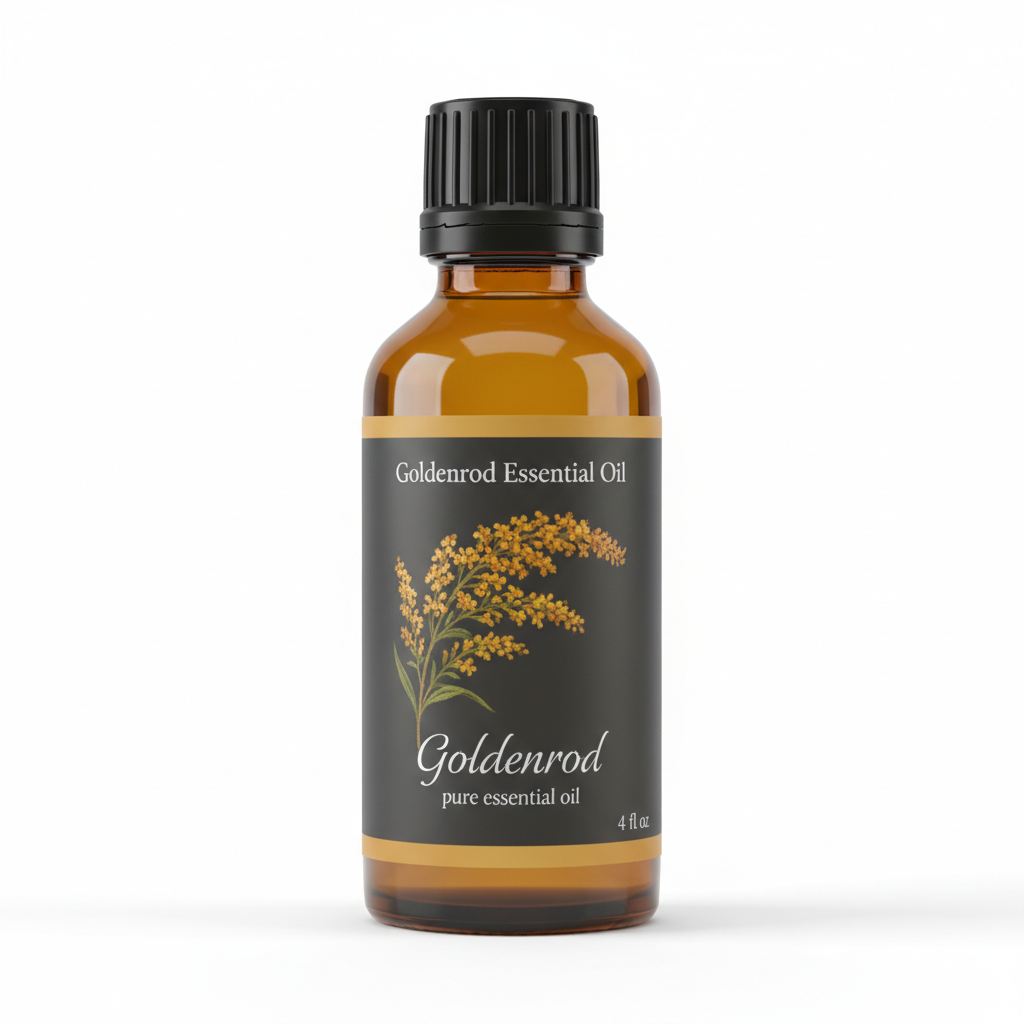
Goldenrod Essential Oil
Our own Goldenrod Essential Oil, in sizes from 0.5 oz to bulk.
From $17.99
Shop Now →Where the cost comes from
Elshafie and colleagues collected wild goldenrod at full bloom in Slovakia, dried it for two weeks and distilled 20-gram portions for two hours. The yield was 0.27% of the dry weight. The authors are clear that yield and composition depend on climate, harvest timing and method, so treat 0.27% as one honest data point and not a rule. Still, it shows why goldenrod oil is a plant-heavy oil: the flowers bloom for a few weeks each late summer, and a lot of material goes in for a small amount of oil coming out.
The same arithmetic is why we offer limited seasonal batches. If you are curious how the oil is made, our steam distillation explainer walks through it, and this article covers why you do not see it everywhere.
Fix the unit before you compare the price
Most price confusion starts with the abbreviation "oz". US cosmetic labeling rules (21 CFR 701.13) have liquids declared in fluid measure and weight declared as net weight, and a listing that just says "1 oz" has not told you which one. For an oil with a relative density of 0.880, which is the figure on the Certificate of Analysis we publish for one batch, the two are not the same amount of oil.
| Listed size | If fluid ounces | If ounces by weight |
|---|---|---|
| 0.5 oz | 14.79 ml | 14.17 g, about 16.1 ml |
| 1 oz | 29.57 ml | 28.35 g, about 32.2 ml |
| 4 oz | 118.29 ml | 113.40 g, about 128.9 ml |
That is roughly a 9% difference in volume, enough to flip which of two similar listings looks cheaper. Convert both to milliliters (or both to grams), divide the price by the amount, and only then compare. Sizes in pounds work the same way: one pound is 453.6 grams, or about 515 ml at 0.880.
One more thing we like to say out loud: a fair price should leave room for the seller to be careful, and a careful seller is usually happy to answer questions. A friendly reply to a plain question tells you more than a discount does.
A very low price per milliliter is a reason to ask a question
Once the units match, you will sometimes meet a figure far below everyone else's. That does not prove anything is wrong, since sellers buy and bottle differently, but it is worth a question. A 2021 study by Capetti and colleagues on lavender, lemon and tea tree is a useful reminder of why. Adding vegetable oil to an essential oil leaves the usual chromatography percentages essentially unchanged, so a standard report cannot reveal it. In one commercial lavender sample the researchers estimated 40% to 50% dilution, and only by measuring absolute amounts.
The practical takeaway is gentle. Ask whether the bottle is sold undiluted, and ask what paperwork exists for the lot. We sell our goldenrod oil neat, with no additives or fillers, in every size from 0.5 oz up to 400 lb, and it is the same oil at each size, produced to one standard here and not a separate bulk grade. Our seller-vetting guide lists what each document can and cannot show, and the label-reading guide covers the printed side.
What to look at in the bottle itself
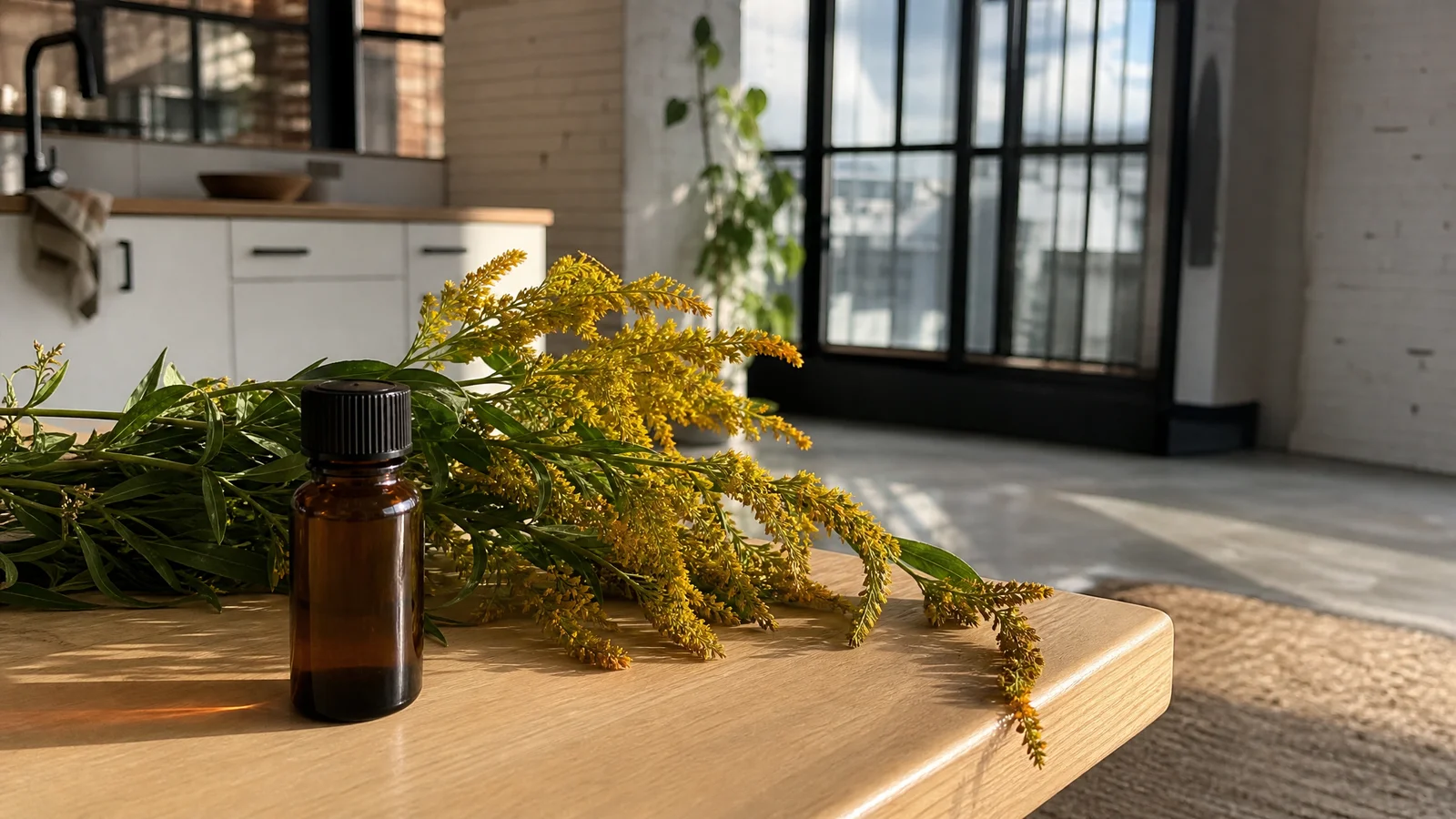
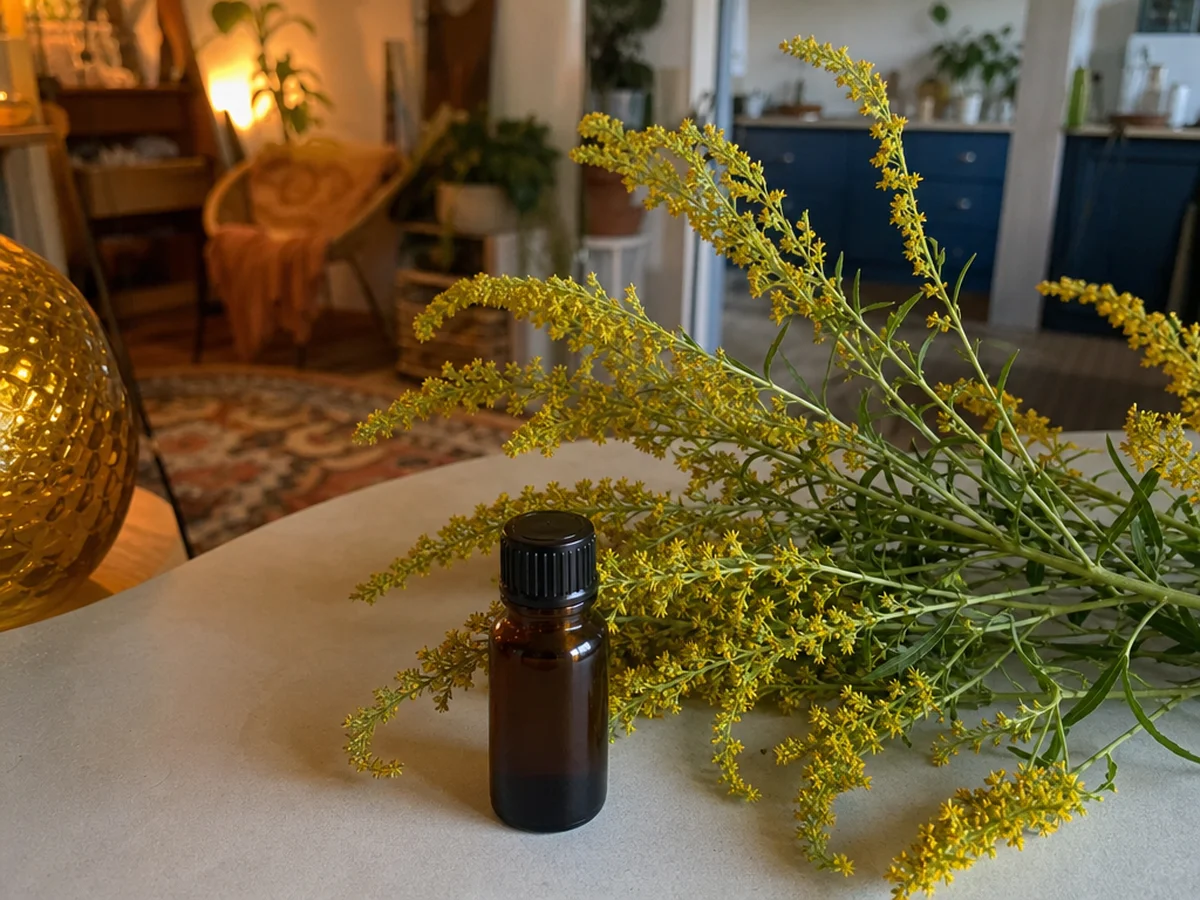
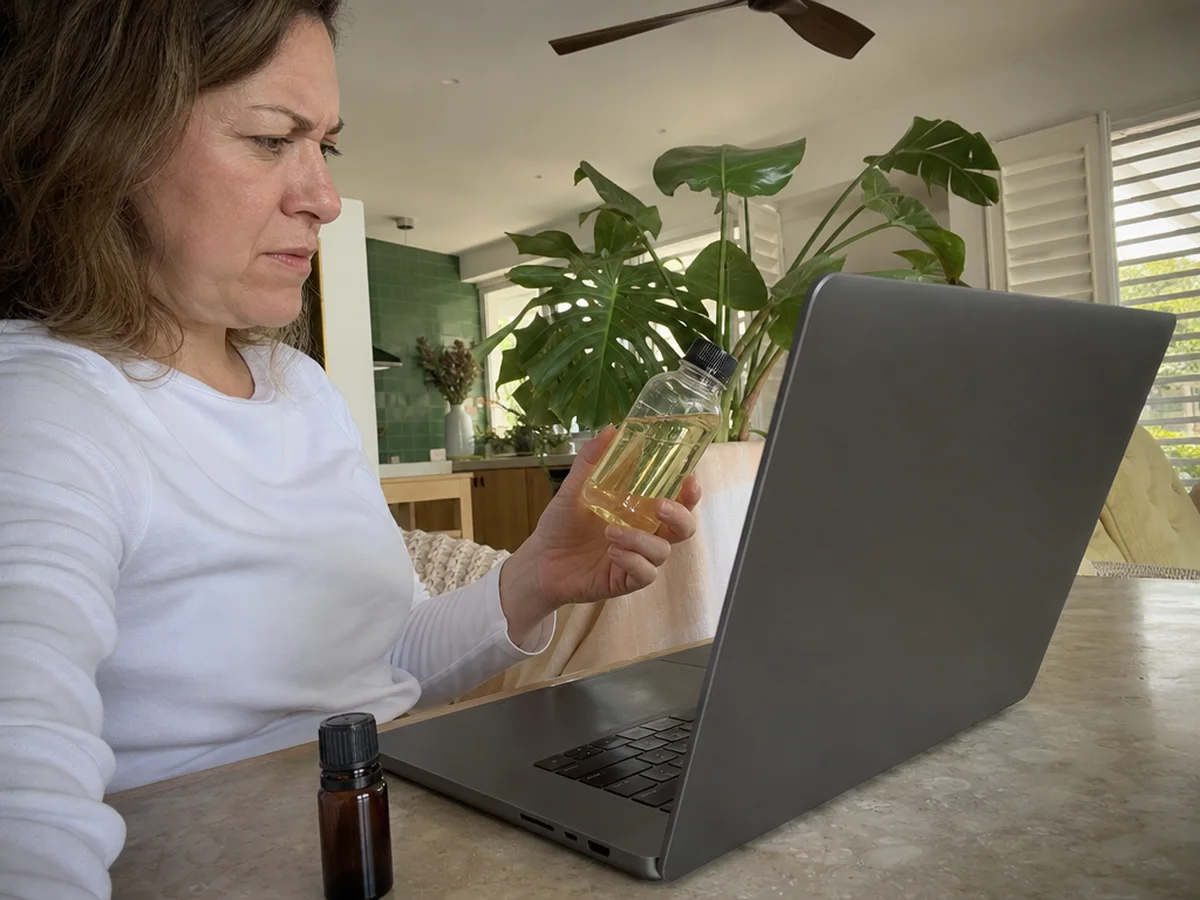
Numbers on a screen are only half of a comparison. When a bottle arrives, you can learn a lot with your eyes and nose. Check whether the glass is dark, since light is not kind to essential oils. Check that the label carries a Latin name and some kind of lot number, because that is what lets you ask questions later. Then put a drop on a paper strip and smell it on its own, away from other scents. Our goldenrod oil is honeyed, grassy and floral, with a soft, hay-like base, and a good oil of any kind should smell like itself, not like something sweetened or smoothed over.
How to use size to your advantage
Small bottles suit a first try, a perfume sketch or a single batch of something. Larger sizes make sense when you know your usage, because an opened bottle is still a bottle of oil sitting in air, and goldenrod keeps best cool and dark. For a mid-size buyer the sensible path is often a sample first, then the size that matches what you will really use in a season. If you are weighing a larger order, our wholesale page explains samples and private label, and the bulk page lists the larger sizes.
A short checklist before you order
- Write the size in milliliters or grams for every listing, so you are comparing like with like.
- Note whether the oil is sold neat or diluted, and whether the seller says so plainly.
- Look for the Latin name, the plant part and a lot number on the label.
- Ask what paperwork exists for your lot, and whether you can see it before you commit.
Price per milliliter is a good tool, as long as the milliliters are real and the question after it gets asked. A small bottle you will finish in good time is usually better value than a large one that sits half full.
Goldenrod Essential Oil
Goldenrod Essential Oil from our own shop, in sizes from 0.5 oz to bulk.
From $17.99
Shop Now →Sources & Further Reading
- Elshafie H.S. et al., 2019. Antimicrobial Activity and Chemical Composition of Essential Oil Extracted from Solidago canadensis L. Growing Wild in Slovakia. Molecules. pmc.ncbi.nlm.nih.gov/articles/PMC6479883
- Capetti F. et al., 2021. Adulteration of Essential Oils: A Multitask Issue for Quality Control. Three Case Studies: Lavandula angustifolia Mill., Citrus limon (L.) Osbeck and Melaleuca alternifolia (Maiden & Betche) Cheel. Molecules 26(18):5610. pmc.ncbi.nlm.nih.gov/articles/PMC8471154
- Code of Federal Regulations. 21 CFR 701.13, Net quantity of contents statement. law.cornell.edu/cfr/text/21/701.13