Goldenrod Oil During Pregnancy: What Sources Say
If you are pregnant or nursing and wondering whether goldenrod oil has a place in your routine, the kind answer is a short one: ask your midwife, obstetrician or pharmacist before you open the bottle. Goldenrod essential oil has not been studied in pregnancy, and that silence is worth understanding rather than skimming past. Here is what the nearest documents say.
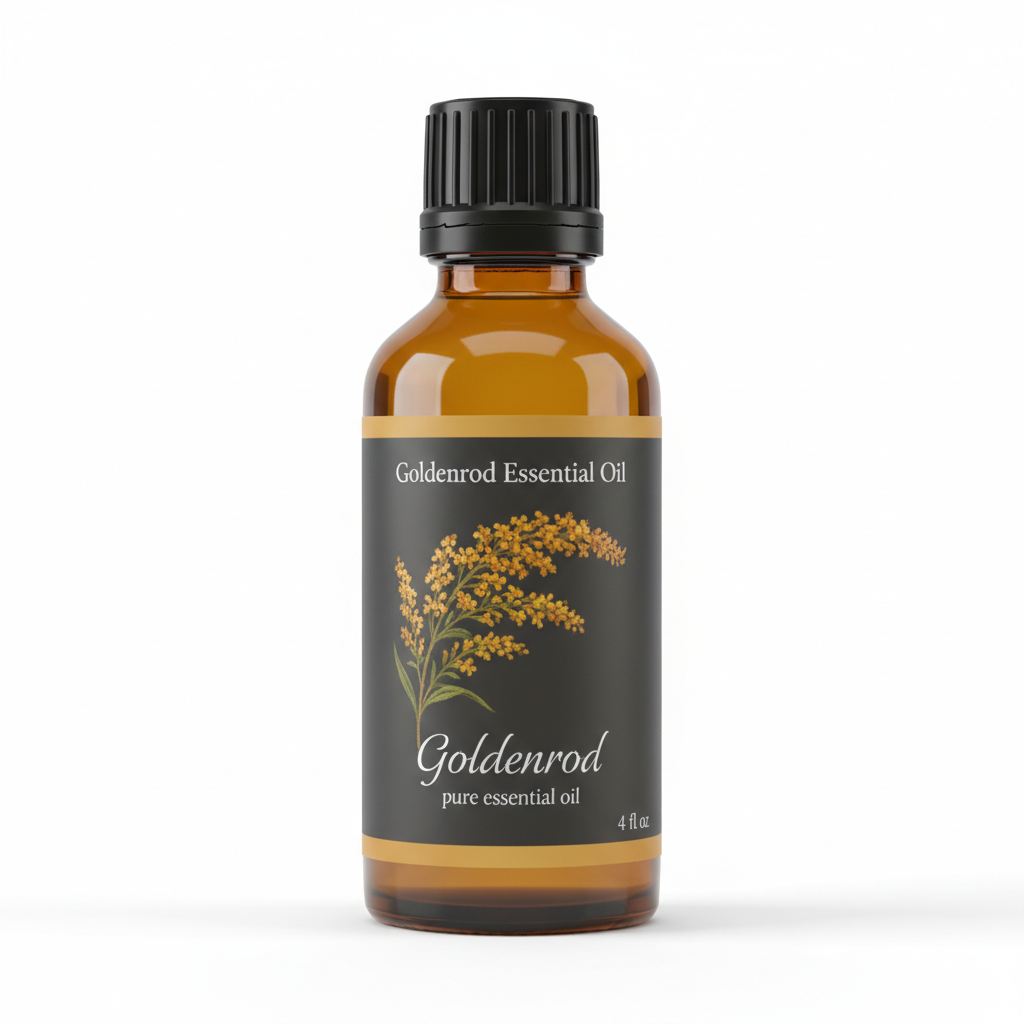
Goldenrod Essential Oil
Our own Goldenrod Essential Oil, in sizes from 0.5 oz to bulk.
From $17.99
Shop Now →Why we keep this page plain
A lot of pages about pregnancy and essential oils either wave you through or frighten you, and neither helps. We would rather be straightforward with you. We sell one oil, goldenrod, for its aroma and for diluted outside use, and we are not the right people to say what suits a pregnant body. What we can do is lay out what the careful sources say and help you walk into your appointment with good questions.
What UK specialists say about essential oils in general
The UK Teratology Information Service, which advises clinicians on exposures in pregnancy, puts it plainly: there are no epidemiological or evidence-based studies on the safety of essential oils during pregnancy, only a small number of anecdotal case reports. Its summary then makes three useful distinctions.
- Ordinary toiletries contain very little essential oil (typically under 0.01%), and using them as directed is not thought to raise risk.
- Higher concentrations, such as a massage blend, have not been studied systematically, so risk cannot be ruled out.
- Swallowing essential oils carries a risk of toxicity for the mother and therefore the baby. Skin contact on its own is not regarded as grounds for extra monitoring, though a clinician still weighs each person's other factors.
Goldenrod is not named anywhere in that summary, and it does not discuss diffusing or breastfeeding.
What Europe's herbal committee says about goldenrod itself
The European Medicines Agency's herbal committee adopted a monograph on European goldenrod (Solidago virgaurea) in September 2008. Its pregnancy line reads: "In the absence of sufficient data, the use during pregnancy and lactation is not recommended." The assessment report behind it explains why: there is no information on reproductive and developmental toxicity.
That is a statement about missing data, not a finding of harm. It also concerns a different species from the Solidago canadensis we sell, and herb preparations taken by mouth rather than a distilled oil, since the report describes only a small amount of essential oil in the herb. We mention it because it is the closest regulator wording that exists, and because it shows the same pattern as the UK summary. Careful reviewers looked, found nothing to go on, and chose caution.
Why strength matters
Our guidance for skin use is 0.5% to 2% in a carrier oil, never neat. Set that beside the toiletry figure of 0.01%, and a homemade body oil is roughly 50 times stronger at the low end and 200 times at the top (0.5 divided by 0.01, then 2 divided by 0.01). That is our own arithmetic, and a store-bought lotion is a different kind of mixture, but it shows why "it is in cosmetics, so it must be fine" does not carry over to a blend you mix at home.
What about the scent alone?
No source we found measures inhaled goldenrod oil in pregnancy, so we cannot tell you that diffusing is the gentler route. If the honeyed, hay-like aroma is what you are after, put the question to your midwife or obstetrician, and ask about each oil in a blend separately, since every partner oil is its own question. We sell goldenrod oil as an external aroma and cosmetic product and make no health claims for it.
If you already have a bottle at home
Plenty of people read a page like this after the bottle has arrived. That is fine, and nothing here asks you to feel bad about it. Simply put the bottle somewhere cool and dark with the cap on, and leave it there until you have talked to the person caring for you. Oils keep well when stored properly, so waiting costs you nothing, whatever size you own. Our larger sizes are listed on our bulk page, and our guide to buying goldenrod essential oil in bulk explains how bulk buying works.
It can also help to wait on any scented products that have goldenrod in them until you have asked. A candle, a room spray and a body oil are three different strengths and three different routes, which is exactly why your midwife will want to know which one you mean.
Taking it to your appointment
- Which route are you asking about: skin, a diffuser, a room spray or a candle?
- What strength would you use? Bring the 0.5% to 2% range and mention that the oil is sold undiluted.
- Do ragweed, daisies, chamomile or fragrance ever bother your skin? Goldenrod belongs to that plant family, and the allergy article explains why it matters.
- Which other oils are in the mix?
Whatever the answer, do not take any essential oil by mouth. If one is swallowed, call a poison center (in the United States, 1-800-222-1222). For the wider picture, our safety guide and skin basics cover the everyday habits, and the ingestion article explains the swallowing question.
If it helps, write your questions down before the visit. A short list on your phone is much easier than trying to remember what you meant to ask once you are in the room.
Pregnancy is a season when a short list of trusted advisers beats any article, ours included. Your midwife knows your history, and a clear answer from them is worth more than a guess from us.
Goldenrod Essential Oil
Goldenrod Essential Oil from our own shop, in sizes from 0.5 oz to bulk.
From $17.99
Shop Now →Sources & Further Reading
- UK Teratology Information Service. Use of essential oils in pregnancy
- European Medicines Agency, HMPC, 2008. Community herbal monograph on Solidago virgaurea L., herba (EMEA/HMPC/285758/2007)
- European Medicines Agency, HMPC, 2008. Assessment report on Solidago virgaurea L., herba
- National Capital Poison Center. Essential oils