Goldenrod vs Tea Tree Oil: Can One Replace the Other?
People searching for a tea tree alternative sometimes land on goldenrod, so it is worth saying clearly what the two oils are. They are different plants, different chemistry and different roles on the shelf. Tea tree oil is one of the better documented essential oils, and goldenrod is a quieter, seasonal oil we sell for its aroma.
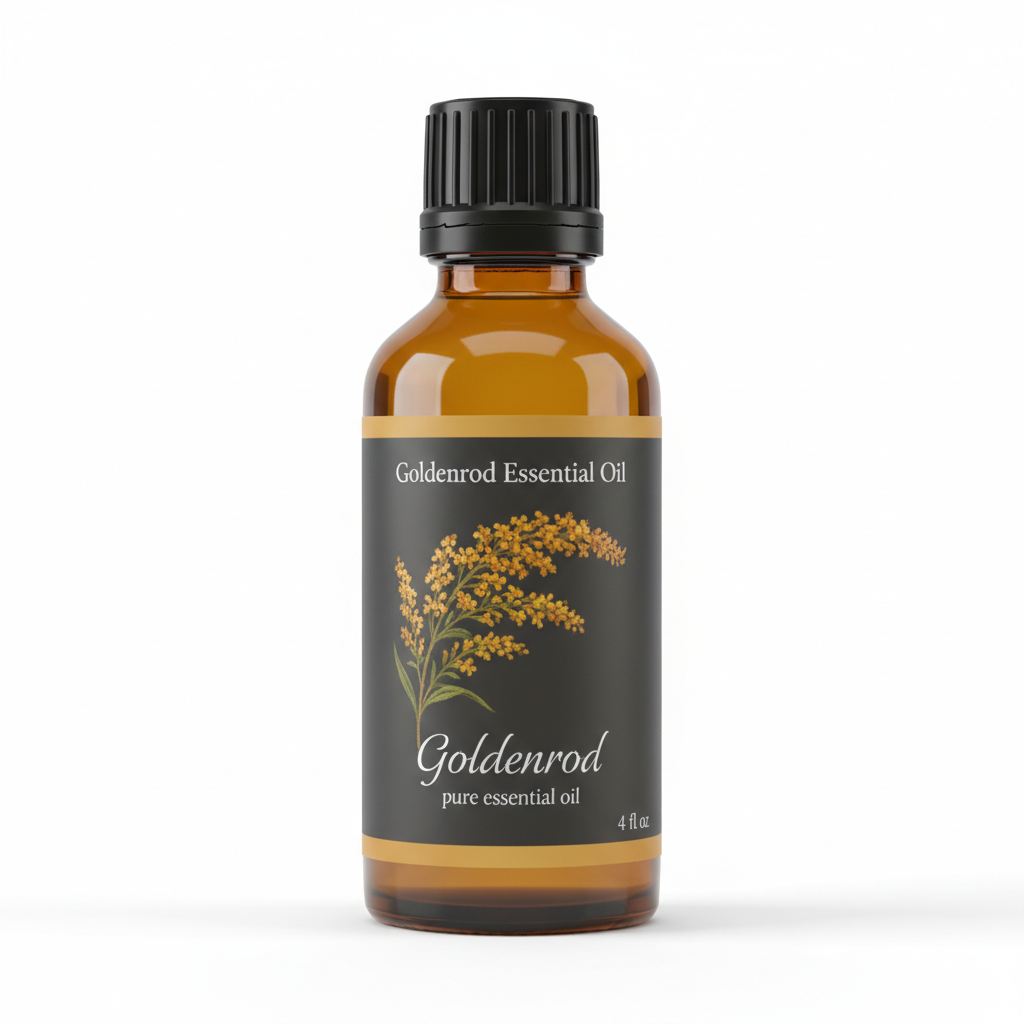
Goldenrod Essential Oil
Our own Goldenrod Essential Oil, in sizes from 0.5 oz to bulk.
From $17.99
Shop Now →Two oils, two very different paper trails
Tea tree has an international quality standard, ISO 4730:2017, which sets ranges for physical properties and for the main constituents. Terpinen-4-ol must make up 35% to 48% of the oil. That standard lets a buyer, a lab and a supplier all point at the same document.
Goldenrod does not have a standard of that kind that we know of. What we have is the Certificate of Analysis we publish for one batch of our oil, which lists relative density, refractive index and optical rotation against printed ranges, and a handful of published studies. The best-documented composition we have read is one wild Slovak sample, led by germacrene D at 34.9%. If you want a constituent profile for a specific lot of ours, ask us in writing through the contact page before you order.
A quick way to tell them apart on paper
If you ever have both certificates in front of you, one number separates them cleanly. Tea tree under ISO 4730 has a positive optical rotation, between +7 and +12 degrees. The goldenrod certificate we publish shows -8.16 degrees, a negative value. The two also differ in refractive index and density, as the table shows.
| At 20 C | Goldenrod batch certificate | Tea tree, ISO 4730:2017 |
|---|---|---|
| Relative density | 0.880 | 0.885 to 0.906 |
| Refractive index | 1.487 | 1.475 to 1.482 |
| Optical rotation | -8.16 degrees | +7 to +12 degrees |
These are bulk physical properties, so they confirm identity, not a full recipe. The batch on our certificate has a best-by date that has passed, which makes it a good example of what a goldenrod certificate looks like rather than a description of what is in stock today.
What about gentleness?
Both deserve a patch test, and it helps to know what is documented. For tea tree, an Australian skin clinic reviewed 4.5 years of patch-test records and found 41 positive reactions to oxidized tea tree oil among 2,320 people tested, or 1.8%. That group was already being tested for dermatitis, so it is not a rate for everyone. The authors also noted that oil from freshly opened bottles gave no or only weak reactions, which is a good argument for storing any essential oil well.
For goldenrod, there is no equivalent patch-test series that we know of for the oil. The nearest evidence is an older guinea pig study of ether extracts from 20 daisy-family plants, which rated goldenrod (Solidago virgaurea, a different species from ours) a medium sensitizer. That is plant material, not essential oil, so it is a reason for care with the plant family and not a measurement of our oil. It fits with what we already say: goldenrod belongs to Asteraceae, so anyone who reacts to ragweed, daisies or chamomile should be careful, and our allergy article goes through that in detail.
Put plainly, the more documented oil is not necessarily the riskier one, and the less documented oil is not automatically the gentle one. Both belong in a carrier, patch tested first.
Different jobs on a shelf
We think of it as a matter of what you reach for and why. Tea tree has a crisp, medicinal sort of smell that many people link to a bathroom cabinet. Goldenrod is warmer and sweeter, closer to hay and meadow flowers than to anything clinical. If you open both bottles in turn, the difference is clear within a breath or two, and you will probably know which one you want in the room before you can say why.
That is the real reason we do not present goldenrod as a stand-in. A good oil is chosen because you like what it does for a space or a blend, not because some other bottle was out of stock.
How we would choose
- If you want the aroma of goldenrod, a honeyed, grassy, floral oil with a faintly balsamic, hay-like base, that is what we sell. We recommend 0.5% to 2% in a carrier oil with a patch test, kept away from eyes, children and pets, and never taken internally. About 3 drops of oil per fluid ounce of carrier gives 0.5%, at roughly 20 drops per milliliter. Our skin basics post has the full steps.
- If you want tea tree, look for a supplier that names the species, gives a lot number and can show a GC report against ISO 4730. We sell only goldenrod.
- If you are trying to pick an oil for a skin concern, a dermatologist is the right person to ask, because both of these are fragranced plant oils.
Keep a simple label habit
Whichever oil you pick, write the date you opened it on the bottle with a marker or a small sticker. It takes five seconds and will save you guessing later. If you keep several oils, a short note on the box about what each one is for keeps the shelf tidy and your blends honest.
For the wider picture of how goldenrod stacks up against other oils, our comparison hub and the Asteraceae guide are good next stops. Goldenrod is at its best when you choose it for what it smells like.
Goldenrod Essential Oil
Goldenrod Essential Oil from our own shop, in sizes from 0.5 oz to bulk.
From $17.99
Shop Now →Sources & Further Reading
- ISO 4730:2017, Essential oil of Melaleuca, terpinen-4-ol type (Tea Tree oil), preview copy. diverdi.colostate.edu (ISO 4730 preview)
- Rutherford T, Nixon R, Tam M, Tate B. Allergy to tea tree oil: retrospective review of 41 cases with positive patch tests over 4.5 years. 2007. europepmc.org/article/MED/17535193
- Zeller W, de Gols M, Hausen BM. The sensitizing capacity of Compositae plants. VI. Guinea pig sensitization experiments with ornamental plants and weeds using different methods. 1985. europepmc.org/article/MED/3970585
- Elshafie HS et al. Antimicrobial Activity and Chemical Composition of Essential Oil Extracted from Solidago canadensis L. Growing Wild in Slovakia. Molecules, 2019. pmc.ncbi.nlm.nih.gov/articles/PMC6479883