How Harvest Choices Shape Goldenrod Oil
Before anyone lights a still, a handful of decisions have already shaped the oil that will come out of it. Which part of the plant goes in? How far into bloom? Dried or fresh? How long does the steam run? Goldenrod makes a good case study because the published work on Solidago is detailed enough to show how much each choice matters.
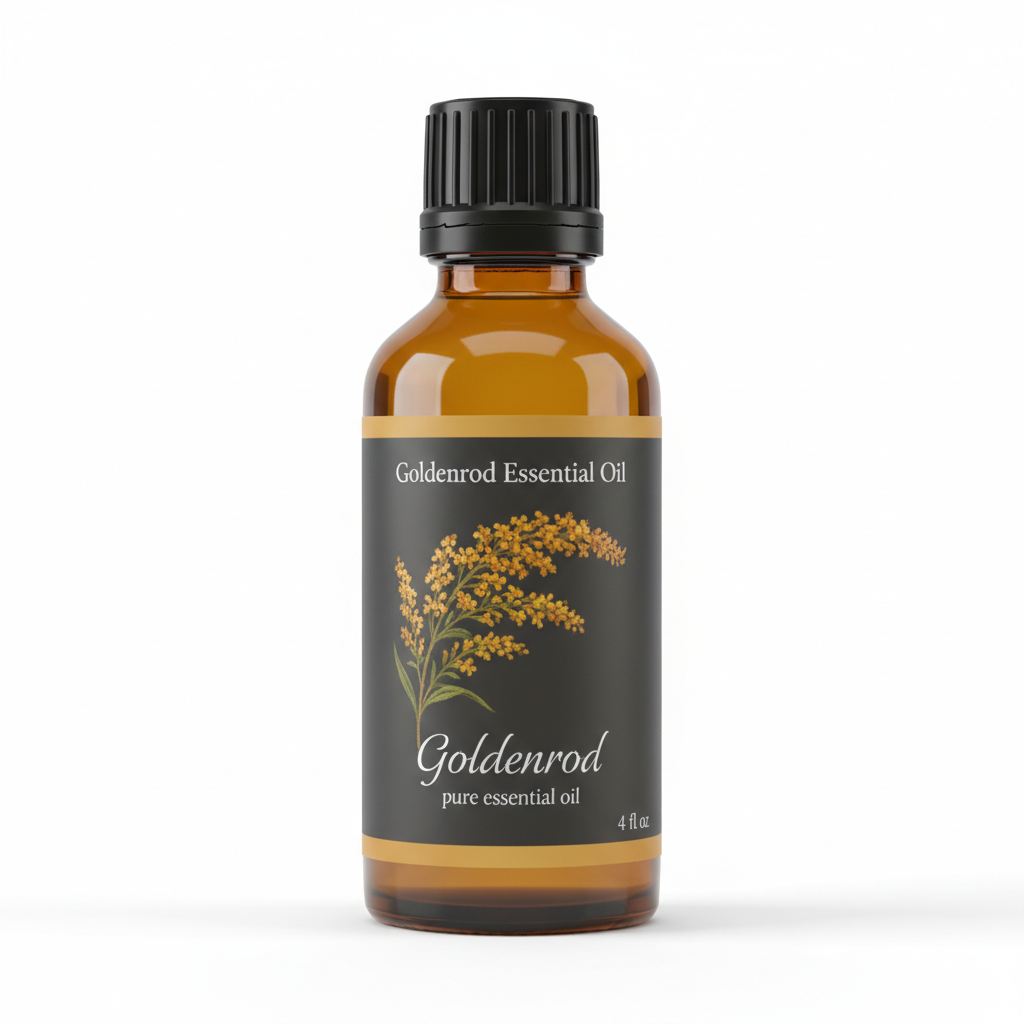
Goldenrod Essential Oil
Our own Goldenrod Essential Oil, in sizes from 0.5 oz to bulk.
From $17.99
Shop Now →Flowers, leaves or stems
The clearest finding is about plant parts. Yang and colleagues separated flowers, leaves and stems of S. canadensis at full bloom in China, dried them in the dark and hydrodistilled each for two hours. Flowers gave 1.00% oil by dry weight, leaves 0.76% and stems just 0.05%. The authors link the stem figure to stems being mostly structural material with little volatile content. A Lithuanian team working with 18 accessions found the same order, though with smaller numbers: 0.19% to 0.26% from inflorescences and 0.14% to 0.18% from leaves.
Those two sets of numbers do not match, and neither paper explains why. Different sites, years, drying and equipment all sit behind the difference, so it is better to treat them as two data points than to average them. What the pair does agree on is the direction, and it is useful: the flower heads are where the oil is richest.
Part also changes character, not just quantity. In the Lithuanian samples, leaf oils ranged from 4.0% to 45.2% germacrene D while inflorescence oils held 1.9% to 11.4%, and flower oils carried far more alpha-pinene. The Chinese study saw the same split, with alpha-pinene leading in flowers and germacrene D in leaves. So "goldenrod oil" can describe noticeably different oils depending on the cut. For more on that variation, see the compounds behind the scent.
Timing the bloom
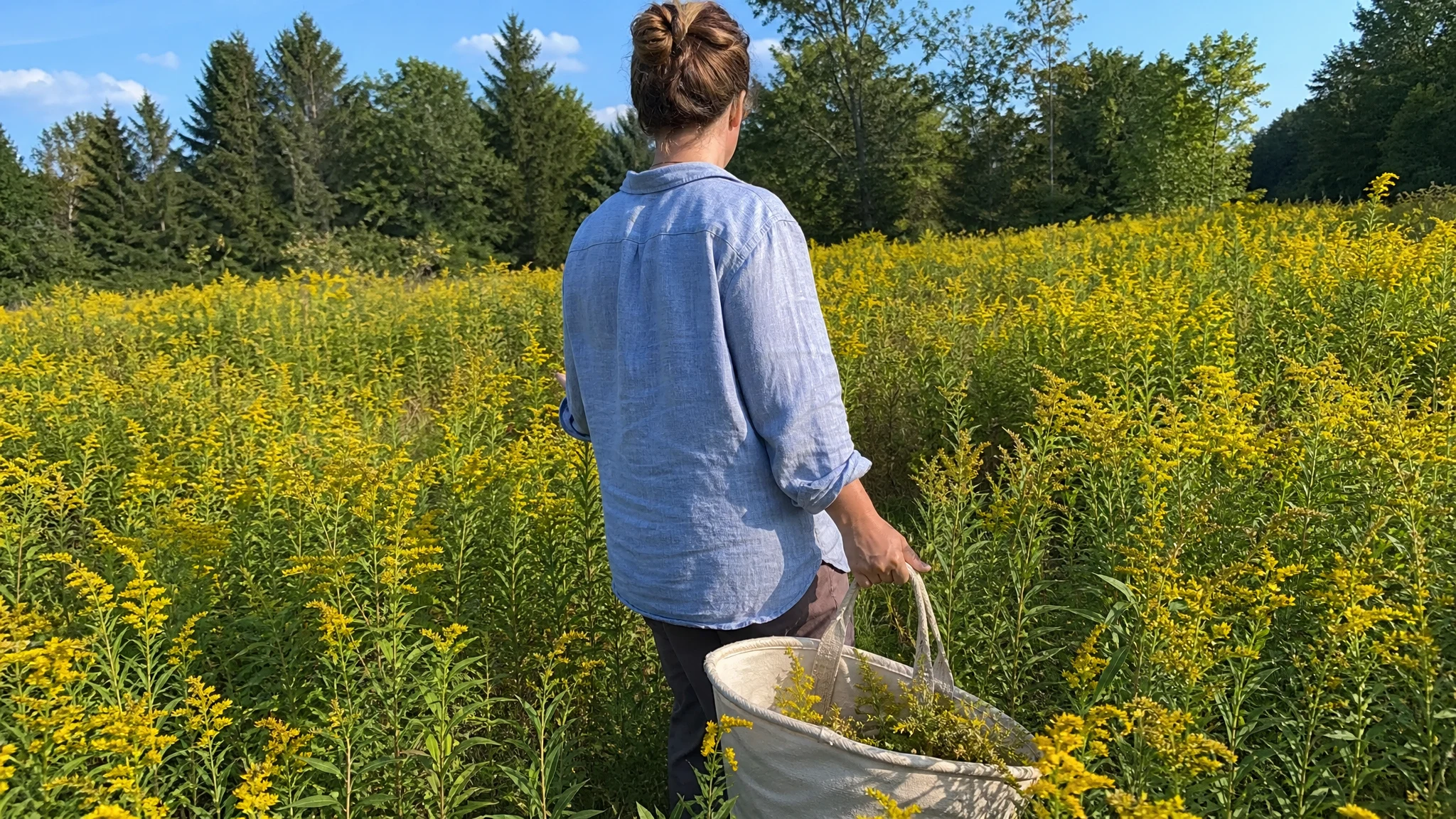
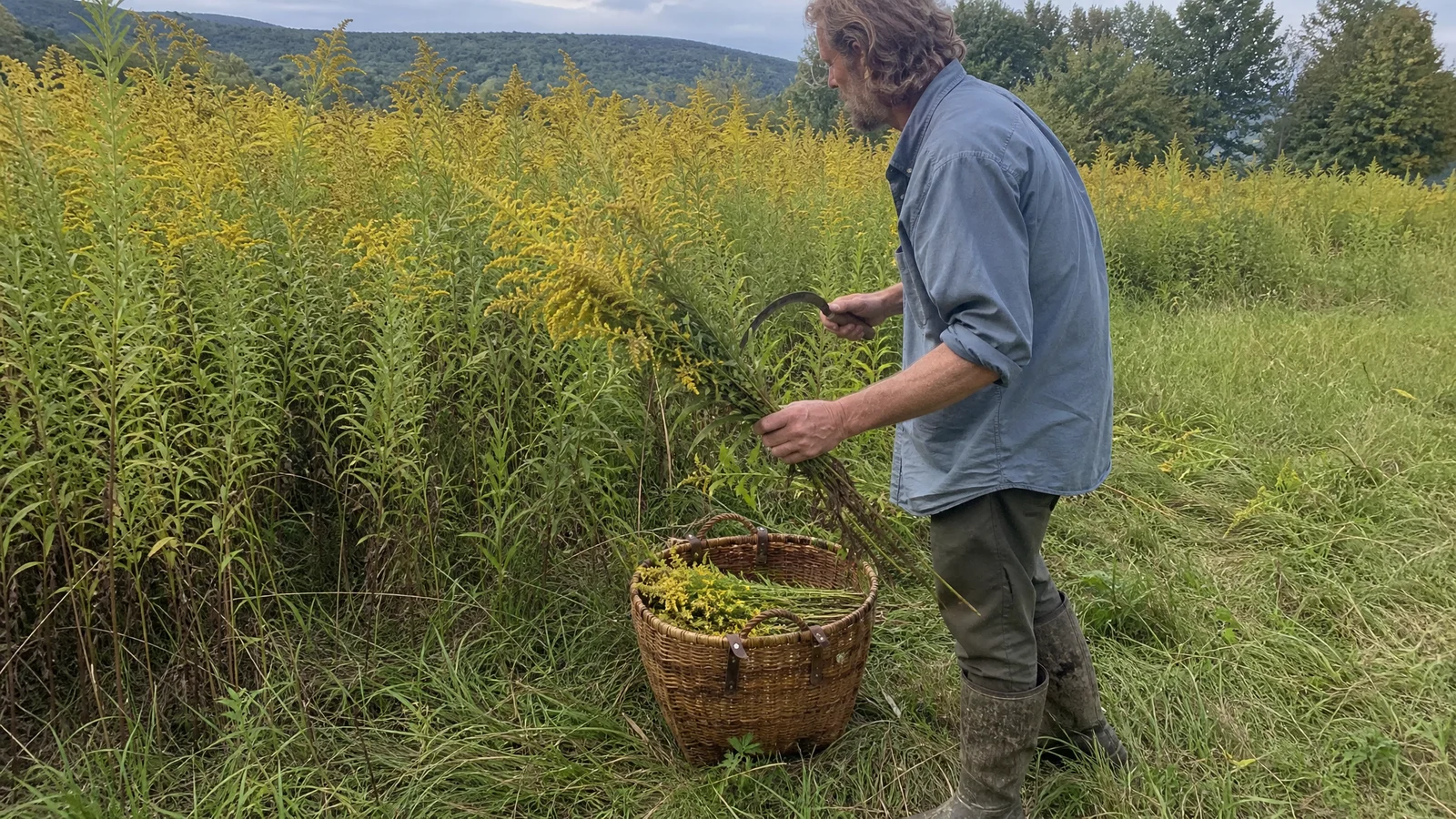
Goldenrod flowers for only a few weeks in August and September, and that short window is a big part of why our batches are limited and seasonal. Published studies sample at full bloom, which makes full bloom the common reference point. The Slovak team behind the most detailed S. canadensis oil paper (Elshafie and colleagues) puts it plainly: yield and composition depend on climate and ecology, the stage of the plant, how the harvest is handled and how the oil is isolated. In other words, a good week for one field in one year may not be the same week elsewhere, and no single date works everywhere.
Dried or fresh, whole or ground
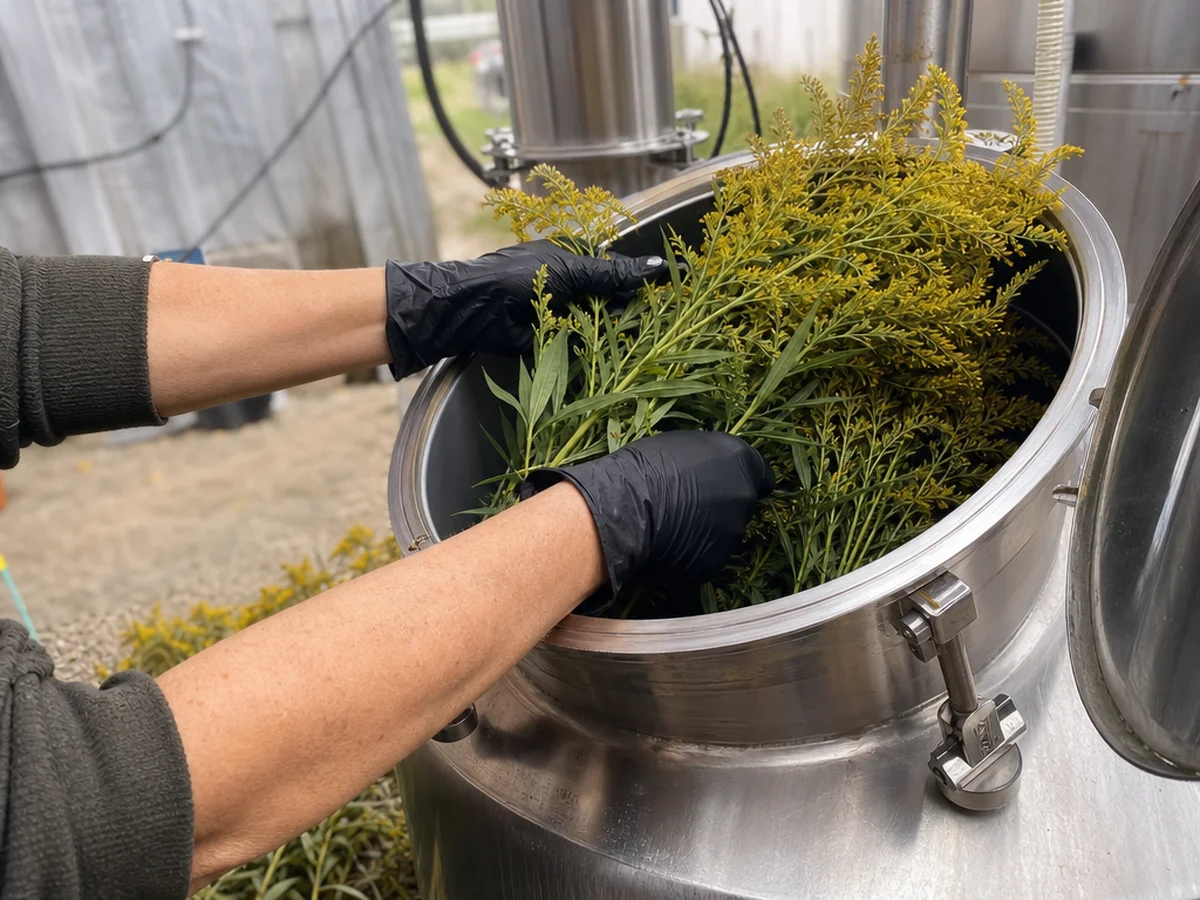
Nearly every laboratory study dries its material first. The Slovak team air-dried a thin layer for about two weeks, until the weight stopped changing, then distilled 20 g. Drying is not neutral. A 2026 comparison across seven aromatic plants (not goldenrod) found laboratory hydrodistillation of dried, ground material gave higher yields than semi-industrial steam distillation of fresh material, by as much as 4.5 times for peppermint, and the two routes produced different profiles, with more oxygenated compounds from the lab and more monoterpene hydrocarbons from the steam still.
Reading that sensibly, the yields in goldenrod papers are best seen as upper bounds from the laboratory bench, not forecasts for a working still run on fresh plumes. They are still very useful for understanding relative amounts.
How long the steam runs
Goldenrod is rich in heavy sesquiterpenes, which generally come over later in a distillation, so it is reasonable to expect run time to matter. A computational study by Setzer also raised the possibility that germacrene D, the leading compound in many goldenrod oils, can rearrange into other skeletons under acid conditions, and noted this might happen during hydrodistillation. That is a concern about method, drawn from a theoretical paper, and it does not show what happens in any particular still. For a buyer, the takeaway is simple: two oils from the same field can differ because one was run longer or hotter, and a constituent report describes the oil, not the plant.
Why we find this worth knowing
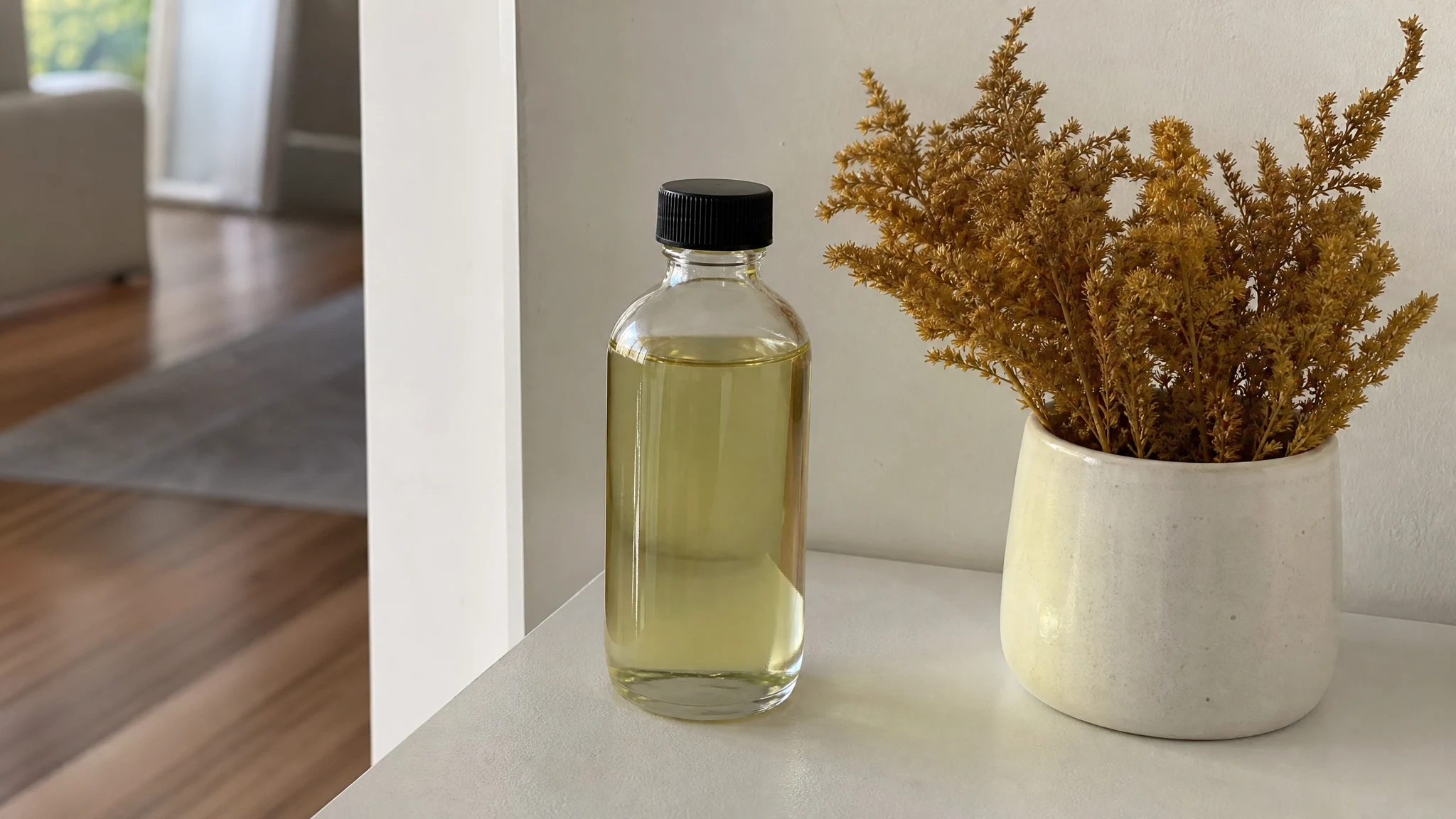
When you hold a small amber bottle, it is easy to forget how many small decisions came before it. A late-summer field has a short season, and the plumes have to be cut at the right moment, handled with some care and run through the still without hurry. None of those steps is glamorous. All of them show up in the aroma, which is part of why we think a seasonal oil deserves a seasonal kind of patience.
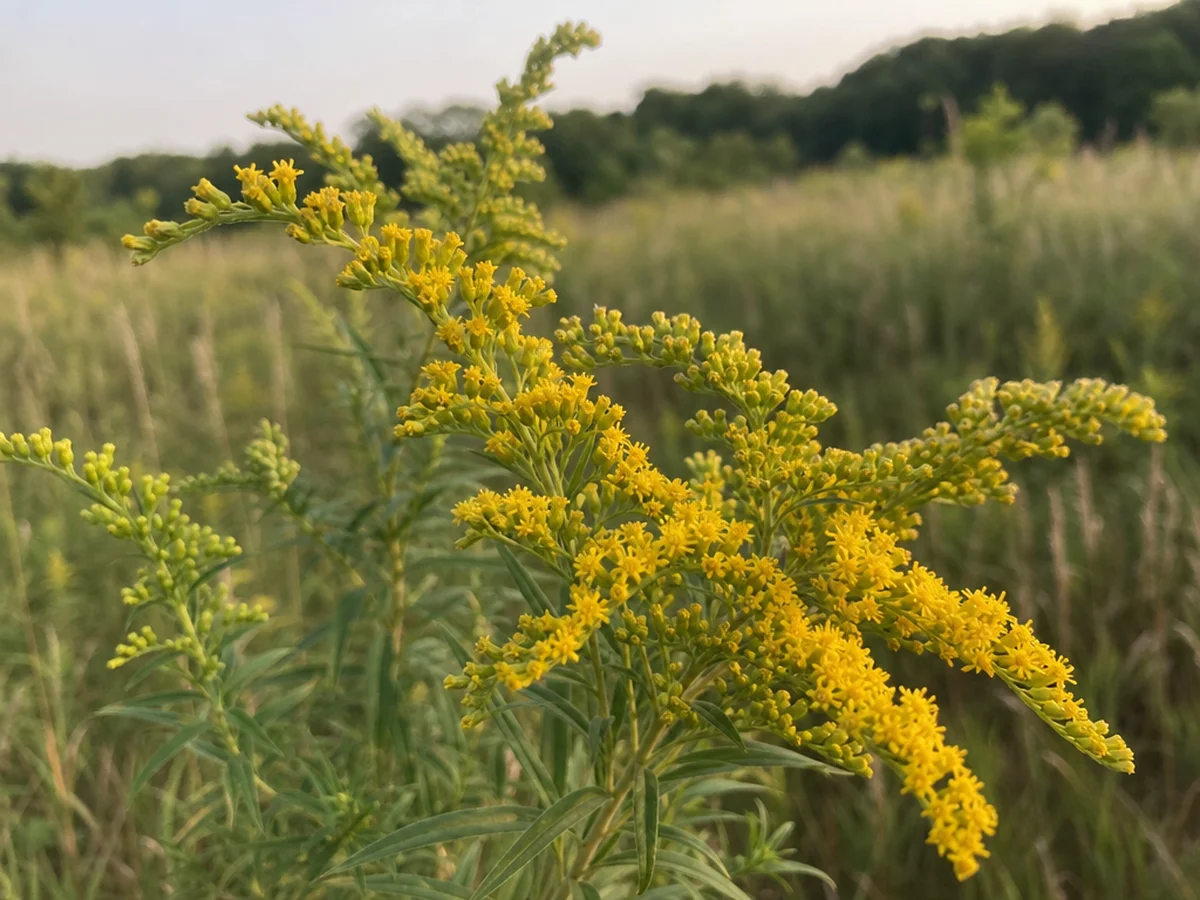
Next time you open a bottle, notice how the scent changes over the first minute: the sweet floral note up front, then the grassy middle, then the dry hay-like finish. That whole arc is the result of choices made in a field and at a still, long before the bottle reached you.
What it means for a small bottle
The yield arithmetic explains scarcity without any storytelling. At the Slovak laboratory yield of 0.27% of dry weight, and the density of 0.880 g/ml recorded on our published certificate, a 0.5 fl oz bottle (14.79 ml, about 13.0 g of oil) corresponds to roughly 4.8 kg of dried plant. If the material were flower-rich at the Chinese figure of 1.00%, the answer drops to about 1.3 kg. Either way, a lot of meadow goes into a small bottle. If you are curious about the practical side, our posts on how the oil is made and why it is hard to find go further, and our label guide shows which of these choices a seller can tell you about.
If you would like lot-specific details for a bottle of ours, such as a constituent profile, you can ask us in writing through the contact page before you order.
Goldenrod Essential Oil
Goldenrod Essential Oil from our own shop, in sizes from 0.5 oz to bulk.
From $17.99
Shop Now →Sources & Further Reading
- Yang et al., 2025. Multivariate Statistical Analysis of Solidago canadensis L. Essential Oil and Its Antifungal Mechanism Against Mulberry Sclerotinia Diseases. Int J Mol Sci
- Radušienė et al., 2022. Distribution Patterns of Essential Oil Terpenes in Native and Invasive Solidago Species and Their Comparative Assessment. Plants
- Elshafie et al., 2019. Antimicrobial Activity and Chemical Composition of Essential Oil Extracted from Solidago canadensis L. Growing Wild in Slovakia. Molecules
- Léva and Gál, 2026. Impact of Extraction Scale and Method on the Chemical Profile of Essential Oils. Molecules
- Setzer, 2008. Germacrene D cyclization: an Ab initio investigation. Int J Mol Sci