What's in Goldenrod Oil? A Plain-English Chemistry Tour
Ask which molecule makes goldenrod smell like goldenrod and you will find that nobody has really answered. What chemists have done is list what is in the oil, and that list is more interesting than it first sounds. It tells you which families of compounds to expect, why two bottles can differ, and what to ask for when a seller offers an analysis.
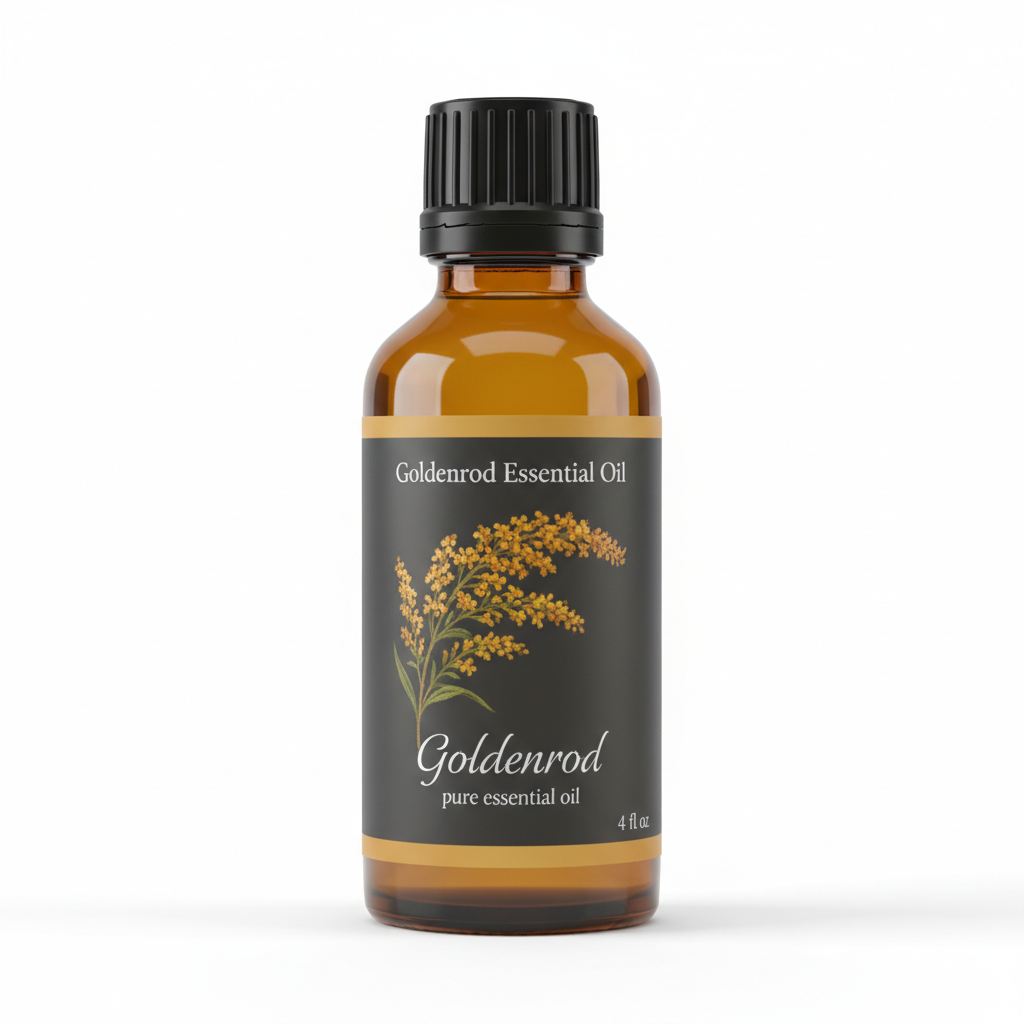
Goldenrod Essential Oil
Our own Goldenrod Essential Oil, in sizes from 0.5 oz to bulk.
From $17.99
Shop Now →A mix of terpenes, in two big families
Essential oils are mixtures, and goldenrod's is mostly terpenes, built from two sizes of molecule. The smaller monoterpenes are light and evaporate quickly; the bigger sesquiterpenes are heavier and linger. Goldenrod carries a lot of both, which is one reason we list it as a middle note.
The details come from two published analyses. In 2019, Elshafie and colleagues distilled wild Solidago canadensis from Slovakia and identified 32 compounds making up 97.7% of the oil. Germacrene D was the largest at about 35%, followed by limonene (12.5%) and alpha-pinene (11.6%), with bornyl acetate at 6.3%. In 2025, Yang and colleagues distilled flowers, leaves and stems from Chinese plants separately and found 72 constituents. Their flower oil was led by alpha-pinene (18%), while their leaf oil was led by germacrene D (24%).
Put side by side, those two results tell a story: the same species can lean piney and citrusy in one sample and heavy and green in another, depending on the plant part, the place and the year. Our germacrene D article follows that spread further, and the species guide explains how the goldenrods differ from one another.
What the numbers say about smell, and what they do not
This is where we think a little modesty is the interesting part. We describe the oil as honeyed, grassy and floral, with a faintly balsamic, hay-like base. Some of its components have known scent descriptions: limonene is described as citrusy and fresh in its common form, and bornyl acetate as woody, pine-like and herbal. But neither goldenrod paper tested odour, and a compound can be a big share of an oil and add little to its smell, because noses detect some molecules far more readily than others. So the link between the chemistry and the honeyed, hay-like impression is still an open question, and any page that names the one "key" molecule is going further than the evidence does.
Why a reported compound may not match the plant exactly
Germacrene D is a delicate molecule. A 2008 study by William Setzer begins from the acid-catalysed cyclisation of germacrene D into related sesquiterpenes and notes concern that such rearrangements could happen during hydrodistillation. In plain terms, a germacrene D-rich oil may shift a little with how it is distilled and handled. Neither goldenrod paper tested whether that happened, so we simply treat any one profile as a snapshot, not a fixed fingerprint.
That is also why optical rotation, the figure on the Certificate of Analysis we publish for one batch (-8.16 degrees, inside the stated window of -25 to -5), should be read modestly. It adds up the twist of every chiral compound in the oil, so it confirms consistency with a standard and says little about the individual ingredients. The same certificate gives a relative density of 0.880 and a refractive index of 1.487, and it carries no constituent table.
What to ask a seller for
If composition matters for your project, ask for a GC-MS report for the lot you will receive, with the laboratory, date and method, and whether the figures are raw peak-area shares or calibrated amounts. Ask which species and which plant part, and how the species was confirmed. A 2021 study of lavender, lemon and tea tree oils found that adding vegetable oil leaves the percentage shares unchanged, so a trustworthy report is one that you can trace to a lot and that says how the figures were measured.
The certificate we publish covers one batch; for a constituent profile or species confirmation on your lot, ask us in writing through our contact page. Our guides to reading a goldenrod label and vetting a seller show how to read each document.
Reading the list like a recipe card
It helps to treat a composition report the way you would treat a recipe card: it tells you what went into a dish, not how the dish tastes. Two soups can share most of the same ingredients and still be nothing alike. A report is a good place to start a conversation about an oil, and your nose is where the conversation ends.
So when you get a bottle, open it, breathe slowly, and ask yourself what you smell before you look at any numbers. For goldenrod, expect honey and grass up front and a soft, hay-like warmth underneath. If a report and your nose seem to disagree, trust your nose and ask the seller more questions.
A word on skin
Several goldenrod components are common terpenes, and DermNet NZ names monoterpenes such as pinene and limonene, and sesquiterpene lactones, among the compounds involved in Compositae skin allergy. Our dilution guidance is 0.5% to 2% in a carrier with a patch test first. Anyone pregnant, nursing, treating a child or a pet, or with broken skin should check with a doctor or vet before use. Our safety article and the Asteraceae allergy notes go deeper.
Goldenrod's chemistry is best read as a landscape, with a few big hills and some variation from lot to lot, and the most useful habit is to match any report to the bottle in your hand.
Goldenrod Essential Oil
Goldenrod Essential Oil from our own shop, in sizes from 0.5 oz to bulk.
From $17.99
Shop Now →Sources & Further Reading
- Elshafie HS et al., 2019. Antimicrobial Activity and Chemical Composition of Essential Oil Extracted from Solidago canadensis L. Growing Wild in Slovakia. Molecules. PMC6479883
- Yang JX et al., 2025. Multivariate Statistical Analysis of Solidago canadensis L. Essential Oil and Its Antifungal Mechanism Against Mulberry Sclerotinia Diseases. Int J Mol Sci. PMC12785313
- Setzer WN, 2008. Germacrene D cyclization: an Ab initio investigation. Int J Mol Sci 9(1):89-97. PMC2635598
- Wikipedia. Limonene; Bornyl acetate. Limonene, Bornyl acetate
- Capetti F et al., 2021. Adulteration of Essential Oils: A Multitask Issue for Quality Control. Three Case Studies: Lavandula angustifolia Mill., Citrus limon (L.) Osbeck and Melaleuca alternifolia (Maiden & Betche) Cheel. Molecules 26(18):5610. PMC8471154
- DermNet NZ. Compositae allergy. dermnetnz.org